Callers decide whether a phone system is going to help them almost immediately, and dealership abandonment clusters in the opening rather than later in the call. The first ten seconds have three jobs, and most systems spend them on a greeting that does none of them.
This guide covers the three jobs of the opening, the four mistakes, what a working opening sounds like, where it breaks, and what to measure.
The three jobs of the opening
1. Confirm they reached the right place. The store name, immediately. A caller who is unsure whether they dialled correctly is not listening to anything else.
2. Establish what they are talking to. Honest, brief, unapologetic: an assistant. Not a long disclaimer and not an impersonation.
3. Get out of the way. Hand the conversation to the caller as fast as possible with an open question they can answer.
That is roughly one sentence. Most dealership openings run three or four, and the extra ones are where callers leave.
Two openings
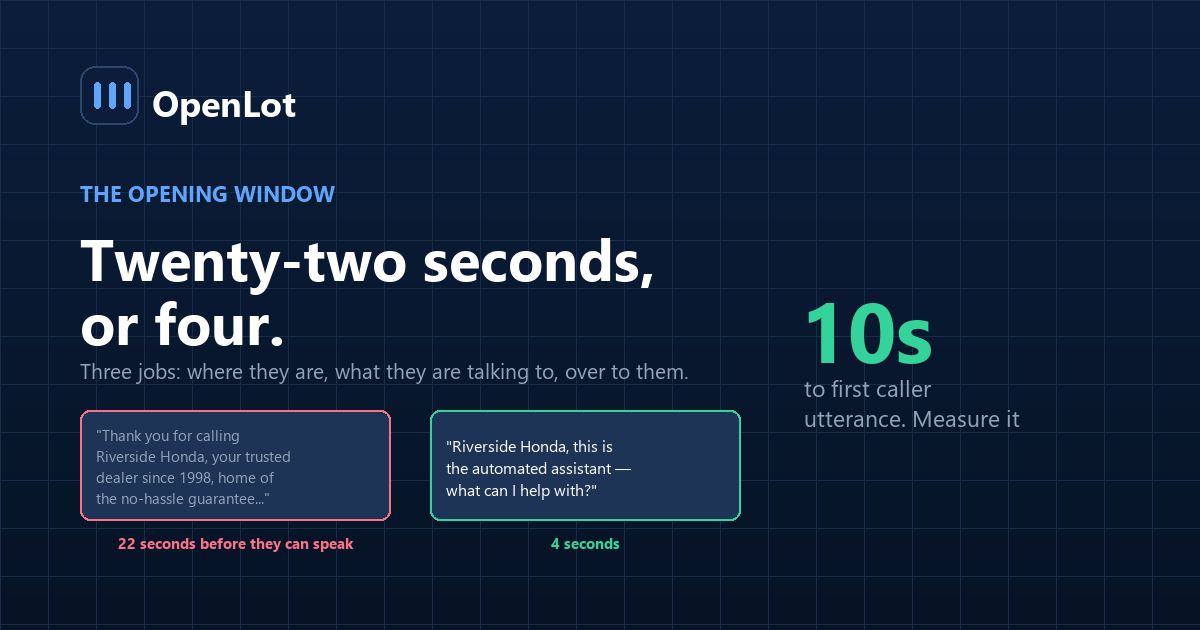
Typical Working "Thank you for calling Riverside Honda, your trusted dealer since 1998, home of the no-hassle guarantee. Your call is important to us. For sales, press 1. For service, press 2. For parts..." "Riverside Honda, this is the automated assistant — what can I help with?" ~22 seconds before the caller can speak ~4 seconds The left column does the branding job and fails all three of the opening's actual jobs. By the time a caller can say anything, they have listened to a sentence about 1998.
The right column is shorter than most people are comfortable with and it is the version that keeps callers on the line. Barge-in matters too: a caller who already knows what they want should be able to speak over it.
The four mistakes
1. Branding before function. Taglines and history belong anywhere except the first ten seconds of a call someone made because they need something.
2. A menu before an open question. "What can I help with?" handles every case a seven-option menu handles, in less time, without asking the caller to classify their own problem — the routing argument in routing is the whole job.
3. No barge-in. A caller who knows what they want is forced to listen anyway. This is the most irritating thing a phone system does and it is a setting.
4. Asking who is calling when the system knows. Caller ID matched against the CRM should remove this question entirely, and asking it signals that nothing is connected.
What does a working opening sound like?
Four variants, by what the system knows.
Unknown caller:
"Riverside Honda, automated assistant — what can I help with?"
Known customer, recent service visit:
"Hi Dana, Riverside Honda — are you calling about the CR-V in service?"
Known customer, recent sales activity:
"Hi Marcus, Riverside Honda — is this about the Accord you looked at Saturday?"
Known, but no obvious reason:
"Hi Dana, Riverside Honda — what can I help with today?"
The second and third resolve a large share of calls in a single exchange, because the guess is usually right. When it is wrong, the caller simply says so and nothing is lost.
This is the payoff from the caller ID match and it is the clearest demonstration that the integration is real rather than cosmetic.
Where does the opening break?
1. Latency before the greeting. Dead air at the start of a call is read as a dropped line — the mechanic covered in voice agent latency.
2. A wrong guess delivered confidently. "Calling about the CR-V?" to someone who sold that car is a small error and it reads as careless. Phrase the guess as a question, always.
3. Over-disclosure. "I am an AI assistant and I may make mistakes, please note that I cannot..." is a disclaimer, not a disclosure, and it spends the window apologising.
4. No immediate path to a person. Some callers want a human immediately, and the fastest way to lose them is to make that difficult — trigger twelve in the transfer list. The same impatience is what phone trees measure as abandonment.
5. Background noise handling. A service drive is loud. If the system cannot cope, it should transfer early rather than failing three times — one more reason phone handling is where deals leak.
What about the caller who just wants a person?
Make it trivially easy. "Or say 'representative' any time."
A store that makes reaching a person difficult is optimising for containment rate, which is a vendor metric rather than a business one. The caller who insists on a person and gets one quickly is a satisfied caller; the one who fights the system for ninety seconds first is not, and they will remember it.
What should you measure?
| Metric | How to compute | What it catches |
|---|---|---|
| Abandonment by second | Hang-ups, bucketed by seconds elapsed | Where the opening loses people |
| Time to first caller utterance | Call start → caller speaks | The length of the opening, measured |
| Barge-in rate | Callers who spoke over the greeting | How many are waiting unnecessarily |
| Caller ID match rate | Matched ÷ calls from known numbers | Whether the integration works |
| Guess accuracy | Correct opening guesses ÷ guesses made | Whether the guess is worth making |
| "Representative" rate | Requests for a person ÷ calls | Honest demand for a human |
Row two is the single most actionable number here. If time to first caller utterance is over ten seconds, shortening the opening will improve the call more than any other change available.
Row six should not be driven to zero. Some share of callers legitimately wants a person, and suppressing that request produces a worse outcome than honouring it.
Frequently asked questions
What should the first ten seconds of a dealership call do?
Three things: confirm the caller reached the right place by naming the store, establish briefly and honestly what they are speaking to, and hand the conversation over with an open question. That is roughly one sentence, and most dealership openings run three or four.
Should the greeting include branding?
Not in the opening. Taglines, history and guarantees belong anywhere other than the first seconds of a call someone made because they need something, and they push the moment the caller can speak out by ten or fifteen seconds.
Is a menu better than an open question?
No. "What can I help with?" handles everything a long departmental menu handles, in less time, without asking the caller to classify their own problem — which is a job they frequently cannot do correctly anyway.
What is barge-in and why does it matter?
The ability for a caller to speak over the greeting rather than waiting for it to finish. Without it, a caller who already knows what they want is forced to listen anyway, which is among the most irritating things a phone system does and is usually just a configuration setting.
Should the system guess why someone is calling?
Yes, when caller ID matches a record with recent activity, and always phrased as a question. A correct guess resolves many calls in one exchange; a wrong one costs nothing if it was asked rather than asserted. Delivered confidently and wrongly, it reads as careless.
How much should the system disclose about being automated?
Briefly and without apology. "This is the automated assistant" is disclosure. A paragraph about limitations and possible mistakes is a disclaimer, and it spends the opening window on something that helps nobody.
Should it be easy to reach a person?
Yes, and trivially so. Making it difficult optimises containment rate, which is a vendor metric rather than a business one. A caller who asks for a person and gets one quickly is satisfied; one who fights the system first is not, and remembers it.
What is the most actionable thing to measure?
Time from call start to the caller's first utterance. If that is over ten seconds, shortening the opening will improve the call more than any other change available, and it is a configuration change rather than a project.
Conclusion
- Three jobs, one sentence. Where you are, what they are talking to, over to them.
- Branding in the opening costs you callers. It belongs anywhere else.
- An open question beats a menu, in less time and without asking the caller to classify.
- Guess, as a question. A matched caller ID resolves many calls in a single exchange.
- Measure time to first caller utterance. Over ten seconds, and that is your fix.
Last updated: