A voice agent is judged on three mechanics long before anyone evaluates how well it understands. Latency, interruption handling and escalation — and a system that fails any of them is one customers hang up on, regardless of how good its comprehension is on paper.
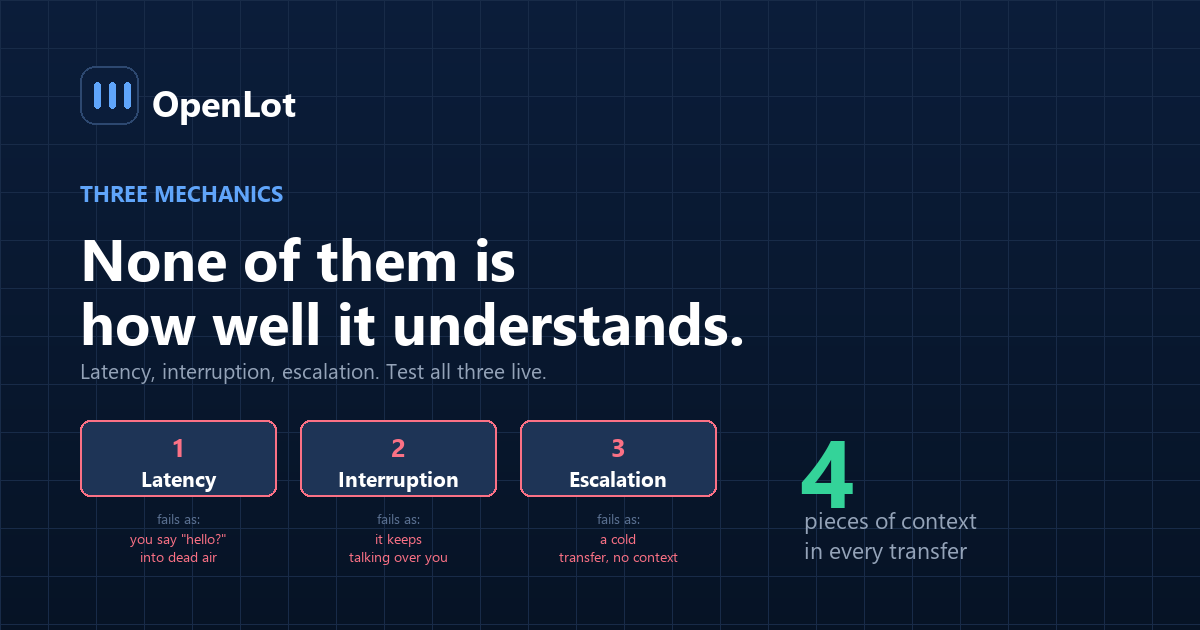
This guide covers the three mechanics, how to test each before signing, what good looks like, where voice agents fail, and what to measure.
1. Latency
The gap between the customer finishing a sentence and the system starting to respond.
In text, a two-second pause is invisible. On a phone call it is dead air, and dead air makes people say "hello?" — at which point the system and the customer are talking over each other and the call is already going badly.
What good looks like: a response beginning fast enough that the pause reads as thinking rather than as a dropped call. The exact threshold is less useful than the comparison: it should feel like a person who paused, not like a line that went quiet.
What makes it worse: long first responses, processing that waits for a complete sentence before starting, and any round trip to a slow system mid-conversation. A lookup against a nightly-batch system mid-call is a guaranteed failure — the integration constraint covered in what integration work contains.
How to test it: on a live demo, ask a question that requires a system lookup — "is my car ready" against a real record. Time the silence. Vendors demo the fast path; the lookup path is the one customers will use.
2. Interruption
What happens when the customer speaks while the system is talking.
Humans interrupt constantly and barely notice. A system that keeps talking over an interruption is immediately identifiable as a machine and immediately frustrating, because the customer now has to wait for it to finish saying something they no longer need.
What good looks like: the system stops promptly, listens, and does not restart its sentence from the beginning.
The three sub-failures:
- Does not stop. The worst, and the most common.
- Stops but loses the thread. Restarts the whole menu.
- Stops too eagerly. Background noise cuts it off mid-sentence, which is its own problem in a showroom or a service drive.
How to test it: interrupt the demo. Twice. Once early in a sentence and once near the end. Then make a background noise and see whether it stops for that too.
3. Escalation
The transfer to a person, which is the product rather than a fallback.
The three tests, run on a live demo
Ask for a live call, not a recording. Then:
Test Do this Fail looks like Latency Ask something requiring a real lookup Silence long enough that you say "hello?" Interruption Talk over it, twice It keeps going, or restarts from the top Escalation Ask for a payment figure It answers, or transfers with no context The third is the one that separates products. A good system says plainly that it cannot quote and offers to connect you — and the person who picks up already knows what you asked.
A system that transfers a cold call to a person who starts from scratch has produced an experience worse than an ordinary phone tree, because the customer has now explained themselves twice.
What the transfer must carry: who is calling, what they asked, what the system already told them, and why it escalated. Without those four, the transfer is a warm hand-off in name only — the same handoff failure as in the showroom.
Where do voice agents fail beyond the three?
1. No barge-in on the greeting. A caller who knows what they want has to listen to a full introduction.
2. Asking for information the system already has. Caller ID matched to a customer record should mean not asking who is calling.
3. Reading long lists aloud. Phone is a terrible medium for enumerating options. Two choices, then narrow — the routing principle applied to speech. It is also the main thing phone trees get wrong.
4. No fallback for poor audio. Bad lines and loud environments happen constantly in automotive. The honest response is an early transfer rather than three failed attempts.
5. Transfer to a queue rather than a person. The caller experiences the fast system and then hold music, which is the version that generates complaints.
6. No recording consent handling. Recording rules vary by state and are the store's obligation — the same accountability framing as the Safeguards Rule.
What should you measure?
| Metric | How to compute | What it catches |
|---|---|---|
| Response latency, p50 and p95 | Measured from call recordings | The p95 is what customers remember |
| Interruption handling rate | Sampled calls where the customer interrupted | The most common mechanical failure |
| Abandonment during the agent | Hung up before transfer or resolution | The headline risk |
| Transfer with context rate | Transfers where the person had the detail | The product, measured |
| Transfer pickup time | Transfer → human answers | Whether escalation works at all |
| Repeat-call rate | Same customer calling back within 24 hours | The quiet failure signal |
Row six is the most honest overall measure and it is rarely tracked. A customer who calls back the next day did not get what they needed, regardless of what the call disposition says.
Frequently asked questions
What makes an AI voice agent feel wrong to customers?
Three mechanics, none of which is comprehension: the delay before it starts responding, how it handles being interrupted, and whether a transfer to a person carries context. A system that fails any of these is one customers hang up on, however well it understands the words.
How much response delay is acceptable on a phone call?
Little enough that the pause reads as thinking rather than as a dropped line. The useful test is whether you find yourself saying "hello?" — and the right thing to time is a response requiring a real system lookup, because that is the path customers actually use rather than the one demos show.
What should happen when a customer interrupts?
The system stops promptly, listens, and resumes without restarting its sentence from the beginning. Three distinct failures exist: not stopping at all, stopping but losing the thread, and stopping so eagerly that background noise cuts it off, which matters in a service drive.
What has to be included in a transfer to a person?
Who is calling, what they asked, what the system already told them, and why it escalated. A transfer missing those four is a warm hand-off in name only, and the customer ends up explaining themselves twice — which is worse than an ordinary phone tree.
How do I test a voice agent before buying?
On a live call rather than a recording. Ask something requiring a real lookup and time the silence, interrupt it twice at different points in a sentence, and ask for a payment figure to see whether it escalates cleanly with context. Those three tests separate products more than any feature list.
Should the system ask who is calling?
Not when caller ID matches a known customer record. Asking for information the system already has is one of the clearest signals that the integration is superficial, and it costs goodwill in the first ten seconds of the call.
What should happen on a bad phone line?
An early transfer. Poor audio is constant in automotive, and the honest response is to hand the call to a person rather than making three failed attempts to understand, which is the sequence that produces a hang-up.
What is the best single measure of whether it is working?
Repeat-call rate — the share of customers who call back within a day. It captures what call dispositions miss, because a call marked resolved that produces a second call the next morning was not resolved, whatever the system recorded.
Conclusion
- Three mechanics decide it, and comprehension is not one of them.
- Time the lookup path, not the demo path. That is the one customers use.
- Interrupt it twice, early and late in a sentence, and make a background noise.
- The transfer is the product. Four pieces of context, or it is a cold transfer.
- Track repeat-call rate. It catches what the call disposition records miss.
Last updated: