Phone trees lose callers at every level, and the loss is measurable from data your phone system already holds. Most dealerships have never produced that measurement — which is the main reason the seven-option menu built in 2014 is still answering the phone.
This guide covers where trees lose callers, what a tree still does better, when to replace and when to simplify, where replacement fails, and what to measure.
Where does a phone tree lose callers?
At every level, and the shedding compounds.
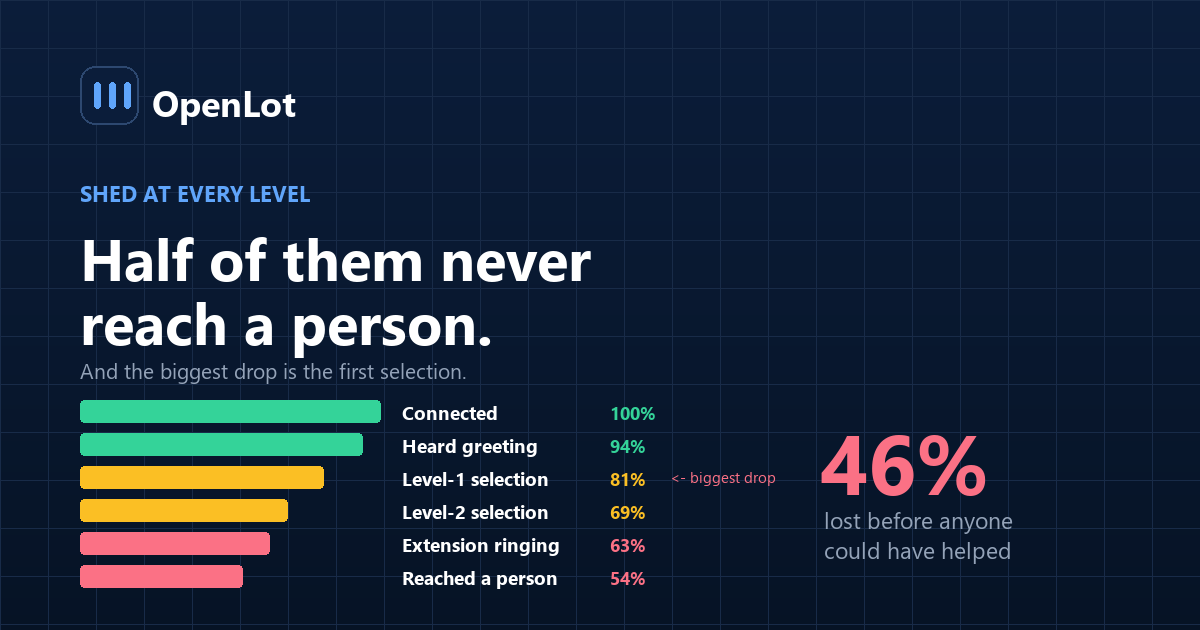
Abandonment by level
Illustrative. Your phone system can produce this; almost nobody asks it to.
Stage Callers remaining Call connected 100% Heard the greeting 94% Made a level-1 selection 81% Made a level-2 selection 69% Reached a ringing extension 63% Reached a person 54% Nearly half lost, and most of it before anyone could have helped. The largest single drop is at the first selection — the point where the caller is asked to classify their own problem into your departments.
Run this once. It is the number that ends the argument about whether the menu is fine.
The pattern behind the drops is consistent: callers leave when asked to do work they cannot do. Choosing between Sales and Service is easy. Choosing where a warranty question goes is not, and the caller who guesses wrong is counted as answered — the measurement problem in routing.
What does a tree still do better?
Three things, genuinely.
Predictability for repeat callers. Someone who calls weekly and knows that 2 then 3 reaches their advisor is well served by a tree and badly served by a conversation.
Zero latency. A keypress is instant. A conversational system has to listen and process, and that delay is real.
Reliability in noise. A keypress works in a loud shop. Speech recognition is less certain.
This argues for keeping keypad shortcuts alongside a conversational opening rather than removing them: "what can I help with — or press 2 for service." The regular caller presses 2 and the new caller speaks.
Replace, or simplify?
Not every store needs to replace the tree. Three cases:
Simplify, if the tree is long but volume is modest, the mix is dominated by two or three intents, and abandonment is concentrated at levels 3 and beyond. Cutting to two levels with two options each frequently recovers most of the loss at no cost.
Replace, if abandonment is concentrated at the first selection, the intent mix is varied, or a large share of callers are being misrouted. Those are the symptoms of callers being unable to classify themselves, and no amount of menu rewording fixes it.
Leave it, if abandonment is low, calls are being answered, and the mix is simple. A working phone tree is not a problem to be solved — the waiting case applies here too.
Where does replacement fail?
1. Removing keypad shortcuts. Regular callers lose the fast path they relied on.
2. A conversational opening that is longer than the menu was. It happens, and it defeats the purpose — the length problem in the first ten seconds.
3. No fallback to a tree. When speech fails, offering a keypad option is better than a third attempt.
4. Replacing the tree and not the destinations. If calls still land in voicemail boxes nobody works, the front end improved and the outcome did not — the same leak as missed calls, and the same reason phone handling loses deals.
5. Measuring containment instead of resolution. A call contained by the system and not resolved is worse than a transfer.
6. No measurement before. Without baseline abandonment by level, there is no way to show the replacement worked.
What should you measure?
| Metric | How to compute | What it decides |
|---|---|---|
| Abandonment by level | Hang-ups, per menu stage | Simplify or replace |
| Time to a person | Call start → human answers | The caller's actual experience |
| Misroute rate | Reached the wrong destination | Hidden inside answer rate |
| Keypad vs speech usage | Share using each, after a change | Whether shortcuts are still needed |
| Repeat-call rate | Same number within 24 hours | The quiet failure signal |
| Resolution rate | Calls resolved, not merely contained | The honest success measure |
Row one decides the whole question and takes one report. Row six is the guardrail against optimising for the wrong thing: containment is a vendor metric, resolution is a business one, and the gap between them is where customers go elsewhere.
Frequently asked questions
How many callers does a dealership phone tree lose?
More than most stores expect, with the shedding compounding at each level and the largest single drop usually at the first selection. The measurement is available from the phone system and almost nobody asks for it, which is why long menus survive.
Why is the first menu selection the biggest drop?
Because that is where the caller is asked to classify their own problem into your departments. Choosing between sales and service is easy, but deciding where a warranty question belongs is not, and callers who cannot decide either guess wrong or hang up.
Is a phone tree ever better than conversational AI?
In three respects: predictability for repeat callers who know the sequence, zero latency on a keypress, and reliability in a noisy environment. That argues for keeping keypad shortcuts alongside a conversational opening rather than removing them entirely.
Should the tree be simplified or replaced?
Simplify when abandonment is concentrated at the deeper levels and the intent mix is simple — cutting to two levels of two options often recovers most of the loss at no cost. Replace when abandonment is concentrated at the first selection or misrouting is high, because those indicate callers cannot classify themselves.
What happens if we remove keypad options entirely?
Regular callers lose the fast path they relied on, which is a real loss concentrated among your most frequent customers. The working pattern is a short conversational opening with keypad shortcuts still available for those who know them.
What is the difference between containment and resolution?
Containment means the call ended without a transfer. Resolution means the caller got what they needed. A contained but unresolved call is worse than a transfer, and optimising for containment is optimising a vendor metric rather than a business one.
How do you know a replacement worked?
By comparing against baseline abandonment by level, time to a person, and misroute rate captured before the change. Without those, the result is unarguable in both directions and the discussion becomes a matter of impressions.
What if calls still end in voicemail after the change?
Then the front end improved and the outcome did not. Replacing the menu without fixing the destinations — unworked voicemail boxes, extensions nobody answers — moves the failure later in the call rather than removing it.
Conclusion
- Trees shed callers at every level, and the largest drop is the first selection.
- Callers leave when asked to do work they cannot do, which is classifying their own problem.
- Keep the keypad shortcuts. Regular callers rely on them and they cost nothing.
- Abandonment at level one means replace; at level three means simplify.
- Resolution, not containment. A contained unresolved call is worse than a transfer.
Last updated: