Voice AI is the most technically demanding thing a dealership can deploy and the channel carrying the highest-intent customers. Three paths exist — buy, build, or wait — and for most stores one of them is clearly right once the call types are separated, because readiness varies enormously between them.
This guide covers the three paths, which call types are ready, what each path costs, the honest case for waiting, and what to measure.
Separate the call types first
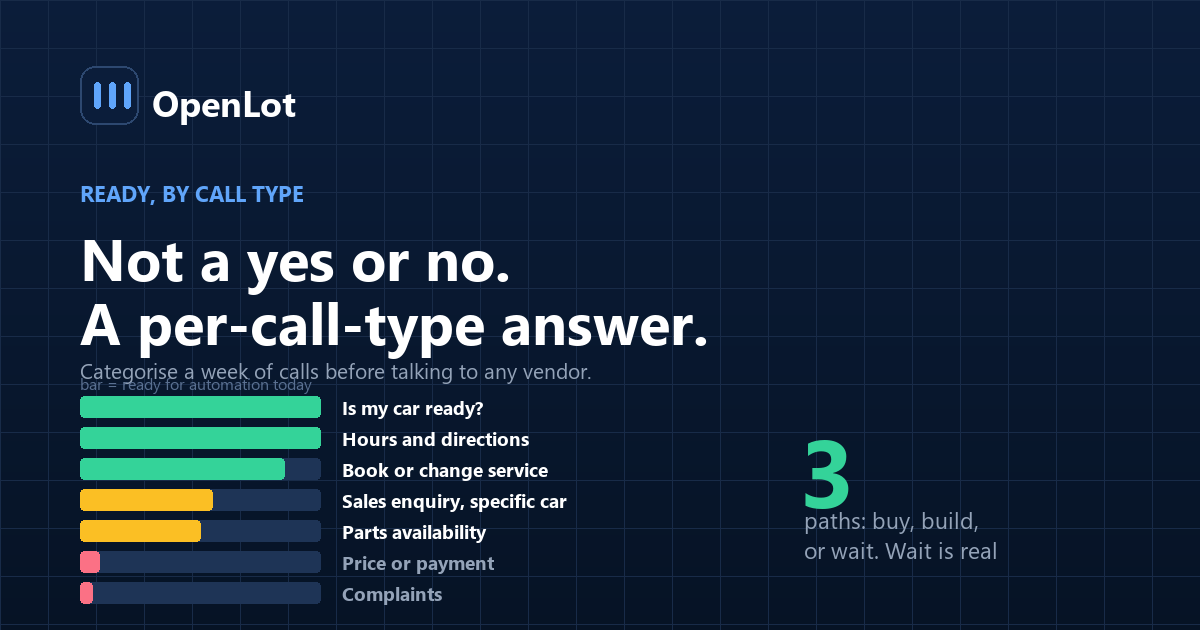
The readiness question is meaningless at the level of "phone calls." It is answerable per call type, and the spread is large.
| Call type | Share of inbound | Ready for automation? |
|---|---|---|
| "Is my car ready?" | High in service | Yes, today |
| Hours, directions, basic info | Moderate | Yes, today |
| Book or change a service appointment | High in service | Mostly |
| Sales enquiry on a specific vehicle | Moderate | Partly — qualify and route |
| Parts availability | Moderate | Partly |
| Price or payment questions | Moderate | No — escalate |
| Complaints | Low, high stakes | No — escalate immediately |
| Anything multi-part or ambiguous | Moderate | No |
A store where half of inbound volume is the first three rows has a strong case today. One whose mix is dominated by the bottom rows does not, and no vendor demo changes that.
Run the categorisation before any conversation with a vendor. A week of call logs, sorted by type, decides the whole question.
The three paths
Buy, build or wait
Illustrative. Substitute your own quotes and your own call mix.
Buy Build Wait Cost $300–1,000/mo $20k+ and ongoing $0 Time to live Weeks Months — Call types covered The vendor's list Whatever you specify None Integration Theirs, limited Yours — When it is right Most stores Non-standard process or systems Low volume, wrong mix, no handoff capacity Buy is right for the large majority. The technology moves quickly enough that building a general voice capability now means maintaining it against a market that improves monthly.
Build earns its cost where the process is genuinely non-standard or the systems have no product between them — the conditions set out in when off-the-shelf stops working.
Wait is a real answer and it is rarely offered. If inbound volume is low, the mix is dominated by escalation-type calls, or nobody is free to take transfers, voice AI will produce a worse experience than the current one.
What does "buy" actually get you?
The honest version, because demos oversell this specific category.
What works well today: answering immediately at any hour, handling status and information requests, booking and changing service appointments against a real calendar, capturing intent and routing, and taking a message with complete detail.
What works unevenly: anything requiring the system to understand a vehicle description from a customer who does not know the trim, multi-part requests, and heavy background noise.
What does not work: negotiation, pricing, an upset customer, anything where being wrong is expensive. These need a transfer, and the transfer is the product — the subject of when a voice bot should hand over.
The honest case for waiting
Three conditions where waiting is the correct decision.
1. Nobody is free to take transfers. Voice AI's entire value is answering and routing. If the routing target is a queue nobody works, the customer gets a fast machine followed by hold music, which is worse than a slow human.
2. The call mix is wrong. A store whose calls are mostly price, trade and negotiation is a store where almost every call escalates. The system adds a step and removes nothing.
3. Volume does not justify the attention. Voice deployments need monitoring, transcript review and tuning in the first months. At low call volume that attention costs more than the calls are worth.
None of these is permanent. All three are measurable, and two of them change as the store does.
Where do voice deployments fail?
1. Deployed across all call types at once. Start with status and information calls. They are high volume, low risk, and they prove the thing works before anything harder is attempted.
2. No transfer target. Covered above, and it is the dominant failure.
3. Latency ignored. A pause that reads as natural in text is dead air on a phone call — see latency, interruption and escalation.
4. Outbound enabled on day one. Inbound and outbound have different risk profiles entirely, which is the subject of the inbound/outbound asymmetry.
5. Recording treated as a feature. Call recording carries its own obligations and they vary by state.
6. No transcript review. The first month of transcripts is where the escalation list gets rewritten, and skipping it means deploying a guess.
What should you measure?
| Metric | How to compute | What it decides |
|---|---|---|
| Call mix by type | A week of logs, categorised | Whether to proceed at all |
| Answer rate, before and after | Answered ÷ offered | The headline gain |
| Abandonment rate | Hung up before resolution | The headline risk |
| Transfer rate | Transferred ÷ handled | Whether the scope is right |
| Transfer pickup time | Transfer → human answers | Whether the gain survives |
| Containment rate by call type | Resolved without a person, per type | Where it actually works |
Row one comes first and decides everything else. Rows four and five together are the honest success measure: a high transfer rate with fast pickup is a working system, and a low transfer rate usually means the system is answering things it should not.
Frequently asked questions
Is voice AI ready for car dealerships?
For some call types, clearly. Status enquiries, basic information and service appointment booking work well today. Price questions, negotiation and complaints do not and should escalate. The useful question is what share of your actual inbound mix falls into the ready categories, which a week of call logs answers.
Should a dealership buy or build voice AI?
Buy, in the large majority of cases. The technology improves monthly, so building a general voice capability means maintaining it against a moving market. Building earns its cost only where the process is genuinely non-standard or the required systems have no product between them.
When is waiting the right decision?
When nobody is free to take transfers, when the call mix is dominated by price and negotiation calls that all escalate, or when volume is too low to justify the transcript review and tuning the first months require. All three are measurable and two of them change as the store grows.
What should voice AI never handle?
Pricing and payment questions, negotiation of any kind, complaints, and anything multi-part or ambiguous. Each of those either creates a commitment the store must honour or needs judgment, and attempting them produces work rather than removing it.
Where should a deployment start?
With status and information calls. They are high volume, low risk, and they demonstrate that the system works before anything harder is attempted. Deploying across all call types simultaneously removes the ability to attribute what is working.
Is a low transfer rate a good sign?
Usually not. A low transfer rate often means the system is answering things it should be escalating. A high transfer rate paired with fast human pickup is the signature of a correctly scoped deployment, which is why those two metrics should be read together.
What does voice AI cost?
Licensed products commonly run in the hundreds to low thousands monthly depending on volume and call types covered. Building is a five-figure project with ongoing maintenance, and is rarely the right call given how quickly the underlying capability is changing.
Does voice AI help if calls are already being answered?
Less than it appears. The gain concentrates in calls currently going unanswered — at peak, after hours, and into voicemail nobody returns. A store already answering nearly everything is buying consistency rather than coverage, which is a smaller and different case.
Conclusion
- Categorise the calls first. Readiness is a per-type question and the spread is large.
- Buy, for most stores. The capability improves monthly and building means maintaining against it.
- Wait is a real answer when there is no transfer capacity or the mix is all escalation.
- Start with status and information calls, not with everything at once.
- Read transfer rate with pickup time. A low transfer rate usually means over-reach.
Last updated: