Inbound and outbound AI calling look like the same capability and are not. Answering a call someone chose to make carries almost no regulatory weight; placing one they did not carries a great deal — and products that bundle the two as a single feature invite a store to switch on the risky half by accident.
This is operational guidance, not legal advice. Calling and recording rules are federal and state and they change. Have counsel review any automated calling programme before it runs.
This guide covers why the two differ, what each requires, where the line gets crossed accidentally, deployment order, and what to measure.
Why are they so different?
Because the customer initiated one of them.
An inbound call is a person choosing to contact your store. Answering it quickly, at any hour, is unambiguously good service. The obligations that attach are modest: recording disclosure where required, and honest identification of what they are speaking to.
An outbound call is your store initiating contact with someone who did not ask for it at that moment. That triggers a different set of requirements around consent, timing, identification and record-keeping — and in several of them the use of automated technology changes the analysis rather than being neutral to it.
| Inbound | Outbound | |
|---|---|---|
| Consent required to place | — | Yes, and the type matters |
| Time-of-day limits | No | Yes, recipient's local time |
| Do-not-call obligations | No | Yes |
| Recording rules | Yes, varies by state | Yes, varies by state |
| Identification | Good practice | Required, and specific |
| Record-keeping | Light | Substantial |
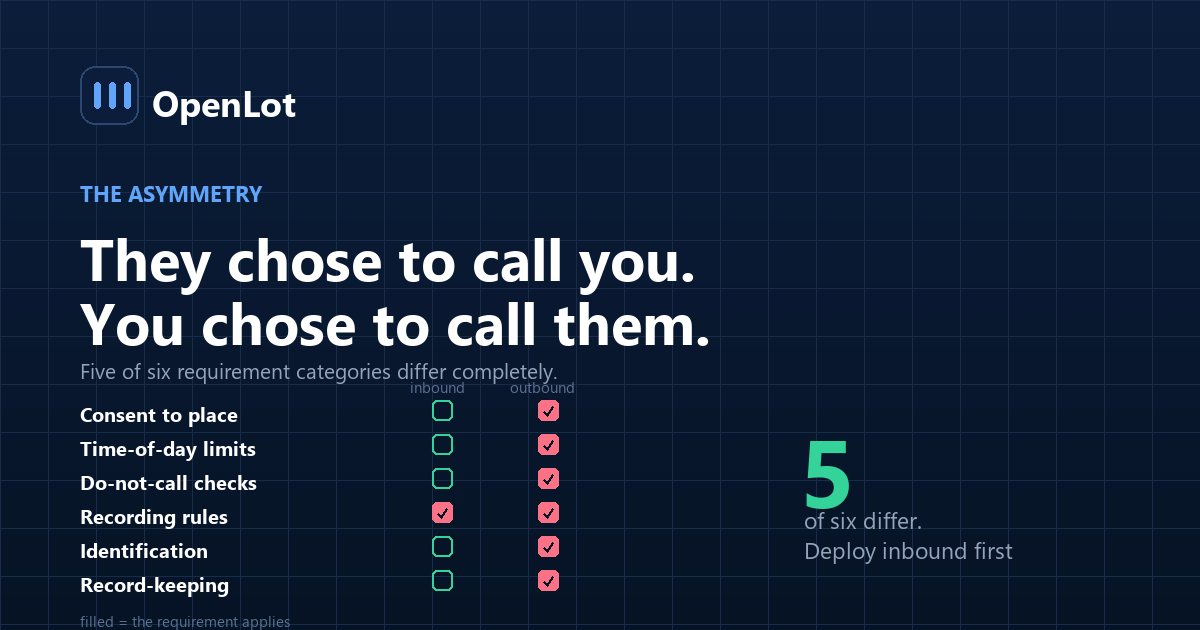
Five of the six rows are either absent or light on the left and substantial on the right. That is the asymmetry, and it should drive the deployment order.
What does inbound require?
Comparatively little, and all of it is reasonable.
Honest identification. The caller should know they are speaking to an automated assistant. Disclosure performs better than a failed impersonation in any case.
Recording disclosure, where required. Rules vary by state and the obligation is the store's. This applies to human-answered calls equally; adding AI does not change it, but it does mean every call is now recorded, which may be new.
A path to a person. Not a regulatory requirement in most contexts, and the absence of one produces complaints.
That is close to the whole list, which is why inbound is where a deployment should start.
What does outbound require?
Before any automated outbound call
Five things, and all five have to be true per call rather than per customer.
Requirement What it means Consent of the right type Recorded, dated, specific to the channel and purpose Within permitted hours In the recipient's time zone, not the store's Not on a do-not-call list Internal and applicable external lists, checked at call time Identified Store name and a callback number, clearly Logged What was said, when, under what consent The second row is the most commonly violated and the least noticed, because systems schedule from store time by default — the same failure as in SMS compliance.
The first row is the one that fails under examination. A consent flag on a contact record cannot demonstrate what permission existed at the moment a specific call was placed.
How does a store cross the line accidentally?
Four ways, none of which involves anyone deciding to.
1. A callback feature. "We will call you back" sounds inbound and is outbound. The customer requested it, which helps, and the timing and identification requirements still apply.
2. A follow-up sequence that includes a call. A cadence with a voice touch at step three is placing automated outbound calls, and the sequence will eventually fire at a bad hour unless a contact-time window is enforced — the stop-condition discipline from cadence design.
3. A vendor default. Outbound enabled in a configuration nobody reviewed — the audit in outbound voice AI finds it. Inbound, by contrast, is the safe place to start a deployment.
4. Reactivation campaigns. Working an aged list by phone is outbound at volume to people whose consent may be old — the segmentation problem in lead nurturing.
All four are findable in an afternoon by asking one question: what is this system permitted to initiate, and under what conditions?
What deployment order follows?
1. Inbound only, status and information calls. Lowest risk, highest volume, and it proves the mechanics.
2. Inbound, booking and routing. Still inbound. Adds value without adding regulatory weight.
3. Callbacks the customer requested. The gentlest form of outbound, with the clearest consent.
4. Outbound confirmations for existing appointments. Transactional, expected, and narrowly scoped.
5. Outbound follow-up on active leads. Only with consent properly recorded and contact windows enforced.
6. Outbound reactivation. Last, and only after the segmentation and consent work is done.
Most stores should run steps 1 and 2 for a quarter before considering step 3. There is enough value in inbound alone to justify the deployment, and the risk profile is entirely different.
Where does this go wrong?
1. Buying one feature and enabling both halves. The most common, and the configuration is rarely reviewed.
2. Consent as a boolean. No date, no source, not retrievable per call.
3. Store time zone scheduling. Silent and systematic.
4. No call recording retention policy. Every call is now recorded, which is a data question as well as a compliance one — see AI and dealership data.
5. Assuming the vendor carries the obligation. They do not. The store is the accountable party and the contract allocates cost rather than responsibility.
What should you measure?
| Metric | How to compute | What it catches |
|---|---|---|
| Outbound calls placed | Count, by trigger | Should match what you believe you enabled |
| Calls outside permitted hours | Against recipient local time | Should be zero |
| Consent retrievable per call | Sampled | Should be 100% |
| Do-not-call checks at call time | Checked ÷ placed | Should be every call |
| Identification compliance | Sampled recordings | Store name and callback number present |
| Recording retention | Days held, against policy | The data question nobody sets |
Row one is the audit to run first, and the common finding is that the system is placing outbound calls nobody remembers enabling.
Frequently asked questions
What is the difference between inbound and outbound AI calling?
Inbound answers a call the customer chose to make, which carries modest obligations around identification and recording disclosure. Outbound places a call the customer did not request, which triggers consent requirements, time-of-day limits in the recipient's time zone, do-not-call obligations and substantially more record-keeping.
Which should a dealership deploy first?
Inbound, and only inbound, for a sustained period. Status and information calls carry the lowest risk and the highest volume, and there is enough value in inbound alone to justify the deployment without taking on the outbound requirements at the same time.
How does a store enable outbound by accident?
Four ways: a callback feature that sounds inbound, a follow-up sequence with a voice touch in it, a vendor default nobody reviewed, and a reactivation campaign run by phone. All four are findable by asking what the system is permitted to initiate and under what conditions.
What does automated outbound calling require?
Consent of the right type recorded and dated per channel and purpose, calling within permitted hours in the recipient's local time, checking do-not-call lists at call time, clear identification with a callback number, and a log of what was said under what consent.
What is the most common silent violation?
Scheduling from the store's time zone rather than the recipient's, which places calls outside permitted local hours without anything flagging it because the system was never told where the recipient is.
Does recording every call create new obligations?
It can. Recording rules vary by state and apply regardless of whether a human or a system answers, but introducing voice AI usually means every call is now recorded where previously only some were. That is a retention and access question as much as a disclosure one.
Is a consent checkbox enough?
No. The question that gets asked is what permission existed at the moment a specific call was placed, and a flag on a contact record cannot answer it. Consent needs a timestamp, a source, and to be retrievable per call rather than per customer.
Who is responsible if the vendor gets it wrong?
The dealership. Contracts allocate cost and remediation between the parties but do not transfer the obligation, which means the store needs its own visibility into what is being placed, when, and under what consent.
Conclusion
- The customer initiated one of them. That single difference drives everything else.
- Five of six requirement categories are light inbound and substantial outbound.
- Deploy inbound only, for a quarter. There is enough value there alone.
- Four accidental paths to outbound, and none involves anyone deciding to.
- Audit what the system may initiate. The common finding is more than you enabled.
Last updated: