Lead nurturing is the long, low-intensity contact that keeps a customer reachable until their timeline arrives. Most dealership leads are closed as dead for timing reasons, not disqualification — which makes the aged list the cheapest inventory of intent in the building, and the hardest to work without automation.
This guide covers why aged leads are worth working, how to segment them before touching anything, the consent problem that stops most programmes, a nurture sequence that works, and what to measure.
Why is the aged list worth anything?
Because most leads are closed for timing, not for fit.
A customer who was nine months from a lease end, or waiting on a bonus, or not yet decided between two segments, gets worked for three weeks and marked dead. Nothing about them changed except that your follow-up ran out — the decay documented in automated follow-up, where a written eight-touch cadence delivers roughly two and a half.
That customer is still in the market. They are simply in it later than your cadence lasted.
What the pile is worth
Illustrative. Segment your own before believing any of it.
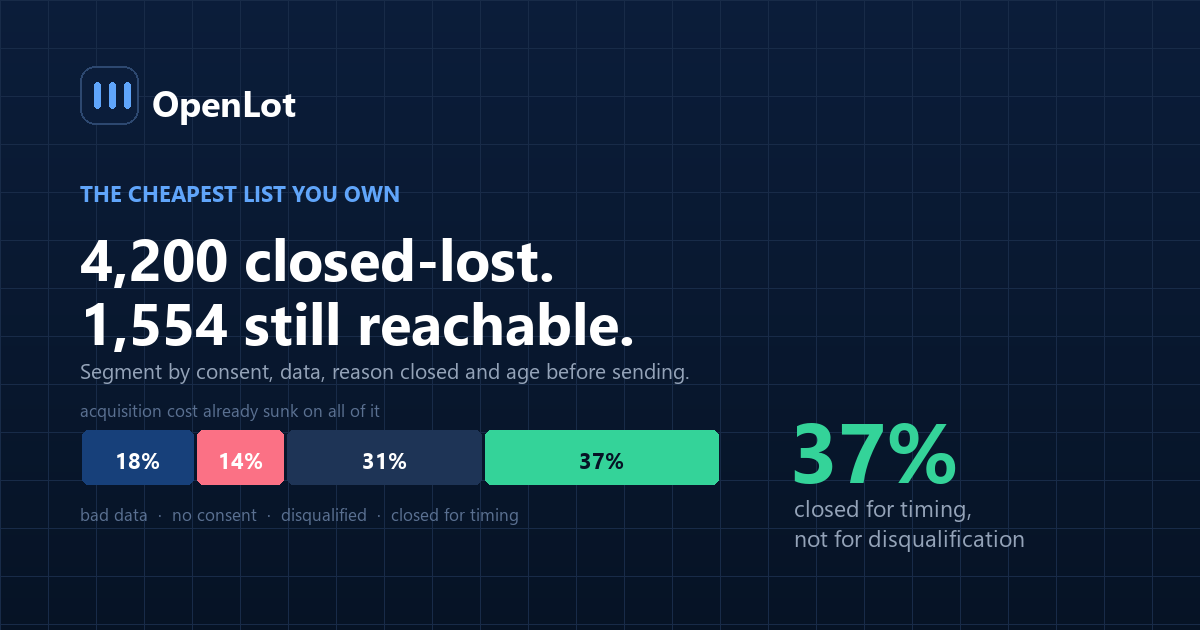
A store with 4,200 leads closed-lost in the last 18 months:
Segment Share Count Bad data — no valid phone or email 18% 756 No consent record, or opted out 14% 588 Genuinely disqualified (bought elsewhere, credit, out of market) 31% 1,302 Closed for timing or simply went quiet 37% 1,554 The last row is the asset. It was paid for once, at full acquisition cost, and never worked past attempt three.
At a 4% reactivation-to-appointment rate and a 55% show rate, 1,554 records are about 34 appointments. Run it with your own ratios — the point is that the denominator is already on your books.
The economics are unlike any other source: the acquisition cost is sunk. Every appointment from this list arrives at a marginal cost of close to zero, which is the fastest available lever on cost per sale.
How do you segment before sending anything?
Four cuts, in this order. Sending before segmenting is how a reactivation programme becomes a complaint programme.
1. Consent state. Does a valid, recorded consent exist for the channel you intend to use, and is it still current? Anyone who opted out is out permanently, and anyone with no record is treated as no consent. This is not a preference, it is the Safeguards Rule and messaging obligations the dealership owns regardless of vendor.
2. Data validity. Dead numbers and bounced addresses. Working them wastes send volume and damages sender reputation, and the share is always larger than anyone expects — the decay is continuous.
3. Reason closed. Bought elsewhere, credit decline and out-of-market are genuinely closed. Timing, went quiet and no-answer are not.
4. Age band. 30–90 days, 90–180, 180–365, 365+. These need different messages, and treating them identically is why most reactivation campaigns read as spam.
Only the intersection — consented, valid, closed for timing, within a sensible age band — gets contacted.
What does the sequence look like?
Not the active cadence. A 90-day-old lead receiving touch nine of an active-shopper sequence is the fastest way to generate opt-outs on a list you already paid for.
| # | When | Channel | Framing |
|---|---|---|---|
| 1 | Day 0 | A reason to be hearing from you: a change in the market, inventory, or rates | |
| 2 | +5 days | Text | One question. "Still looking, or did you get sorted?" |
| 3 | +14 days | Something useful whether or not they buy — segment pricing, timing, trade values | |
| 4 | +30 days | Text | The close-out. "Want me to keep you posted, or close this out?" |
Four touches over a month, not eight over three weeks. The framing difference is the whole thing: the active cadence pursues, the nurture sequence gives a reason to be in touch. A customer who went quiet nine months ago does not want to know you are still following up. They want to know something changed.
Touch 4 performs best, as it does in the active cadence, and for the same reason: asking permission to stop produces replies from people who were never actively avoiding you.
Where AI earns its place here
This list cannot be worked by hand. Fifteen hundred records at four touches is six thousand sends with branching on reply, consent checks per send, and stop conditions on six events. No BDC does this alongside live leads, which is why the aged pile sits untouched in almost every store.
What AI does not do is decide who is contactable. That is the segmentation above, and it is a data exercise rather than an automation one.
Where does nurturing go wrong?
1. Sending before segmenting. The single failure that produces complaints, opt-outs and occasionally regulatory attention.
2. Treating consent as a field rather than a record. You need consent with a timestamp, demonstrable for the specific message sent. A flag saying "opted in" with no date cannot support a compliance question.
3. The active cadence applied to aged records. Different list, different intent, different sequence.
4. Reactivating into no capacity. The programme generates conversations with customers who went quiet once already. If the reply waits two days, they go quiet again, permanently.
5. No source tagging. Reactivated leads that are not tagged cannot be attributed, so the programme cannot be defended at budget time — the same failure mode as in lead attribution.
6. Running it continuously at full volume. Aged lists are finite. Burning the whole pile in one month leaves nothing for next quarter and spikes opt-outs. Work it in cohorts.
What should you measure?
| Metric | How to compute | What it tells you |
|---|---|---|
| Contactable share | Consented + valid + timing-closed ÷ total aged | The real size of the asset |
| Reactivation reply rate | Replies ÷ records contacted | Whether the framing works |
| Opt-out rate, aged vs active | Split | Whether the sequence is too aggressive for the list |
| Reactivation to appointment | Appointments ÷ records contacted | The number that justifies the programme |
| Show rate, reactivated | Attended ÷ set | Whether reactivated appointments are real |
| Cost per reactivated unit | Programme cost ÷ units | Usually the lowest in the store |
The last row is the argument. Compare it against your blended cost per sale and the programme defends itself without a presentation.
Frequently asked questions
Are aged dealership leads worth working?
Usually yes, because a large share are closed for timing rather than disqualification — the customer was months from buying and the follow-up ran out before their timeline arrived. Those records were paid for at full acquisition cost and never worked past the first few attempts, which makes them the cheapest intent available to the store.
How should aged leads be segmented before contacting them?
By consent state first, then data validity, then reason closed, then age band. Only the intersection — a current consent record, a working phone or email, closed for timing rather than disqualification, and within a sensible age band — should be contacted. Sending before segmenting is what turns a reactivation programme into a complaint programme.
Can we text customers who went quiet a year ago?
Only with a current, recorded consent for that channel, and never after an opt-out. A consent flag without a timestamp cannot demonstrate compliance for a specific message, and the dealership is the accountable party regardless of which vendor sends it. Records with no consent history should be treated as having no consent.
Should aged leads get the same follow-up cadence as new ones?
No. An active-shopper cadence applied to a lead that went quiet nine months ago reads as pursuit and generates opt-outs on a list you already paid for. Aged records need fewer touches over a longer window, framed around something that changed rather than around continued follow-up.
How many touches should a nurture sequence have?
Around four over a month, rather than eight over three weeks. The key difference is framing rather than count: each touch needs a reason the customer is hearing from you — a market change, new inventory, a rate movement — instead of another check-in.
Why does the close-out message work so well?
Because asking whether to keep someone on the list or close them out produces replies from people who were not avoiding you, just not prioritising a response. It also generates a clean stop for everyone else, which is better for the list than trailing off and better for compliance than ambiguity.
Should the whole aged list be worked at once?
No. Aged lists are finite, so burning the entire pile in one month leaves nothing for the following quarter and concentrates opt-outs into a single spike. Working it in cohorts by age band, a portion at a time, produces steadier results and preserves the asset.
How do we prove the programme is worth running?
Tag reactivated leads as their own source and follow them through to appointment, show and sale, then compute cost per reactivated unit against your blended cost per sale. Because acquisition cost is already sunk, this figure is usually the lowest in the store, and the comparison makes the case without needing a presentation.
Conclusion
- Most leads are closed for timing, not fit. That share is the asset.
- Segment before sending: consent, data validity, reason closed, age band — in that order.
- Different list, different sequence. Four touches framed around something that changed, not eight pursuing.
- Acquisition cost is already sunk, which makes cost per reactivated unit the lowest number in the store.
- Work it in cohorts. The list is finite, and burning it in a month spikes opt-outs.
Last updated: