Outbound automated calling is the highest-obligation thing a dealership can switch on, and products present it as a toggle. Four call types exist and they carry very different weight — and separating them is what makes an outbound programme defensible rather than a single risky switch.
This is operational guidance, not legal advice. Automated calling is governed by federal and state rules that vary and change. Have counsel review any outbound programme before it runs.
This guide covers the four call types by risk, what each requires, the records to keep, the controls to build, and what to measure.
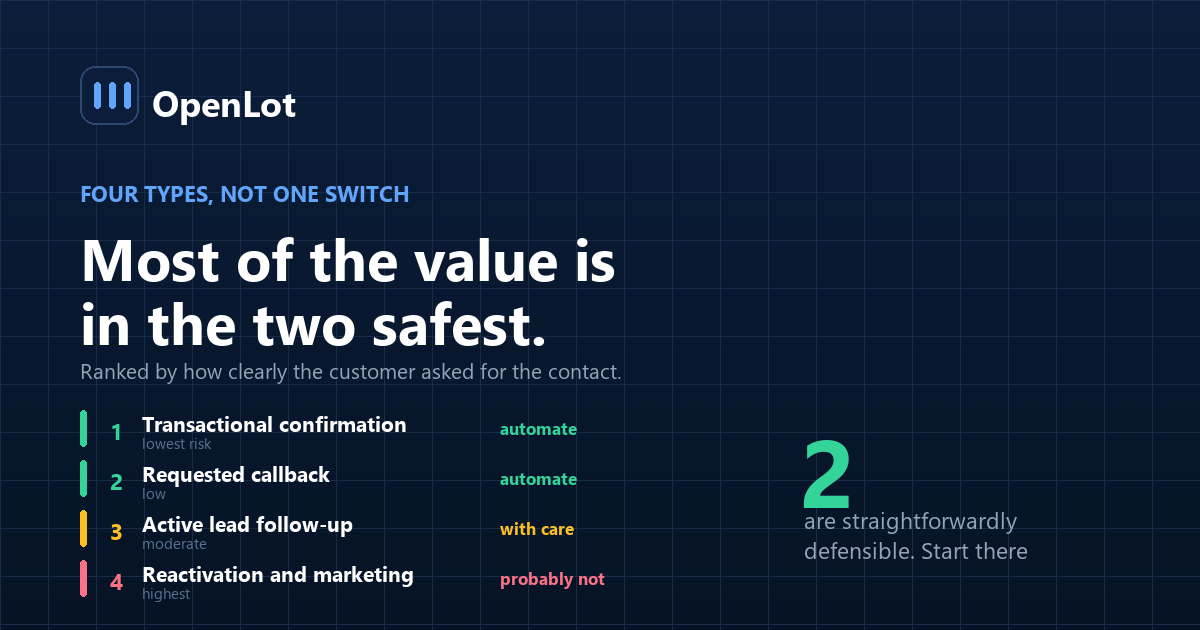
The four call types
| Type | Example | Risk | Automate? |
|---|---|---|---|
| 1. Transactional confirmation | "Your service appointment is tomorrow at 9" | Lowest | Yes |
| 2. Requested callback | The customer asked to be called | Low | Yes |
| 3. Active lead follow-up | A lead from three days ago | Moderate | With care |
| 4. Reactivation and marketing | An aged list, an offer | Highest | Probably not |
The ranking follows how clearly the customer asked for the contact. Type 1 relates to something they arranged. Type 4 relates to something they have not thought about in a year.
Most of the available value sits in types 1 and 2, which is convenient, because those are also the ones that are straightforwardly defensible.
What does each type require?
Type 1 — transactional confirmation. The customer has an appointment with you. The call relates directly to it, the timing is bounded by the appointment, and the content is factual. Requirements: identification, permitted hours, recording disclosure, a log.
Type 2 — requested callback. The customer asked. Requirements: the same, plus a record of the request and reasonable promptness — a callback three days later is no longer the thing they asked for.
Type 3 — active lead follow-up. This is where consent type starts to matter, and where a voice touch inside a follow-up cadence needs a contact-time window applied so the sequence cannot fire at a bad hour.
Type 4 — reactivation and marketing. Old consent, no recent relationship, and the customer did not initiate anything. The segmentation work in lead nurturing applies before any channel is chosen, and voice is the channel with the highest obligations of the three. For most stores, text or email is the right medium for this and voice is not.
The records to keep
Per call, not per customer
Record Must show Consent Type, date, source, and that it covered voice specifically Call time In the recipient's local time zone DNC check That lists were checked at call time, not at import Identification What the system said, including the callback number Outcome Answered, voicemail, declined, opted out Recording With disclosure state, and a retention policy Row one is where programmes fail under examination: consent to be emailed is not consent to be called, and a single blanket permission does not distinguish.
Row three fails for a different reason — lists are frequently checked when a campaign is built rather than when each call is placed, and the gap between those two moments can be days.
The controls to build
As capability limits, not settings. A setting gets changed; a capability does not exist.
1. A hard contact-time window, enforced in recipient local time, with no override.
2. A call-type gate. The system can place type 1 and 2 calls. Types 3 and 4 require an explicit, separately approved configuration.
3. Immediate opt-out handling, propagating across every channel and system — the cross-system requirement in SMS compliance.
4. Frequency caps, enforced per customer per period, because patterns are regulated independently of any single call.
5. A hard stop on dispute or complaint language, routing to a person rather than responding.
6. An exportable log, in your possession, without asking the vendor.
The first and second together prevent most accidental exposure. A system that structurally cannot place a marketing call at 8pm will not place one, regardless of who configures what.
Where do outbound programmes go wrong?
1. One switch for all four types. The dominant failure, and it means enabling confirmations enables reactivation — the asymmetry explained in inbound versus outbound. Sampling calls monthly is how it gets found, per the call QA checklist.
2. Consent as a single flag. No channel specificity, no date, not retrievable per call.
3. Store time zone. Silent, systematic, and easy to fix once noticed.
4. DNC checked at import. The list moves between import and call.
5. Voicemail drops treated as not-a-call. They are a call, and the rules apply.
6. No retention policy on recordings. Every outbound call is now recorded audio of a customer, which is a data question — see AI and dealership data.
7. Reactivation by voice. The highest-obligation channel applied to the lowest-consent list.
What should you measure?
| Metric | How to compute | Target |
|---|---|---|
| Calls by type | Count, per the four categories | Types 3 and 4 should be deliberate |
| Calls outside permitted hours | Recipient local time | Zero |
| Consent retrievable per call | Sampled | 100% |
| DNC checked at call time | Checked ÷ placed | Every call |
| Opt-out propagation lag | Request → last message on any channel | Immediate |
| Complaint rate | Complaints ÷ calls placed | The honest outcome measure |
Row one is the audit that matters. The common and uncomfortable finding is that a store believed it had enabled appointment confirmations and the system is also placing follow-up calls on an aged list.
Frequently asked questions
Which outbound calls are safe to automate at a dealership?
Transactional confirmations relating to something the customer already arranged, and callbacks the customer specifically requested. Both relate to an interaction the customer initiated, and most of the available value sits in those two types.
Should reactivation campaigns use automated voice calls?
Usually not. Reactivation combines the oldest consent with the weakest relationship and the customer did not initiate anything, while voice carries the highest obligations of the three channels. Text or email is generally the right medium for that work.
What consent is needed for an automated outbound call?
Consent that is specific to voice rather than general, recorded with a date and a source, and retrievable for the specific call placed. Permission to be emailed is not permission to be called, and a single blanket flag cannot demonstrate what applied at the moment of a given call.
When should do-not-call lists be checked?
At the moment the call is placed, not when the campaign was built. Lists change, and the gap between building a campaign and running it can be days, which is long enough for the check to be out of date.
Do voicemail drops count as calls?
Yes. Leaving an automated message is placing a call for these purposes, and the consent, timing, identification and record-keeping requirements apply the same way. Treating them as a lighter-touch alternative is a common and incorrect assumption.
How should outbound controls be implemented?
As capability limits rather than settings. A hard contact-time window in recipient local time with no override, and a call-type gate where riskier categories require separate explicit approval, prevent most accidental exposure because the system structurally cannot do the risky thing.
What is the most common configuration problem?
A single switch covering all four call types, so enabling appointment confirmations also enables follow-up and reactivation calling. The audit to run is simply counting what the system has actually placed, by type, against what anyone believes was enabled.
Does recording outbound calls create extra obligations?
Yes, on two fronts. Recording disclosure rules vary by state and apply to automated calls, and the resulting audio is customer data with retention and access implications that need a policy rather than a default.
Conclusion
- Four types, very different weight. Most of the value is in the two safest.
- Consent must be voice-specific, dated, and retrievable per call.
- Check DNC at call time, not when the campaign was built.
- Build controls as capability limits. A setting gets changed; a capability does not exist.
- Audit what has actually been placed, by type. It is usually more than was enabled.
Last updated: