Proactive chat is deployed as a single setting and its effect is not uniform. It helps where the visitor is undirected and costs you where they are reading — and the honest way to settle it is a split test on your own site rather than a position on whether popups are good.
This guide covers the six settings, when prompting helps, how to test it honestly, where chat behaviour goes wrong, and what to measure.
The six settings
Everything about whether chat helps or annoys comes down to six configurable things.
| Setting | Converts when | Annoys when |
|---|---|---|
| Prompt timing | After meaningful engagement | On arrival |
| Prompt frequency | Once per session | Every page |
| Prompt copy | Specific to the page | "Hi! Can I help you?" |
| Widget size and position | Out of the content | Covering photos, especially on mobile |
| Dismiss behaviour | Stays dismissed | Returns on the next page |
| Page targeting | Undirected pages only | Everywhere, uniformly |
The fifth row is the one most often wrong and the most irritating to visitors. A widget that reappears after being closed tells the visitor their input does not matter, which is a poor note to open a relationship on.
The sixth is the one with the largest measurable effect, and it is the subject of placement and intent capture: a prompt on a homepage and a prompt on a vehicle page are different interventions.
When does prompting help?
Where the visitor is in their task
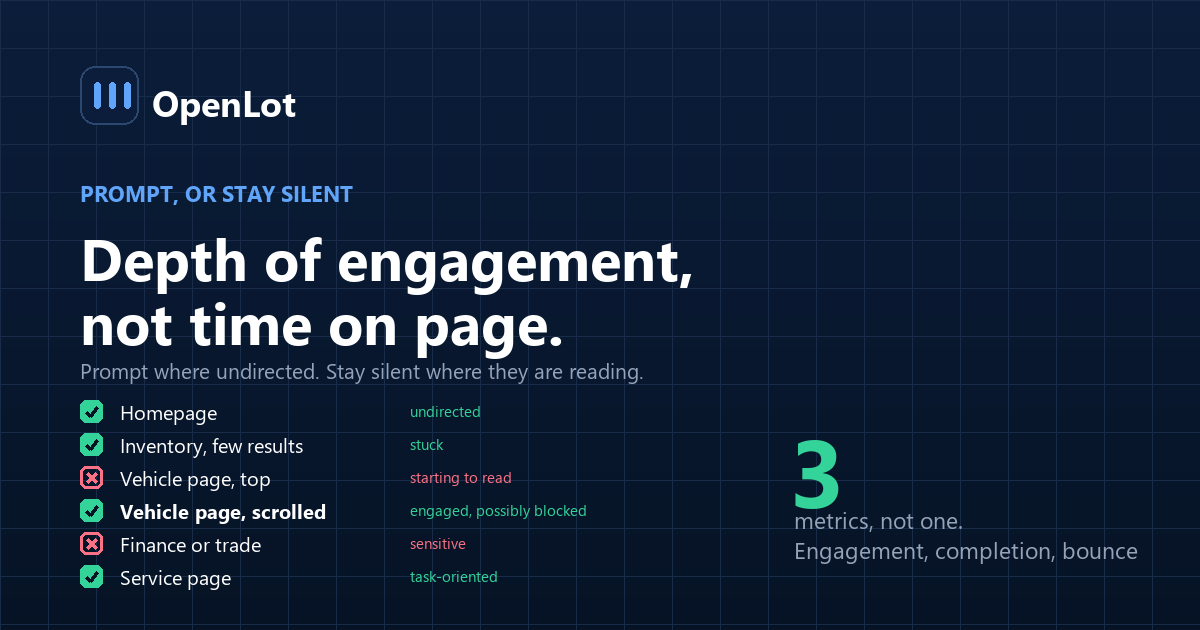
Page State Prompt? Homepage Undirected Yes, after a delay Inventory listing Browsing, may be stuck Yes, after filters applied with few results Vehicle detail, top Starting to read No Vehicle detail, after scrolling Engaged, possibly blocked Yes — this is the best moment Finance or trade page Researching No. Stay available Service page Task-oriented Yes, booking help Row four is the finding that surprises stores. Prompting a visitor who has scrolled most of the way down a vehicle page performs well, because they are engaged and frequently stuck on one specific question. Prompting the same visitor on arrival performs badly, because they have not read anything yet.
Depth of engagement, not time on page. A visitor idle for sixty seconds may have left the tab open; one who has scrolled through the photos and reached the specifications is genuinely reading.
How do you test it honestly?
Three rules, otherwise the test produces a number that confirms whatever was assumed.
1. Split by page type, not globally. A global test averages a positive effect on the homepage with a negative one on vehicle pages and reports approximately nothing.
2. Measure bounce, not just engagement. Proactive chat reliably increases engagement — that is what prompting does. The question is whether it increases completions without increasing bounce, and only measuring both answers it.
3. Run it long enough to clear a weekend. Weekend traffic behaves differently, and a Tuesday-to-Thursday test describes Tuesday to Thursday.
| Measure | Why |
|---|---|
| Engagement rate | Will rise. Expected |
| Completion rate | Did the extra conversations produce contact details? |
| Bounce rate | Did prompting push people off the page? |
| Chat-to-appointment | The business outcome |
| Time on page | A proxy for whether it interrupted something |
If engagement rises and completion is flat while bounce rises, prompting generated conversations that went nowhere and pushed away visitors who were reading. That is a clear result and it is the one global testing hides.
Where does chat behaviour go wrong?
1. Prompting on arrival. Before the visitor has read anything.
2. Reappearing after dismissal. The clearest signal that the store is not listening.
3. Covering the photos on mobile. Vehicle images are the product, and most traffic is mobile — the device gap in website conversion rate is usually the largest finding a store has available. It is also where phone handling and web behaviour meet: a frustrated visitor calls.
4. Generic prompt copy. "Can I help you find something?" on a page showing one specific vehicle wastes the context.
5. Prompting on trade and finance pages. Those visitors are researching something sensitive and the prompt reads as pressure.
6. Testing globally. Hides opposite effects on different page types.
7. Measuring engagement alone. Guarantees a positive-looking result from any prompting change — the same trap as reading a blended website conversion rate. And none of it matters if the chat produces a lead nobody follows up.
What should you measure?
| Metric | How to compute | What it decides |
|---|---|---|
| Engagement by page type | Chats started ÷ sessions, split | Where prompting works |
| Completion by page type | Contact details ÷ chats started | Whether the conversations are real |
| Bounce by page type, prompted vs not | Split | The cost side |
| Dismiss-then-return rate | Visitors shown a prompt after dismissing | Should be zero |
| Mobile vs desktop outcomes | Split | Where the widget covers content |
| Scroll depth at prompt | Average | Whether timing follows engagement |
Row three is the one nobody runs and the one that makes the test honest. Engagement is trivially increased by prompting more; whether that was worth it is a question only bounce and completion together can answer.
Frequently asked questions
Does proactive chat help or annoy?
Both, depending on the page. It helps where the visitor is undirected — a homepage, or an inventory listing with few results — and costs you where they are reading, particularly near the top of a vehicle detail page. The effect is measurable and specific to each site.
When is the best moment to prompt on a vehicle page?
After the visitor has scrolled most of the way down. At that point they are engaged and frequently blocked on one specific question, which is exactly what chat handles well. Prompting the same visitor on arrival performs badly because they have not read anything yet.
Should timing be based on time on page or scroll depth?
Scroll depth. A visitor idle for sixty seconds may simply have left the tab open, while one who has scrolled through the photographs and reached the specifications is genuinely engaged and nearly through the page.
What is the most irritating chat behaviour?
A widget that reappears after being dismissed. It tells the visitor directly that their input does not matter, which is a poor way to open a relationship and is usually a single configuration setting.
How should proactive chat be tested?
Split by page type rather than globally, measure bounce and completion rather than engagement alone, and run it long enough to include a weekend. A global test averages opposite effects on different pages and reports approximately nothing.
Why is engagement rate a misleading metric?
Because prompting more reliably increases it — that is what prompting does. The question is whether the extra conversations produced contact details without pushing away visitors who were reading, and only completion and bounce together answer that.
Should chat prompt on trade and finance pages?
No. Visitors on those pages are researching something they consider sensitive, and a prompt reads as pressure. The widget should remain available and silent, capturing and escalating if the visitor opens it.
What matters most on mobile?
That the widget does not cover the vehicle photographs. Most dealership traffic is mobile and the images are the product, so a widget obscuring them costs more than the conversations it produces.
Conclusion
- Six settings decide it, and page targeting has the largest effect.
- Prompt where undirected, stay silent where they are reading.
- The best vehicle-page moment is after scrolling, not on arrival.
- A dismissed widget stays dismissed. Anything else says you are not listening.
- Measure bounce with completion. Engagement alone makes every prompt change look good.
Last updated: