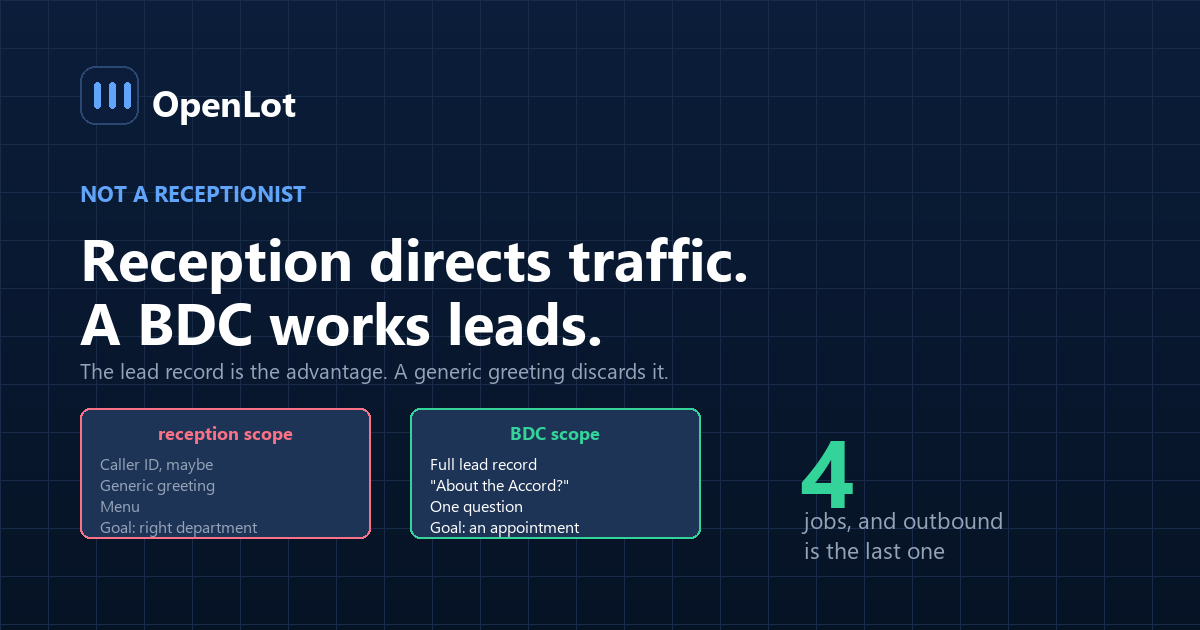
An AI phone agent in a BDC does a different job from one on the main line. Reception directs traffic; a BDC works leads — and conflating the two produces a system scoped for switchboard duty, deployed against the highest-intent conversations in the store.
This guide covers how BDC phone work differs, the four jobs an agent covers, the script structure, where it fails, and what to measure.
How does BDC phone work differ from reception?
Four ways, and each one changes the design.
| Reception | BDC | |
|---|---|---|
| Caller's state | Needs directing | Already in a conversation with you |
| Context available | Caller ID, maybe | A full lead record and thread history |
| Goal | Right department, fast | An appointment |
| Success | Connected to someone | Booked, and they showed |
The second row is the one that should change everything and usually does not. A BDC call comes from someone who submitted a lead two days ago, exchanged four messages, and asked about a specific vehicle. A system that answers that call as though it is an unknown caller has thrown away the only advantage it had.
The four jobs
1. Answering a callback on an active lead. The customer is responding to your outreach. The system should know which outreach, about what vehicle, and what was already said — the handoff principle from the showroom, applied to the phone.
2. Taking an inbound call from a lead source. Marketplace and portal calls arrive with a known source and frequently a known vehicle. Treating them as generic inbound discards the attribution.
3. Confirming and rescheduling appointments. Mechanical and high volume — the sequence in confirmation design.
4. Placing outbound follow-up calls on consented leads. The highest-value and highest-obligation of the four, and the one to enable last, for the reasons in inbound versus outbound.
Jobs 1 and 3 are where most of the value is, and both are inbound or customer-initiated.
The script structure
Four parts, and the first is where BDC differs most sharply from reception.
Opening, with context
Situation Opening Unknown caller "Riverside Honda, automated assistant — what can I help with?" Active lead, known vehicle "Hi Dana — is this about the Accord Sport you asked about Tuesday?" Appointment tomorrow "Hi Marcus — calling about tomorrow at 6?" The second and third lines resolve a large share of calls in one exchange, and they are only possible if the phone system can see the lead record. That is a DMS and CRM integration question rather than a voice one.
Phrase it as a question, always. A confident wrong guess reads as careless.
Part 2 — one qualifying question, not five. The lead record already holds most of what a generic script would ask.
Part 3 — two concrete times. The same structure that works in text.
Part 4 — escalate or confirm. Anything about price, trade or terms goes to a person; anything mechanical completes.
Where does a BDC phone agent fail?
1. Scoped as reception. Generic greeting, menu, no lead context. The commonest error and the most wasteful.
2. Asking what the lead record already answers. Vehicle, timing, trade — all usually present, and asking again signals the systems are not connected.
3. Quoting. Price, payment and trade are commitments, and on a phone call there is no written record the customer can re-read, which makes it worse rather than better.
4. Outbound enabled with the rest. The four jobs are not one switch.
5. No transfer target during peak. The escalation ratio problem in the AI call centre.
6. Measured on calls handled. A BDC phone agent should be measured on appointments, not on volume — the metric problem in the AI call centre. What the agent may say at all is set by the escalation document.
What should you measure?
| Metric | How to compute | What it decides |
|---|---|---|
| Lead-matched call rate | Calls matched to a lead record ÷ calls from leads | Whether the integration works |
| One-exchange resolution | Calls resolved in a single exchange | The payoff from context |
| Appointments from calls | Count, against baseline | The actual job |
| Escalation accuracy | Triggers fired when they should have | The boundary |
| Escalation pickup time | Transfer → human | Whether the gain survives |
| Show rate, phone-booked | Attended ÷ booked, phone-sourced | Whether the appointments are real |
Row one is the diagnostic. If calls from known leads are not being matched to their records, the agent is doing reception work on BDC calls, and every other number on this list is depressed as a result.
Frequently asked questions
How is a BDC phone agent different from a receptionist?
Reception directs traffic; a BDC works leads toward an appointment. A BDC call comes from someone already in a conversation with the store, with a lead record and message history available, and a system that answers it as an unknown caller discards its only advantage.
What should a BDC phone agent cover?
Four jobs: answering callbacks on active leads, taking inbound calls from lead sources, confirming and rescheduling appointments, and — last and most carefully — placing outbound follow-up calls on properly consented leads. The first and third carry most of the value.
What should the opening sound like on a lead call?
A question naming what the system already knows: the customer's name and the vehicle they asked about. That resolves many calls in a single exchange, and it requires the phone system to see the lead record, which is an integration question rather than a voice one.
How many questions should it ask?
One, because the lead record already holds most of what a generic qualification script would ask. Asking for information the store already has is the clearest signal that the systems are not connected and it costs goodwill immediately.
Can a phone agent quote prices on a BDC call?
No, and on a call it is worse than in text, because there is no written record for the customer to re-read and interpretations diverge. Price, payment and trade questions should escalate to a person with the context of what was asked.
Should outbound calling be part of the same deployment?
Not initially. The four jobs are not one switch, and outbound carries consent, timing and record-keeping obligations the inbound jobs do not. Enabling it alongside the rest is the most common way a store takes on exposure it did not evaluate.
What is the right success metric?
Appointments, and the show rate on them. Calls handled is a volume metric that rewards the wrong behaviour, and a BDC phone agent that handles every call without producing appointments has done reception work on sales calls.
How do you tell whether the integration is working?
Measure the share of calls from known leads that were matched to their lead record. If that number is low, the agent is treating BDC calls as anonymous inbound, and every other metric is depressed by it regardless of how good the voice layer is.
Conclusion
- Reception directs traffic; a BDC works leads. Different job, different scope.
- The lead record is the advantage. A generic greeting on a known lead throws it away.
- One question, not five. Most of what a script would ask is already on file.
- Four jobs, not one switch, and outbound is the one to enable last.
- Measure appointments, not calls handled. Volume rewards the wrong behaviour.
Last updated: