"AI call center" imports a volume mindset into a dealership, and the import does not survive contact. A store does not need to handle more calls — it needs to lose fewer of the ones it gets, and the staffing ratio that decides whether that happens is the one nobody models.
This guide covers why call centre framing misleads, the escalation ratio, what scope actually works, where campaigns misfire, and what to measure.
Why does call centre framing mislead?
Because a call centre optimises throughput and a dealership does not have a throughput problem.
A contact centre handling thirty thousand calls a month genuinely benefits from deflecting a percentage of them. A dealership taking fourteen hundred has a different situation: the calls are few enough that losing any of them matters, and valuable enough that deflection is the wrong goal.
The two metrics the framing imports are both wrong here:
Containment rate — the share of calls resolved without a person — is a cost metric. At a dealership, a contained call that did not produce an appointment is a worse outcome than a transferred one that did.
Average handle time — optimised downward in a call centre. At a dealership, a longer call with a buying customer is usually better.
The metric that transfers correctly is answer rate, and it is the one that matters most, because the baseline is poor — the leak sized in missed calls.
The escalation ratio
The number nobody models, and the one that determines whether any of this works.
How many people does the handoff need?
Illustrative. Substitute your own volumes and your own escalation rate.
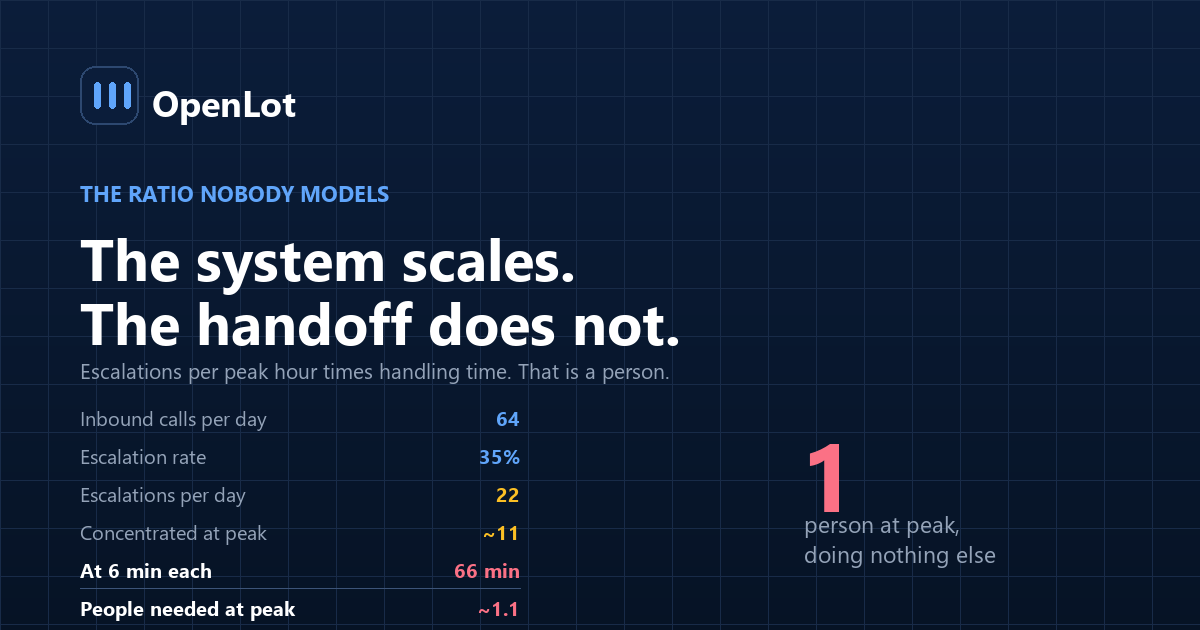
Inbound calls per day 64 Handled by the system 64 Escalation rate 35% Escalations per day 22 Concentrated in two peak hours ~11 of them Average escalation handling time 6 min People needed at peak ~1.1 One person, at peak, doing nothing else. If that person is also writing up a customer, the escalations queue and the fast system produces a slow outcome.
Run it with your own numbers. The common finding is that the escalation load at peak is roughly one full person, and that nobody has been assigned.
The ratio to plan against: escalations per peak hour × handling time, divided by sixty. Anything above 0.8 needs a dedicated person during those hours.
What scope actually works?
The same narrow scope that works everywhere, stated for the call centre case.
In: answering at peak and after hours, status and information requests, service booking and changes, capturing intent, routing, and taking a complete message.
Out: price, payment, trade, negotiation, complaints, anything ambiguous — the twelve triggers apply unchanged.
The addition that call centre framing suggests and should be resisted: outbound campaigns. The BDC phone job is narrower than a call centre and is covered in the BDC phone agent, with the staffing side in what an AI BDC costs. A dialler-style campaign against a lead list is a different activity with different obligations, and it is the highest-risk thing in the category — see outbound requirements.
Where do campaigns misfire?
1. Volume without consent granularity. A campaign list assembled from a CRM export rarely carries channel-specific, dated consent per record.
2. No contact-time window. A dialler runs until the list is finished, which means it runs into the evening in whatever time zone the next record happens to be.
3. The call connects and there is nobody to hand to. Outbound campaigns generate conversations in bursts, and the escalation ratio above applies with a much worse distribution.
4. Measured on dials, not on outcomes. The classic call centre metric, and it rewards exactly the wrong behaviour.
5. Aged lists treated as campaign fuel. The segmentation discipline in lead nurturing applies before any channel decision, and voice is the channel with the highest obligations.
What does good look like?
A dealership "AI call centre" that works is unglamorous:
- Answers every call, at peak and overnight
- Resolves the mechanical ones — status, hours, booking
- Escalates generously, with full context
- Has one named person per peak hour whose job is taking those escalations
- Does no outbound campaigning, or does it narrowly and with real consent records
- Is measured on answer rate and appointments, not on containment or handle time
That configuration produces a measurable gain in a store that is currently losing calls, and it produces very little in a store that is already answering nearly all of them.
What should you measure?
| Metric | How to compute | What it decides |
|---|---|---|
| Answer rate | Answered ÷ offered | The headline, and the honest one |
| Escalations per peak hour | Volume × escalation rate, bucketed | The staffing requirement |
| Escalation pickup time | Transfer → human answers | Whether staffing is sufficient |
| Appointments from calls | Count, against baseline | The business outcome |
| Containment rate | Resolved without a person | Context only — never a target |
| Repeat-call rate | Same number within 24h | The quiet failure |
Row five is listed so it can be explicitly deprioritised. Vendors report it because it is the metric their category grew up with, and at a dealership optimising it produces contained calls that did not become appointments.
Frequently asked questions
Does a dealership need an AI call centre?
It needs to lose fewer of the calls it already gets, which is a different goal from handling more. Call centre framing optimises throughput and deflection, and a store taking a modest number of high-value calls benefits from answering them rather than from containing them.
Why is containment rate the wrong metric for a dealership?
Because it is a cost metric from a high-volume context. A contained call that produced no appointment is a worse outcome than a transferred call that did, and optimising containment rewards the system for handling calls it should have passed to a person.
What is the escalation ratio and why does it matter?
Escalations per peak hour multiplied by average handling time, divided by sixty — the number of people the handoff requires during the busiest hours. The common finding is roughly one full person at peak, and that nobody has been assigned to it.
Should the system do outbound calling campaigns?
Rarely, and never as the first thing. Outbound campaigning carries consent, time-of-day and record-keeping obligations that inbound answering does not, and it generates conversations in bursts that make the escalation staffing problem considerably worse.
What should an AI call centre handle?
Answering at peak and after hours, status and information requests, service booking and changes, capturing intent, routing and taking complete messages. Price, payment, trade, negotiation, complaints and anything ambiguous should escalate.
Is average handle time a useful metric here?
No, and optimising it downward is actively harmful. A longer call with a buying customer is usually a better call, and the call centre instinct to compress handle time works against the outcome a dealership actually wants.
What happens if escalations are not staffed?
The fast system produces a slow outcome. Calls are answered immediately, escalated correctly, and then queue because the person who would take them is writing up a customer — which is worse than a slow answer, because an expectation was set and broken.
Where does this produce little value?
At a store already answering nearly all of its calls. The gain concentrates in calls currently going unanswered at peak, after hours and into unreturned voicemail, so a store with a high existing answer rate is buying consistency rather than coverage.
Conclusion
- A dealership has a loss problem, not a throughput problem. The framing imports the wrong goals.
- Containment and handle time are the wrong metrics, and both are what vendors report.
- Model the escalation ratio. It is usually about one person at peak and usually unassigned.
- Outbound campaigning is a different activity with different obligations. Not first.
- Measure answer rate and appointments. Everything else in the category is context.
Last updated: