An independent competing with a public group is not a smaller version of the same business. The advantages are structural and so are the disadvantages — and the useful question is not how to be bigger, but which of the four advantages technology now makes larger and which of the three disadvantages it genuinely reduces.
This guide covers the four structural advantages, the three real disadvantages, which gaps technology closes, which it does not, and what to measure.
The four advantages
1. Decision speed. An independent can change pricing strategy, buy a unit, or try a new tool in an afternoon. A group needs approvals, policy alignment and a rollout plan. In a market that moves, this is the largest advantage and it is frequently unused.
2. No policy floor. Group processes are designed to work acceptably at every store, which means they are optimised for the median rather than for yours. An independent can run a process that only works in its specific market.
3. Owner proximity. The person who decides is on the lot. Customers notice, employees notice, and problems get resolved in minutes rather than in tickets.
4. Acquisition flexibility. No franchise obligations, no OEM program constraints, no required floorplan relationships. The acquisition strategy can be opportunistic in ways a franchise cannot.
The three disadvantages
1. Capital. Floorplan terms, the ability to hold aged units, and the capacity to absorb a bad quarter. This is the real gap and technology does nothing about it.
2. Data volume. A group sees thousands of transactions a month across markets. An independent sees dozens. Any pricing or demand model built on your own data alone is working with a thin sample.
3. Vendor pricing. Groups negotiate. A single rooftop pays rate card, and frequently pays per-rooftop pricing designed for someone with twenty of them — the pattern covered in pricing models.
Which gaps has technology actually closed?
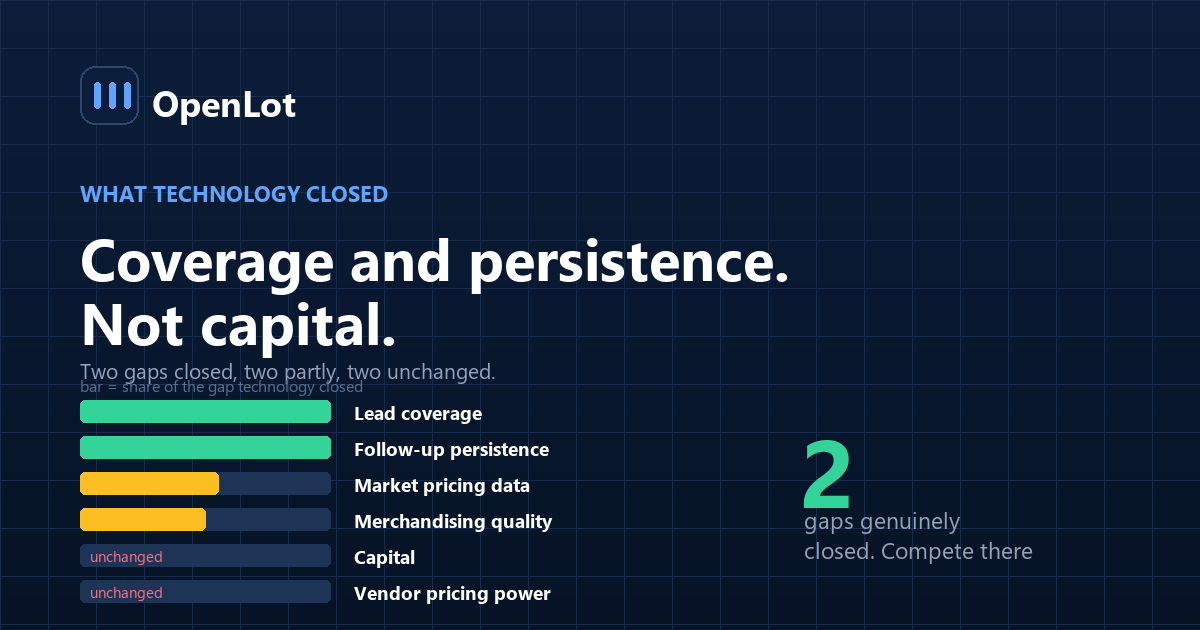
Gap Closed? What changed Lead coverage Largely Automation covers 168 hours at one store as easily as at twenty Follow-up persistence Largely Execution no longer depends on headcount Market pricing data Partly Third-party market data substitutes for scale, imperfectly Merchandising quality Partly Photo and description tooling is cheap now Capital No Unchanged Vendor pricing power No Arguably worse, with per-rooftop models The first two rows are the real story. A decade ago, an independent genuinely could not cover nights and weekends the way a staffed group BDC could. That specific gap is now closeable for a few hundred dollars a month, and it is the one worth closing first.
Where should an independent actually compete?
Not on inventory breadth or on price position. On three things the structure favours:
Speed of response. A group with a centralised BDC frequently has worse first-touch time than a well-run independent, because the lead routes through a call centre and back. An independent with after-hours coverage can genuinely be faster than the biggest competitor in the market.
Specificity. Group messaging is written to work in forty markets. Yours can mention the road, the weather, the local employer whose shift pattern explains why your customers shop at 9pm. This is unglamorous and it is the thing group marketing structurally cannot do.
Decision latency for the customer. A trade number that takes two hours at a group can take ten minutes at a store where the owner is standing there. That is a genuine product difference and worth saying out loud.
Where should an independent not compete?
On breadth of inventory. You will lose, and chasing it ties up capital you need for turn.
On price alone. A group can absorb a loss on a unit in a way you cannot, and a price war against someone with a stronger balance sheet has a predictable ending.
On being everywhere. Paid search against a group's budget in the same market is a bidding contest against someone with more money and better attribution.
On looking bigger than you are. Customers who want a group experience go to a group. The ones who come to you frequently came because you are not one.
What does this mean for buying software?
Three implications.
Buy for coverage and persistence first. Those are the gaps that actually closed, and they are closeable at single-rooftop budgets.
Do not buy the group's stack. Platforms built for groups carry group features and group pricing. The relevant question is which of the nine group features you are being charged for.
Protect decision speed. Any tool that adds an approval step, a configuration backlog or a vendor dependency is spending your largest structural advantage. If a change takes a week because support has to make it, the tool has made you slower than the group you were competing with.
What should you measure?
| Metric | How to compute | Against what |
|---|---|---|
| First-touch time, worst bucket | By day-part | The group's centralised BDC is beatable here |
| Coverage hours | Hours with any response capability ÷ 168 | Should approach 168 |
| Attempts per lead | From activity logs | Persistence, not headcount |
| Days to sale, by acquisition channel | Your own | Where flexibility is paying off |
| Time to change something | Decision to live | Your largest advantage, measured |
| Software cost per unit sold | Total ÷ units | Whether vendor pricing is eating the advantage |
Row five is the one nobody tracks and the one that matters most. If changing a price rule, a message or a process takes you more than a day, the structural advantage has been spent somewhere, usually on a vendor dependency.
Frequently asked questions
Can an independent dealer compete with a public group?
On some dimensions, structurally better. Decision speed, local specificity and the absence of a policy floor are genuine advantages. On capital and vendor pricing power the gap is real and technology does not change it, so the strategy is to compete where the structure favours you rather than where it does not.
Which competitive gaps has technology actually closed?
Lead coverage and follow-up persistence, largely. Covering 168 hours a week and executing a full follow-up cadence no longer depend on headcount, which removes two advantages a staffed group BDC used to have. Market data and merchandising quality are partly closed. Capital is not.
Where can an independent genuinely be faster than a group?
First response. A group routing leads through a centralised BDC frequently has worse first-touch time than a well-run independent with after-hours coverage, because the lead goes out and comes back. It is one of the few places where being small is mechanically an advantage.
What should an independent avoid competing on?
Inventory breadth, price alone, paid search saturation in the same market, and the appearance of being larger than you are. Each of those contests favours a stronger balance sheet, and customers who want a group experience are already going to a group.
Does an independent need the same software a group uses?
No, and buying it is a common and expensive mistake. Group platforms carry multi-store reporting, cross-rooftop inventory, permission hierarchies and per-rooftop pricing, none of which functions at a single location while all of it is in the price.
How does software affect decision speed?
It can spend it. A tool where changing a rule requires a support ticket converts an afternoon decision into a week, which is the independent's largest structural advantage given away. Any evaluation should include how a rule change is made and how long it takes.
What is the data disadvantage and can it be fixed?
A group sees thousands of transactions a month across markets and an independent sees dozens, so any model built on your own data alone has a thin sample. Third-party market data substitutes imperfectly, which narrows the gap without closing it.
What single metric shows whether the advantage is intact?
Time from decision to live — how long it takes to change a price rule, a message or a process. If that is longer than a day, the structural advantage over a group has been spent somewhere, usually on a vendor dependency nobody evaluated for it.
Conclusion
- Four advantages and three disadvantages, and they are structural rather than a matter of effort.
- Technology closed coverage and persistence. Those were real gaps and they are now affordable.
- It did not close capital or vendor pricing, and per-rooftop models made the second one worse.
- Compete on speed and specificity, not on breadth or price.
- Measure time from decision to live. It is the advantage, and it is the easiest to give away.
Last updated: