Comparing dealership AI offers on monthly price compares the wrong thing. The pricing model decides what you pay once the tool is working — and the most common model charges you more precisely when it starts succeeding, which is a structure worth recognising before signing rather than after.
This guide covers the five pricing models, which punishes growth, how to compare offers honestly, the questions to ask before signing, and what to measure.
The five models
| Model | You pay for | Cost as you grow | Fits |
|---|---|---|---|
| Flat monthly | Access | Flat | Predictable budgets, any size |
| Per seat | Each user | Rises with headcount | Stores with stable teams |
| Per lead or per conversation | Volume handled | Rises with success | Low-volume stores, cautiously |
| Per rooftop | Each location | Rises with stores | Groups, and it is where independents overpay |
| Usage-based (minutes, messages) | Consumption | Rises with activity | Voice and messaging, hard to forecast |
Flat monthly is the easiest to budget and the hardest to negotiate down. Per seat is predictable until you hire. The other three all have the same property: the bill grows as the thing works.
That is not automatically wrong — it aligns the vendor with usage — but it has to be modelled forward rather than evaluated on today's number.
Which model punishes growth?
Per-lead and usage-based, most sharply.
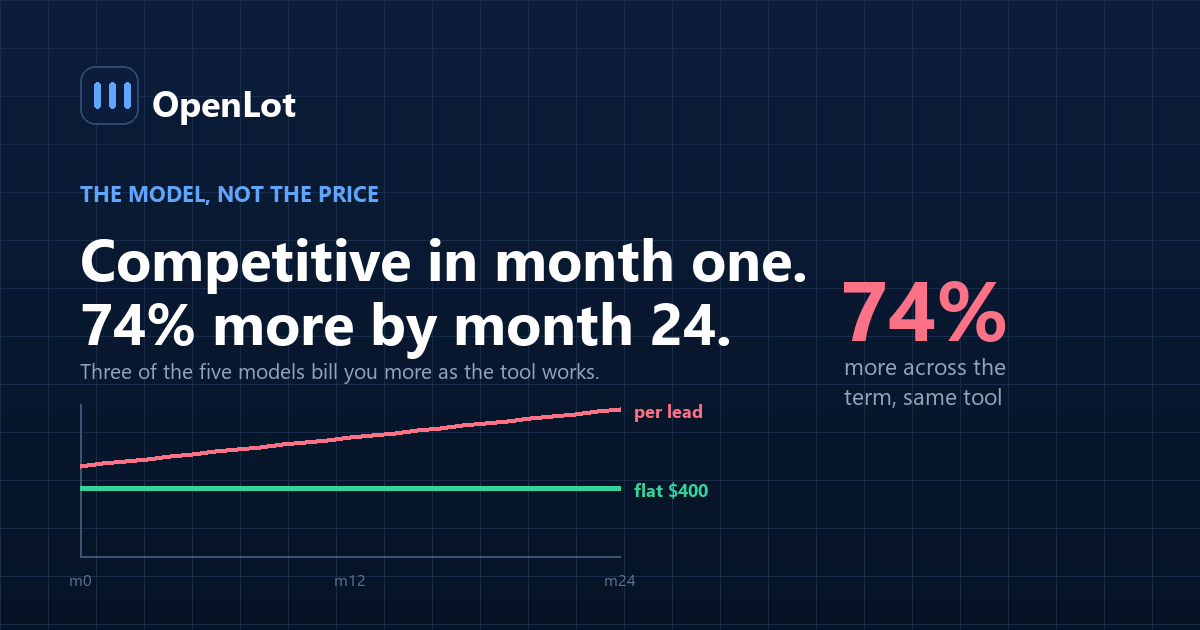
Same tool, two models, two years
Illustrative. Substitute your own volumes.
A store at 380 leads a month, growing to 620 over 24 months.
Flat $400/mo Per lead, $1.40 Month 1 $400 $532 Month 12 $400 $672 Month 24 $400 $868 24-month total $9,600 $16,700 The per-lead offer looked competitive in month one and cost 74% more across the term.
Reverse it, though: a store whose volume fell would pay less on per-lead and the same on flat. The model is a bet on direction, and the vendor is usually better informed about which way the category is going than the buyer is.
The practical rule: flat or per-seat when you expect to grow, per-lead when you are testing or shrinking.
How do you compare offers honestly?
Three steps, none of which is the monthly price.
1. Normalise to 24 months, at your own growth rate. Not today's volume. Your volume in month 24, at whatever growth you actually plan for.
2. Add everything outside the licence. Setup, integration, per-rooftop fees, minimum commitments, overage rates. The pattern is covered at length in the six costs the quote leaves out, and integration is routinely the largest.
3. Model the renewal. Ask what the increase has been for existing customers. A vendor that will not answer has answered.
Only then compare. A proposal that wins at month one and loses at month 24 is common enough that comparing on the headline is the single most expensive habit in dealership software buying.
What should you ask before signing?
| Question | What it reveals |
|---|---|
| "What is the single-rooftop price?" | Whether the pricing was built for a group |
| "What counts as a lead or a conversation?" | The definition drives the bill. Does a reply count? A duplicate? |
| "Is there a minimum commitment?" | Floors turn usage-based into flat, badly |
| "What is the overage rate?" | Where usage models get expensive fast |
| "What has the renewal increase been?" | The number nobody volunteers |
| "What is the notice period?" | How trapped you will be |
| "What does it cost to add a user?" | Per-seat models punish exactly when you hire |
The second question matters more than it looks. Under a per-conversation model, a duplicate record generating two conversations with the same human bills twice — which means CRM data quality is now a line on your invoice as well as a customer experience problem.
Where does "affordable" go wrong?
1. Comparing on month one. The whole subject above, and the reason a 20-question evaluation ends with commercial terms rather than starting with them.
2. Ignoring the minimum. A usage model with a floor is a flat model that can only go up.
3. Not defining the billable unit. "Per conversation" without a definition is an open-ended number.
4. Annual prepay for a discount on an unproven tool. The discount is real and so is the risk at this scale.
5. Treating integration as included. Rarely is, and frequently per rooftop.
6. Buying the cheapest thing that does not solve your leak. The cheapest tool addressing the wrong problem costs more than the right tool at full price — which is why measuring first precedes any pricing conversation.
What should you measure?
| Metric | How to compute | What it decides |
|---|---|---|
| 24-month total, at projected volume | Model it, do not quote it | The real comparison |
| Cost per unit sold | All software ÷ units | Whether the stack earns its place |
| Cost per incremental unit | Tool cost ÷ units above baseline | Whether a specific tool does |
| Billable units vs actual customers | Conversations billed ÷ unique people | Catches duplicate billing |
| Renewal increase, actual | Year two price ÷ year one | The number to track across vendors |
| Effective rate at overage | Overage charges ÷ overage units | Usually far above the headline rate |
Row four is the one almost nobody runs, and under per-conversation pricing it can be a meaningful share of the bill. Two records for the same human means two conversations, billed separately, for one customer.
Frequently asked questions
What pricing models do dealership AI vendors use?
Five: flat monthly, per seat, per lead or conversation, per rooftop, and usage-based on minutes or messages. Flat is easiest to budget, per seat rises with hiring, and the remaining three all increase as the tool succeeds, which has to be modelled forward rather than judged on month one.
Which pricing model is best for a growing dealership?
Flat monthly or per seat, generally. Per-lead and usage-based models charge more precisely as volume grows, so a store expecting growth pays substantially more over a two-year term than the month-one comparison suggests. Per-lead makes sense when testing a tool or when volume is falling.
How should two AI offers be compared?
Normalise both to a 24-month total at your own projected volume, add everything outside the licence including setup and integration and per-rooftop fees, and model the renewal increase. A proposal that wins on month one and loses over the term is common enough that headline comparison is the most expensive habit in this category.
What should I ask about per-conversation pricing?
What counts as a conversation. Whether a customer reply starts a new one, whether a duplicate record bills twice, and what the overage rate is beyond any included volume. Without a precise definition, per-conversation pricing is an open-ended number.
Do duplicate CRM records increase the bill?
Under per-conversation or per-lead pricing, yes. Two records for the same person generate two billable conversations for one customer, which turns data quality from an internal problem into a line on the invoice. Measuring unique customers against billed units is worth doing once.
Is an annual prepay discount worth taking?
For a proven tool, often. For an unproven one at a small store, the discount is rarely worth a twelve-month commitment to something that may not move the number it was bought for. Month-to-month first, annual once it has demonstrated something.
What is a minimum commitment and why does it matter?
A floor on usage-based pricing that guarantees the vendor a baseline regardless of consumption. It converts a usage model into a flat model that can only move upward, which removes the main advantage of usage pricing while keeping its unpredictability.
What is the single most useful number for software spend?
Monthly software cost per unit sold. It makes the whole stack comparable to any other expense, surfaces the question of whether it earns its place, and is simple enough to track monthly without building anything.
Conclusion
- The model matters more than the price. Three of the five bill you more as the tool works.
- Normalise to 24 months at your own growth rate, then compare.
- Define the billable unit in writing. "Per conversation" without a definition is open-ended.
- Duplicates bill twice under volume pricing. Data quality becomes an invoice item.
- Ask what the renewal increase has been. A vendor who will not answer has answered.
Last updated: