An AI integration touching deal and F&I systems raises a different set of questions from one touching leads. The data is more sensitive, the downstream consumers are regulated, and the useful conversation is about permission boundaries rather than about what the AI can do with the access.
Verify everything here with the vendors themselves. Platform capabilities, certification programmes and partner terms change, and configurations differ by dealership. This article is about what to establish and where the boundaries belong, not a description of any platform's current behaviour.
This guide covers why F&I data differs, what AI genuinely needs from it, the permission boundary, where these integrations break, and what to confirm.
Why is deal and F&I data different?
Three reasons, and they compound.
It is the most sensitive data in the store. Credit applications, financing terms and personal financial information sit in a different category from a phone number, and they are squarely within the scope of the Safeguards Rule obligations.
Its downstream consumers are regulated. Deal data feeds accounting, lender submissions and manufacturer reporting. An error does not stay local.
The useful AI applications are thin. This is the part worth saying plainly: there is far less a general AI layer needs from deal and F&I systems than vendors imply. Most dealership AI value sits in lead response, scheduling and inventory, none of which requires financing data.
What does AI genuinely need from here?
Honestly, very little, and the list is shorter than most proposals assume.
| Need | Genuinely required? | Why |
|---|---|---|
| Deal status — open, sold, delivered | Yes | To stop sequences on a sold customer |
| Delivery date | Yes | Post-sale follow-up timing |
| Vehicle sold, VIN | Yes | Service scheduling and future equity |
| Credit application content | No | No AI task at a dealership needs this |
| Financing terms and rates | No | Nothing customer-facing may quote them anyway |
| Payment amounts | No | And nothing should be allowed to state one |
| Lender decisions | No | — |
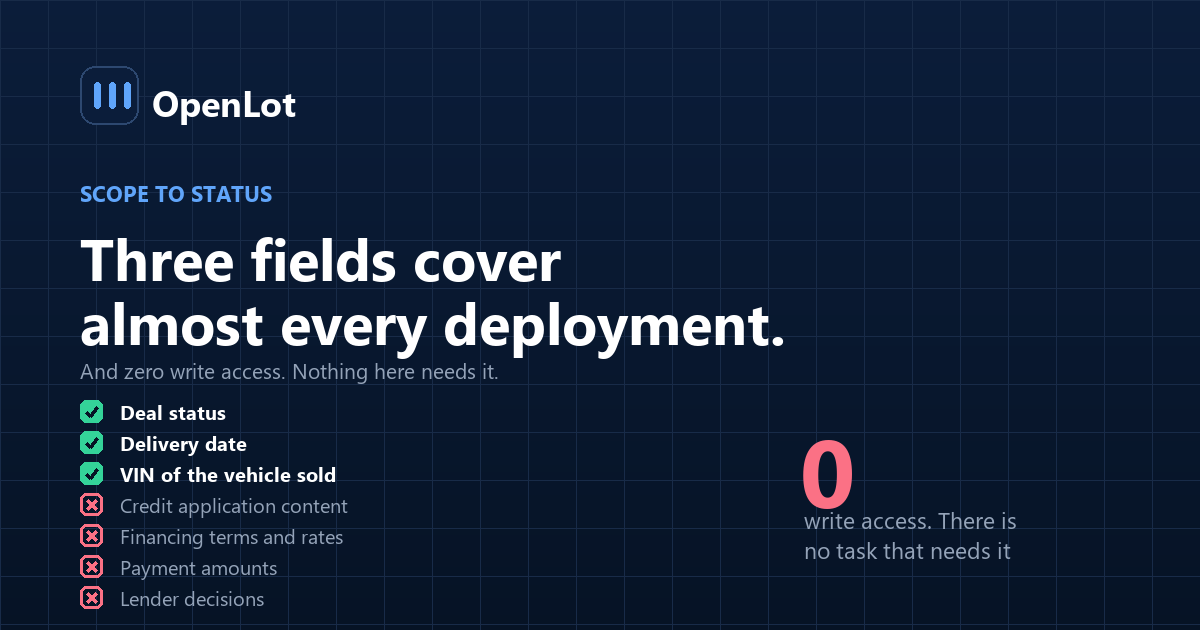
The first three are the whole list for almost every deployment, and they are status fields rather than financial content. An integration scoped to those three is a very different exposure from one granted access to the deal object.
The stop-on-sold case is worth highlighting because it is both the most valuable and the most commonly missing: a follow-up sequence still messaging a customer who bought last week is the fastest way to lose their service business — the stop-condition discipline from cadence design.
Where should the permission boundary sit?
Scope to status, not to content
Grant Do not grant Deal status, as an enumerated value The deal record Delivery date Credit application data VIN of the vehicle sold Financing terms, rates, payments Read only Any write access, at all The last row is close to absolute. There is no AI task at a dealership that requires writing to a deal or F&I record, and the downstream consequences of a wrong write — accounting, lender submissions, manufacturer reporting — are outside the vendor's awareness and outside your ability to undo.
If a proposal includes write access here, ask what specific task requires it. The answer is usually that the grant was requested at object level because narrowing was extra work.
Where do these integrations break?
1. Granted at object level. The default path, and it converts a status question into a financial-data exposure.
2. Write access included by default. Covered above, and it should be refused absent a specific named task.
3. Deal status not reaching the sequences. The most valuable single field, and the most common omission — sequences keep running after a sale.
4. Credit data in scope with no task needing it. Expands the service provider inventory and the breach surface for no benefit.
5. Subprocessors not named. The model provider and logging service behind the platform are also receiving whatever flows — the clause set in AI data security.
6. Certification or partner status assumed. Franchise stores in particular need this confirmed in writing rather than inferred — see franchise program constraints, and the path question in enterprise DMS integration. The write-scope principle is the one in read, write and what breaks.
What should you confirm before connecting?
| Item | Who answers |
|---|---|
| Exact fields read, enumerated | Vendor, in writing |
| That write access is zero | Vendor, in writing |
| Which subprocessors receive this data | Vendor |
| Whether the platform permits this integration at all | The platform provider |
| Partner or certification status, current | The platform provider |
| Whether your brand's approved list covers it | Factory rep, for franchise stores |
| Retention of any deal-derived data | Vendor contract |
Rows four and five are the ones that cannot be answered by the AI vendor alone. A proposal describing an integration the underlying platform does not permit is not a plan, and confirming it directly is a short conversation that prevents a long one.
What should you measure after connecting?
| Metric | How to compute | What it catches |
|---|---|---|
| Fields read vs fields granted | Actual against scope | Over-granting, which is the norm |
| Write attempts | Count | Should be zero |
| Sequences stopped on sale | Stopped ÷ sales | The valuable field, working |
| Post-sale messages sent | Messages to customers who bought | Should be zero, excluding post-sale sequences |
| Subprocessor list changes | Notifications received | The contract clause, exercised |
Row four is the customer-visible one. A customer who bought a car last Tuesday and received a "still interested?" message on Thursday has experienced the single most avoidable failure in dealership automation, and it is caused entirely by deal status not reaching the sequence engine.
Frequently asked questions
What does AI actually need from deal and F&I systems?
Three things: deal status so sequences stop when a customer buys, delivery date for post-sale timing, and the VIN of the vehicle sold for service scheduling and future equity work. Credit application content, financing terms, payment amounts and lender decisions are not needed by any common dealership AI task.
Should an AI integration have write access to deal records?
No. There is no common dealership AI task that requires it, and the downstream consequences of a wrong write reach accounting, lender submissions and manufacturer reporting — all outside the vendor's awareness and outside your ability to undo by disconnecting.
Why is deal status the most valuable field?
Because it stops sequences on customers who have already bought. A follow-up message asking whether someone is still interested, three days after they took delivery, is the most avoidable failure in dealership automation and is caused entirely by that field not reaching the sequence engine.
Why should credit data be excluded from scope?
Because no common AI task uses it, and including it expands both the service provider inventory and the breach surface for no benefit. Scoping to enumerated status fields rather than to the deal object is a substantially different exposure.
Who confirms whether an integration is permitted?
The platform provider, not the AI vendor. A proposal describing an integration the underlying system does not permit is not a plan, and confirming partner or certification status directly is a short conversation that prevents a much longer one.
Does a franchise store have extra checks here?
Yes. Approved vendor lists and data-sharing obligations under the franchise agreement both apply, and both should be confirmed in writing with the factory representative rather than inferred from the agreement text.
What should be measured after connecting?
Fields actually read against fields granted, write attempts which should be zero, the share of sequences correctly stopped on a sale, post-sale messages that should not have been sent, and whether subprocessor change notifications are actually arriving.
What is the most common scoping error?
Granting at object level because narrowing was extra work. That converts a question about three status fields into access to financial content, and it is usually discovered during a security review rather than at the point it was granted.
Conclusion
- Three status fields cover almost every deployment. Not the deal object.
- Zero write access. There is no common AI task that needs it here.
- Deal status is the valuable one — it stops sequences on customers who bought.
- Credit and financing content is out of scope because nothing needs it.
- Confirm permission with the platform provider, not with the AI vendor.
Last updated: