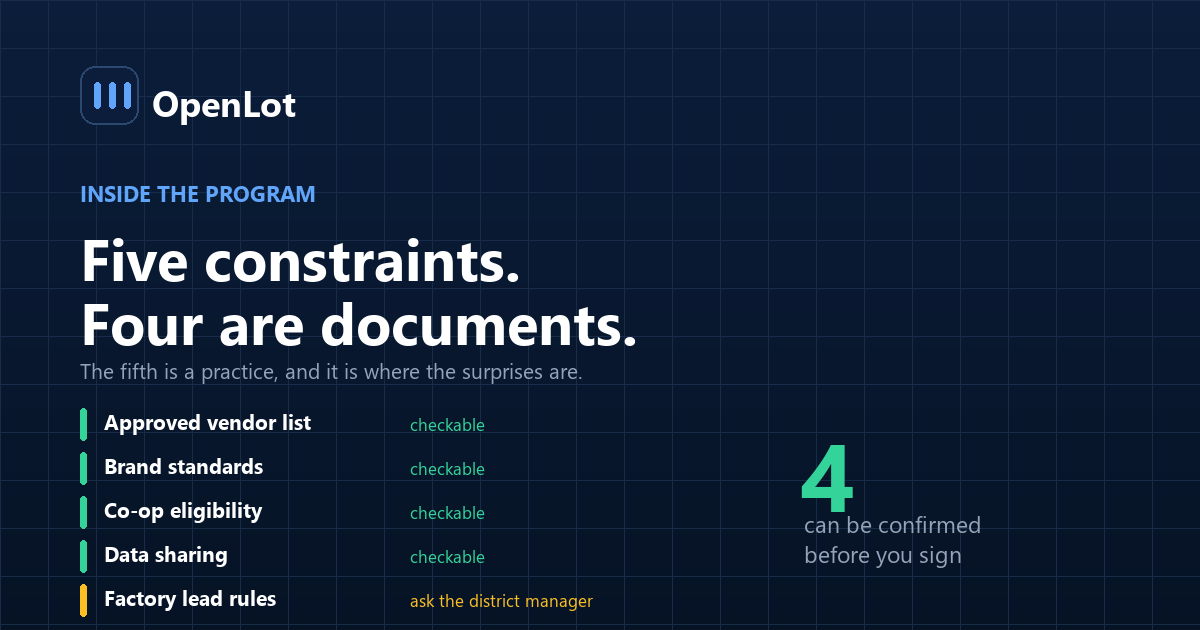
Franchise dealers evaluate AI inside constraints independents do not have. Five of them shape what is actually deployable — approved vendor lists, brand standards, co-op eligibility, data-sharing obligations and lead-source rules — and four can be confirmed before you sign rather than discovered in a program review.
This guide covers the five constraints, which are checkable in advance, how co-op funding changes the decision, where franchise deployments go wrong, and what to confirm.
The five constraints
| Constraint | What it governs | Checkable in advance? |
|---|---|---|
| Approved vendor list | Which products may touch brand systems or customer data | Yes — ask the factory rep |
| Brand standards | How the store may present itself in customer messaging | Yes — it is written down |
| Co-op eligibility | Whether the spend is reimbursable | Yes — the rules are published |
| Data sharing | What flows back to the OEM, and what may not leave | Yes — in your agreement |
| Lead source rules | How factory-sourced leads must be handled and reported | Partly — the practice differs from the document |
The first four are documents. The fifth is a practice, and it is the one that produces surprises — the stated rule and what the district manager expects are frequently not identical.
Approved vendor lists
The single most common blocker, and the easiest to check.
Most brands maintain a list of vendors certified to integrate with factory systems or to handle customer data in particular ways. A tool outside that list may still be usable for internal purposes, but frequently cannot touch the CRM the factory requires you to run — which removes most of its value.
Ask three things:
- Is this vendor on the current approved list for my brand?
- If not, what specifically are they prevented from doing?
- Is there an exception process, and how long does it take?
A vendor who cannot answer the first question about your brand has not sold into it before, and you will be the pilot.
Brand standards and messaging
OEM standards generally govern how the store presents itself in customer-facing communication — naming, visual identity, and in some cases how the brand may be referenced in automated messages.
The practical implications:
- Disclosure of automation interacts with brand voice requirements. Confirm the brand's position rather than assuming.
- Templates referencing model names and features may need to match factory language.
- Offers and pricing claims in automated messages are governed by advertising standards that apply regardless of the channel.
None of this prevents automation. It shapes the copy, and it means the message templates need a review step a single-rooftop independent would skip — one more reason the escalation and template discipline matters.
Co-op funding
This changes the arithmetic more than anything else on the list.
If a category of spend is co-op eligible, the effective cost may be substantially lower than the invoice. If it is not, the full cost sits with the store. Two tools of similar price can therefore differ enormously in real cost, and the difference is invisible on a comparison sheet.
What to establish before comparing
Question Why Is this category co-op eligible at all? Varies by brand and by year At what percentage? Changes the real comparison entirely Does the vendor need to be approved for eligibility? Frequently yes, which ties this to constraint 1 What documentation is required for the claim? Some vendors supply it; some do not Does eligibility depend on the message content? Advertising co-op often does Run two offers through this before comparing monthly price. A tool at a higher list price that is co-op eligible can be the cheaper choice by a wide margin — which is the franchise equivalent of the pricing model question.
Data sharing obligations
Franchise agreements typically specify what customer and transaction data flows to the OEM. Adding an AI vendor adds a party to that picture, and two questions follow:
What does the new vendor receive? This is the service provider inventory question covered in AI data security, with an additional party who has contractual expectations.
Does anything the vendor does conflict with the data obligations? Most commonly this arises around where data is stored and whether it may be used to train general models — a clause worth having regardless, and specifically relevant here.
Lead source rules
Factory-sourced leads frequently come with handling requirements: response time expectations, reporting obligations, and in some cases rules about who may respond.
The question to ask directly: may an automated system make the first response to a factory lead, and does it satisfy the response requirement? The answer varies by brand and it is not always documented. Ask the district manager rather than inferring from the agreement, because the practice is what gets measured in a review.
Where do franchise deployments go wrong?
1. Buying before checking the approved list. The most common and most expensive sequence.
2. Assuming co-op eligibility. It is checkable and frequently assumed instead.
3. Templates that do not clear brand standards. Discovered at a program review rather than before launch.
4. Automated responses to factory leads without confirming it satisfies the requirement. The response time improves and the compliance position may not.
5. Ignoring the district manager. The document and the expectation differ, and only one of them attends your review.
6. Treating franchise constraints as reasons not to automate. They shape the choice; they rarely prevent it. The coverage and persistence gains are available to franchise stores too.
What should you confirm before signing?
| Item | Who answers |
|---|---|
| Vendor on the approved list, currently | Factory rep, in writing |
| Exception process and timeline, if not | Factory rep |
| Co-op eligibility and percentage | Co-op administrator |
| Documentation the claim requires | Vendor and administrator |
| Automated first response to factory leads, permitted | District manager |
| Data flows and training restrictions | Your agreement, plus the vendor contract |
Get the first and fifth in writing. They are the two that come up in reviews, and a verbal yes from six months ago is not a record.
Frequently asked questions
Can franchise dealers use the same AI tools as independents?
Often, but inside five constraints independents do not have: approved vendor lists, brand standards for customer messaging, co-op eligibility, data-sharing obligations and factory lead-source rules. Four of the five are documented and checkable before signing.
What is an approved vendor list and why does it matter?
Most brands certify which vendors may integrate with factory systems or handle customer data in specific ways. A tool outside the list may still work for internal purposes but frequently cannot touch the CRM the factory requires, which removes most of its value. Checking first is the cheapest step in the process.
Does co-op funding apply to AI software?
It depends on the brand, the year and often the category and message content. Where it applies, it changes the real cost enough that a higher-priced eligible tool can be substantially cheaper than a lower-priced ineligible one — which makes eligibility a question to settle before comparing prices.
Can an automated system make the first response to a factory lead?
It varies by brand and it is not always written down. Ask the district manager directly rather than inferring from the agreement, because the practice is what gets measured at a program review and the document and the expectation are frequently not identical.
Do brand standards affect automated messages?
Yes. Naming, visual identity, model and feature language, and any pricing or offer claim are governed by standards that apply regardless of channel. This does not prevent automation; it means templates need a review step that a single-rooftop independent would skip.
What data questions arise when adding an AI vendor at a franchise store?
What the vendor receives, where it is stored, and whether it may be used to train general models. The franchise agreement already specifies what flows to the OEM, and an additional party handling the same data needs to be consistent with those obligations as well as with your own security programme.
Are franchise constraints a reason not to automate?
Rarely. They shape which vendor and which configuration, not whether. The coverage and follow-up persistence gains that matter most are available to franchise stores on the same terms, provided the vendor clears the approved list and the templates clear brand standards.
What should be obtained in writing?
Confirmation that the vendor is currently on the approved list, and confirmation that an automated first response satisfies the factory lead requirement. Those are the two items that come up in program reviews, and a verbal answer from six months earlier is not a record.
Conclusion
- Five constraints, four of them documents you can read before signing.
- The approved vendor list is the common blocker and the cheapest thing to check.
- Co-op eligibility can reverse a price comparison entirely. Settle it before comparing.
- Ask the district manager about factory leads. The document and the expectation differ.
- Constraints shape the choice, not the decision. The coverage gains are available to you too.
Last updated: