Automated test drive booking fails on copy far more often than on capability. Honest disclosure consistently outperforms a system trying to pass as human, because a failed impersonation reads as spam and ends the thread — while over-eager, interchangeable messages fail whoever sends them.
This guide covers the four properties of a message that gets replies, how to disclose honestly, the patterns that kill threads, what to do when the reply is not a yes, and what to measure.
What makes a booking message work?
Four properties. None of them is clever writing.
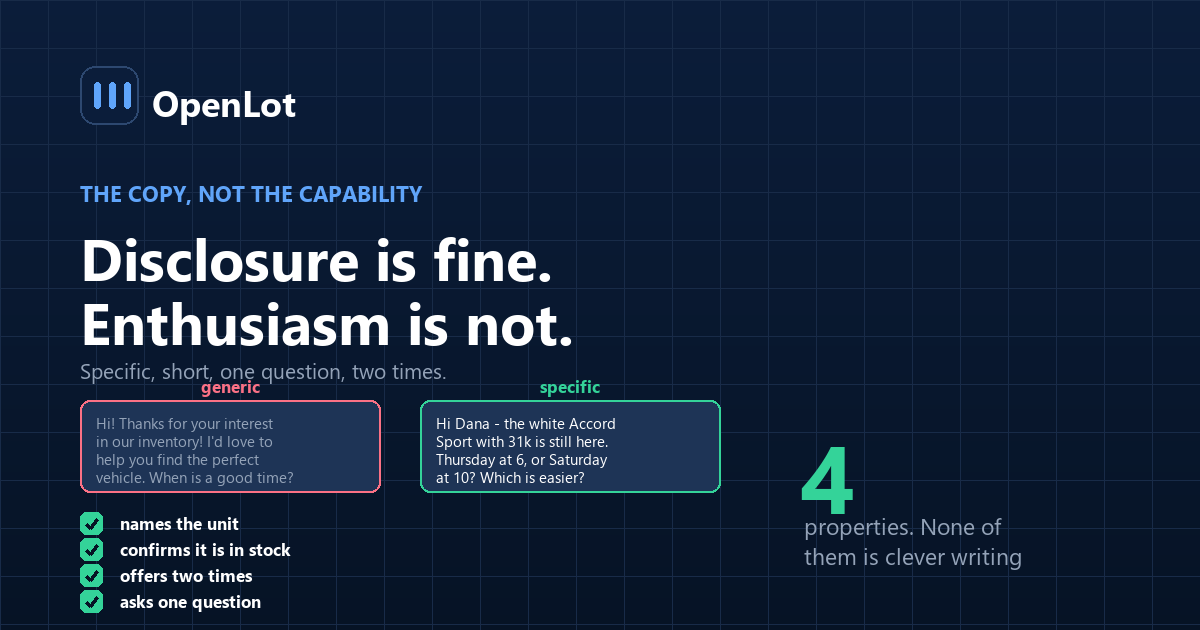
1. Specific to the vehicle. Not "the vehicle you enquired about." The year, the trim, something true about that unit — "the Accord Sport in white, the one with 31k on it." Specificity proves a human-equivalent read of their request, which is the thing generic copy cannot fake.
2. Short. Two or three sentences. Long messages read as marketing regardless of content.
3. One question. Covered at length in what four facts are needed — each additional question lowers the reply rate.
4. Two concrete times. Never an open calendar, never "when works for you?" A question with two answers is easier than a question with infinite ones.
The same message, two ways
Pattern Example ✗ Generic "Hi! Thanks for your interest in our inventory! I'd love to help you find the perfect vehicle. When would be a good time to connect?" ✓ Specific "Hi Dana — the white Accord Sport with 31k is still here. I can have it out front Thursday at 6, or Saturday at 10. Which is easier?" The second is shorter, names the unit, confirms availability, offers two times and asks one question. It is also obviously written for one person, which is the only thing that genuinely cannot be faked at scale by a bad template.
How should the system disclose itself?
Plainly, early, and without apology.
The evidence from deployments is consistent: customers who are told they are talking to an assistant continue the conversation at higher rates than those who work it out mid-thread. The damage comes from the discovery, not from the fact.
Three patterns that work:
- A named assistant with the store's name: "This is the assistant at Riverside Honda."
- An explicit human handoff: "I can get this booked for you, and Marcus will take it from there."
- Honest limits: "I can't quote pricing — Marcus handles that when you're in."
Three that do not:
- A human first name with no indication, which creates the discovery problem.
- Burying disclosure in a footer nobody reads.
- Over-apologising for being automated, which draws attention to it and reads as a weakness.
The general principle: the system should be obviously useful and obviously bounded. Customers accept both easily.
What kills a thread?
"Just checking in." Says nothing, asks nothing, and reads as a template — and it is most of why leads stop answering. If there is no new information, the message should at least carry a specific question.
Exclamation marks and enthusiasm. Over-eager copy is the single strongest tell of an automated message, and it is the thing customers actually dislike.
A price answer. Any number sent is treated as an offer. Acknowledge and redirect, as in the price deflection.
Five questions. Reply rate drops with each one, which is why four facts are enough. And the thread only matters if someone is briefed when they arrive — see the handoff.
A link as the first response. Discussed in why calendar links fail.
Messages at 2am. The system can respond at 2am to an inbound message — that is the point. It should not initiate at 2am, which is both a contact-time compliance question and a basic courtesy one. The obligations sit with the dealership regardless of vendor, per the Safeguards Rule framing.
What if the reply is not a yes?
Three common replies, three patterns that work.
"Still looking around." The worst response is pressure; the best is usefulness. Offer something concrete — a comparable unit, a note about what is arriving — and ask whether to keep them posted. A customer who says yes to that has given permission rather than a brush-off.
"What's your best price?" Covered above. Acknowledge, explain honestly, keep the appointment offer alive.
"I bought something else." Thank them, close the thread cleanly, and record it as a stop condition so no sequence contacts them again. Getting this wrong — continuing to message someone who bought elsewhere — is the fastest way to guarantee they never come back for service either.
The third one is worth stating plainly because the failure is common and entirely avoidable: a clean close is worth more than one more attempt.
What should you measure?
| Metric | How to compute | What it catches |
|---|---|---|
| Reply rate to first message | Replies ÷ sent | The headline number |
| Reply rate by message length | Split by sentence count | Usually favours short, measurably |
| Reply rate by question count | Split | One question wins |
| Specificity audit | Sample 50: does it name the actual unit? | Frequently fails |
| Thread-end triggers | Which message type preceded the last reply | Finds your own thread-killers |
| Opt-out rate by message pattern | Split | Catches over-eager copy early |
The fifth row is the most useful and the least run. Take the threads that went quiet, look at the last message the store sent, and categorise. The pattern is usually obvious within fifty threads and it is specific to your copy rather than to general advice.
Frequently asked questions
Should a dealership tell customers they are talking to AI?
Yes. Customers who are told continue the conversation at higher rates than those who work it out partway through, because the damage comes from the discovery rather than from the fact. A named assistant identified with the store, plus a clear handoff to a person, works well.
What makes an automated booking message get a reply?
Four things: it names the specific vehicle rather than referring to it generically, it is two or three sentences long, it asks a single question, and it offers two concrete times instead of an open calendar. None of these require clever writing.
What is the most common mistake in automated booking copy?
Over-eager, enthusiastic phrasing. Exclamation marks and generic warmth are the strongest tell of an automated message and the thing customers actually object to, far more than automation itself. Plain and specific outperforms friendly and generic.
How should the system respond to "what's your best price"?
Acknowledge the question, explain honestly that a final number comes from a person once trade and terms are known, and keep the appointment offer alive in the same message. Sending any figure creates a commitment the store has to honour, and ignoring the question loses the customer.
What should happen when a customer says they bought elsewhere?
Thank them, close the thread cleanly, and record a stop condition so no sequence contacts them again. Continuing to message someone who has already bought is the most reliable way to lose their service business as well as the sale that was already lost.
Can the system send messages at any hour?
It can respond at any hour, which is the point. It should not initiate outbound contact overnight, both because contact-time rules apply and because it reads badly. Responding to a 2am enquiry at 2am is good service; starting a conversation at 2am is not.
Does "just checking in" ever work?
Rarely. A message carrying no new information and no specific question reads as a template, which is exactly what it is. If there is nothing new to say, the message should at least ask something concrete, such as whether a specific alternative unit would be of interest.
How do we find what is killing our threads?
Take the conversations that went quiet, look at the last message the store sent before silence, and categorise them. A sample of fifty usually makes the pattern obvious, and the result is specific to your own copy rather than to general guidance.
Conclusion
- Disclosure helps. The damage comes from discovery, not from the fact of automation.
- Specific, short, one question, two times. That is the whole formula.
- Over-eager copy is the tell, and it is what customers actually dislike.
- A clean close beats one more attempt when someone says they bought elsewhere.
- Audit your own thread-killers. Fifty quiet threads will show you the pattern.
Last updated: