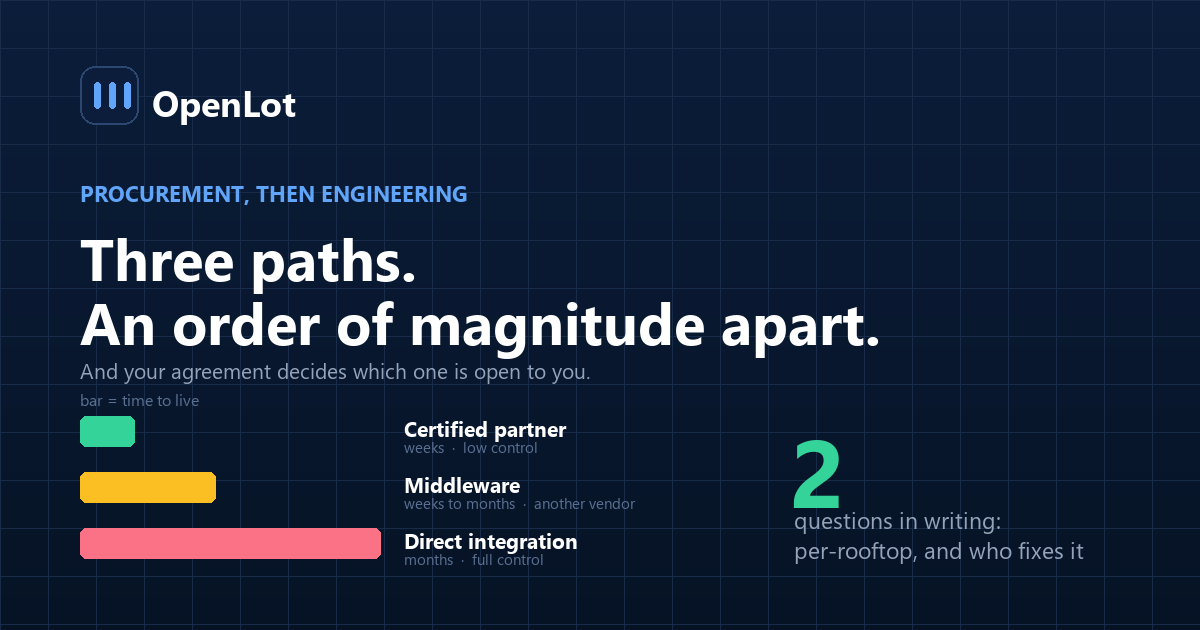
Integrating with an enterprise DMS is a procurement question before it is a technical one. Three paths exist and they differ by an order of magnitude in time and cost — and the path available to you is decided by your platform agreement rather than by what the AI vendor would prefer.
Verify everything here with the vendors themselves. Integration programmes, certification requirements, fee structures and partner terms change, and they differ by agreement. This article is about the shape of the decision and the questions to ask, not a description of any provider's current terms.
This guide covers the three paths, how each is priced and timed, what decides which is available, where enterprise integrations break, and what to establish.
The three paths
| Path | What it is | Time | Control |
|---|---|---|---|
| 1. Certified partner | The AI vendor is already integrated via the DMS provider's programme | Weeks | Low — the integration is what it is |
| 2. Direct integration | Built against whatever interface your agreement grants | Months | High |
| 3. Middleware | A third party sits between, already connected to both | Weeks to months | Medium, plus another vendor |
Path 1 is the fastest and the default when available. The trade is that the data scope is whatever the certified integration covers, which may be more or less than you need and is not negotiable per store.
Path 2 gives control and costs time. It is the right answer when the certified integration misses something you genuinely need, and the wrong answer when it is chosen because nobody checked whether path 1 existed.
Path 3 adds a party. Sometimes the pragmatic answer, and it means another service provider in your inventory, another contract with the five clauses, and another thing that can break silently.
How is each priced?
The pattern rather than the numbers, which change and differ by agreement.
| Cost element | Path 1 | Path 2 | Path 3 |
|---|---|---|---|
| Integration or programme fee | Usually, often per rooftop | Setup, one-time | Both, frequently |
| Ongoing connection fee | Common | Less common | Common |
| Build cost | None | Substantial | Low |
| Maintenance | Vendor's problem | Yours | Shared, unclearly |
Two things to establish early, in writing:
Per-rooftop charging. The most common budget surprise in a group, and it compounds — the pattern in pricing models.
Who maintains it when the DMS changes. Platform updates happen, and path 2 means the maintenance burden is yours permanently.
What decides which path is available?
Not the AI vendor's preference. Three things:
1. Your agreement. What interfaces and access your contract grants, which differs between dealerships on the same platform.
2. The vendor's status. Whether the AI vendor participates in the provider's integration programme at all. A vendor that cannot answer this about your platform has not done it before.
3. Your brand, if franchised. Approved vendor lists apply independently of what the DMS permits — the constraint set in franchise program rules.
All three are answerable in a week by asking the platform provider, your factory representative and the AI vendor the same question and comparing the answers. Comparing them matters: the answers do not always agree, and the disagreement is itself the finding.
Where do enterprise integrations break?
1. The path was assumed rather than confirmed. A proposal built on path 1 when the vendor is not in the programme is a proposal for path 2 at path 1 pricing.
2. Per-rooftop fees discovered at store two. Commercial, and entirely avoidable.
3. Scope mismatch with certification. The certified integration covers fields you do not need and misses one you do, and there is no negotiating it — which makes what you can export the fallback worth checking.
4. Maintenance ownership undefined. The DMS updates, something breaks, and two vendors each believe it is the other's responsibility.
5. Timeline assumed from a demo. Enterprise integration timelines are driven by procurement and certification rather than by engineering.
6. Write access scoped at object level. The risk discussed in read, write and what breaks, amplified by the number of downstream consumers an enterprise DMS has.
What should you establish before committing?
| Item | Who answers | Get it in writing |
|---|---|---|
| Which paths your agreement permits | Platform provider | Yes |
| Vendor's current programme status | Platform provider, and vendor | Yes |
| Fields covered by the certified integration | Platform provider | Yes |
| Per-rooftop fee structure | Platform provider | Yes |
| Who maintains it on a platform update | Both vendors, jointly | Yes |
| Realistic timeline, including procurement | Platform provider | Yes |
| Approved vendor list status | Factory rep, if franchised | Yes |
The fifth row is the one that produces the longest arguments later and takes the least time to settle now. "Who fixes it when the DMS updates and this stops working" is a question both vendors can answer in a sentence, and getting both sentences in writing costs nothing.
What should you measure?
| Metric | How to compute | What it catches |
|---|---|---|
| Actual timeline vs quoted | Weeks, both | Procurement reality |
| First-year cost vs quoted | All in, including per-rooftop | The commercial surprise |
| Fields needed vs fields covered | Gap analysis | Scope mismatch |
| Downtime after platform updates | Hours, per update | Maintenance ownership, tested |
| Time to resolve an integration fault | Report to fix | Which vendor actually owns it |
Row four is where the maintenance question stops being theoretical. The first platform update after go-live tells you whether the written answer to row five of the previous table was real.
Frequently asked questions
What are the paths for integrating AI with an enterprise DMS?
Three: via the DMS provider's certified partner programme where the AI vendor is already integrated, a direct integration built against whatever interface your agreement grants, or a middleware provider already connected to both. They differ substantially in time, cost and control.
Which path is fastest?
The certified partner route, where it is available, typically measured in weeks rather than months. The trade is that the data scope is whatever the certified integration covers and is not negotiable per dealership, which matters if it misses a field you genuinely need.
What decides which path is available?
Your platform agreement, the AI vendor's current status in the provider's programme, and — for franchise stores — the brand's approved vendor list. All three are answerable within a week by asking the platform provider, the factory representative and the AI vendor, and comparing the answers.
What is the most common commercial surprise?
Per-rooftop fees, discovered at the second store. It compounds across a group and it is entirely avoidable by establishing the fee structure in writing during the first negotiation rather than the second.
Who maintains the integration when the DMS updates?
That has to be settled in writing before committing, because it produces the longest arguments later and takes the least time to settle now. Both vendors can answer it in a sentence, and getting both sentences on paper costs nothing.
Why do enterprise integration timelines slip?
Because they are driven by procurement and certification rather than by engineering. A timeline estimated from a technical demo omits the part that actually takes the time, which is why the quoted and actual durations should be compared afterwards.
What if the certified integration does not cover a field we need?
Then the choice is between doing without it, building a direct integration for that gap, or adding middleware. Certified scope is generally not negotiable per dealership, so the decision is about whether the missing field justifies a slower and more expensive path.
Does middleware simplify things?
It can shorten the timeline and it adds a party. That means another contract with security and subprocessor clauses, another service provider in your inventory, and another connection that can fail silently — which is a real trade rather than a free shortcut.
Conclusion
- Procurement before engineering. The path available is set by your agreement, not by preference.
- Three paths, an order of magnitude apart in time and cost.
- Confirm the vendor's programme status with the platform provider, not with the vendor alone.
- Settle per-rooftop fees and maintenance ownership in writing before committing.
- The first platform update tests the maintenance answer. Measure the downtime.
Last updated: