Data portability is treated as an exit question and it is a purchase criterion. "Your data is yours" is true in every contract and means something different in each one — and the time to find out which meaning applies is while you still have leverage, not when you are leaving.
Verify terms with the vendors themselves. Export capabilities, formats, fees and contractual terms differ by platform and by agreement, and they change. This article is about what to establish and how to test it, not a description of any provider's current terms.
This guide covers the levels of portability, the six questions, how to test it while you can, where portability fails, and what to measure.
The levels of portability
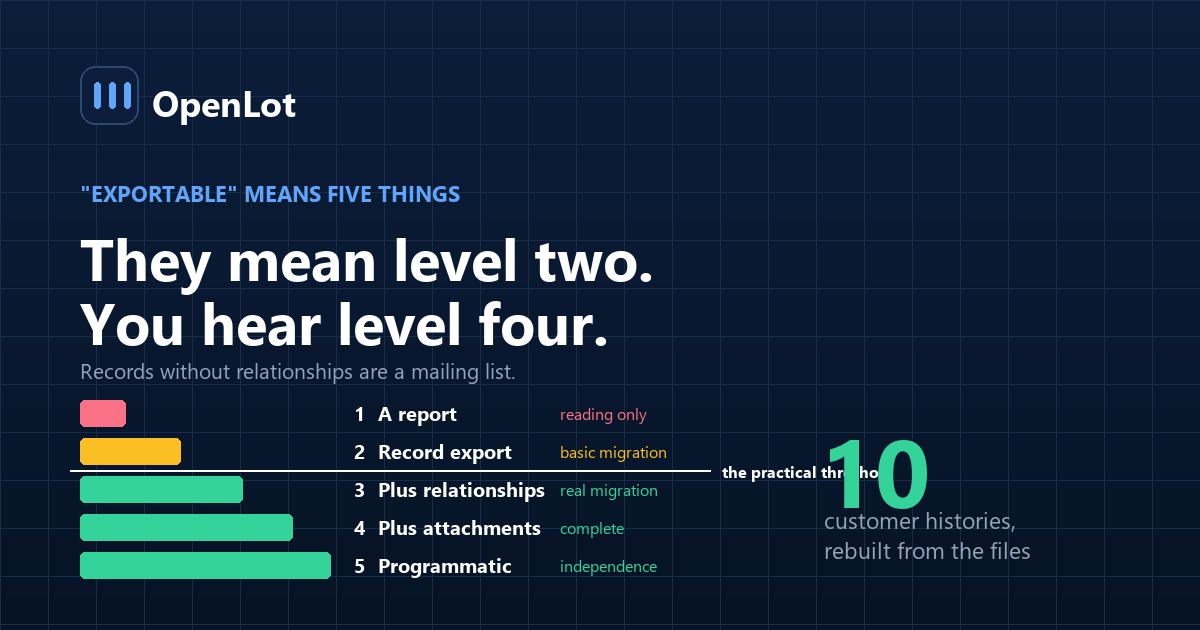
"Exportable" covers a wide range, and the differences matter enormously.
| Level | What you get | Usable for |
|---|---|---|
| 1. A report | Rows matching a screen | Reading. Not migration |
| 2. Record export | Objects, as flat files | Basic migration, with work |
| 3. Records plus relationships | Which activity belongs to which customer | Real migration |
| 4. Plus attachments and notes | Documents, photos, free text | Complete |
| 5. Programmatic, on demand | An API you can call whenever | Independence |
Most vendors mean level 2 when they say exportable and most buyers hear level 4. The gap between them is the difference between a migration that preserves history and one that starts over — the cost discussed in what to ask before migrating.
Level 3 is the practical threshold. Records without relationships are a list of customers and a separate list of activities with no way to connect them, which is close to useless for anything but a mailing list.
The six questions
Settle these before signing, not at renewal.
1. What level of export, specifically? Point at the table above and ask which row.
2. In what format? A proprietary format you cannot read without their software is not portability.
3. On demand, or on request? The difference between calling an API and emailing support and waiting.
4. How often, and at what cost? Some arrangements permit one export, or charge per extraction.
5. What is excluded? There is always something. Attachments, audit history, deleted records, system-generated notes.
6. What happens on termination? How long is the data available after the relationship ends, and what does retrieval cost then?
Question 6 is the one with the least leverage attached once you need it, which is exactly why it is a purchase-time question.
How do you test it while you can?
Run an export in month two, not in year four
Step What you learn Request a full export How long it takes, and through what channel Open the files without their software Whether the format is genuinely readable Pick ten customers and rebuild their history Whether relationships survived Look for attachments and notes What was silently excluded Count the records against the system What did not come Step three is the test. Rebuilding ten customers' full history from the export files — their activities, their appointments, their notes in order — takes an afternoon and tells you precisely which level you actually have.
Doing this in month two costs an afternoon. Doing it in year four, during a migration, costs the migration.
Why is this a purchase criterion?
Because it determines your position in every subsequent conversation.
Renewal. A vendor who knows you cannot leave prices accordingly. The escalation history question in pricing models is downstream of this one.
Capability gaps. A store that can export can add a tool alongside. One that cannot is limited to whatever the platform offers.
Continuity. If the vendor fails, is acquired or discontinues the product, your position is determined entirely by what you can extract — the exposure in the continuity plan.
Compliance. Responding to data requests and honouring deletion requires being able to find and extract specific records.
Where does portability fail?
1. Level 2 sold as level 4. The commonest, and the gap only appears during a migration.
2. Proprietary format. Technically an export, practically a dependency.
3. One-time export only. Fine for leaving, useless for running two systems.
4. Attachments excluded. Deal documents, inspection photos, signed forms — the records most likely to be needed later.
5. Audit history excluded. The compliance record, which is the one you most need to keep.
6. Tested at exit. By definition the moment of least leverage.
7. No contractual commitment. A capability that exists today and is not promised can be removed in a product update — the same clause discipline as in the five service provider clauses. It also matters most for the system that owns each object.
What should you establish in writing?
| Item | Why |
|---|---|
| Export level, explicitly | Levels 2 and 4 are different purchases |
| Format, named | Proprietary is not portable |
| On-demand access, or frequency permitted | Determines whether you can run parallel |
| Exclusions, enumerated | There are always some |
| Cost per export, if any | Including after termination |
| Availability window post-termination | The least-leverage moment |
| That the capability is contractual, not merely current | Product updates remove features |
The last row is the one people miss. A vendor whose platform currently supports a full export has not promised to continue doing so, and the clause that turns a feature into a commitment costs nothing to request at signature.
What should you measure?
| Metric | How to compute | What it catches |
|---|---|---|
| Export level achieved | Against the five-level table | What you actually have |
| Relationship reconstruction | Ten customers rebuilt from files ÷ 10 | The practical test |
| Records exported vs in system | Counts | Silent exclusions |
| Time to receive an export | Request to delivery | On demand, or not |
| Attachments included | Count, sampled | The common exclusion |
| Format readable without vendor software | Yes or no | Whether it is portability at all |
Row two is the whole exercise. A store that can reconstruct ten customers' complete histories from its own export files has genuine portability, and one that cannot has a report.
Frequently asked questions
What does data portability actually mean?
It ranges across five levels: a report matching a screen, a flat record export, records with their relationships intact, those plus attachments and notes, and programmatic access on demand. Vendors usually mean the second level and buyers usually hear the fourth.
What is the practical threshold for portability?
Records plus relationships. Without them you have a list of customers and a separate list of activities with no way to connect the two, which is close to useless for anything beyond a mailing list and certainly for a migration.
How do you test whether an export is real?
Run one in month two, open the files without the vendor's software, and try to rebuild ten customers' complete histories — activities, appointments and notes in order. That takes an afternoon and tells you precisely which level you have, while you still have leverage.
Why is portability a purchase criterion rather than an exit question?
Because it determines your position at every renewal, whether you can add tools alongside the platform, what happens if the vendor fails or is acquired, and whether you can respond to data and deletion requests. All of those are live questions long before you leave.
What is usually excluded from an export?
Attachments, audit history, deleted records and system-generated notes. Attachments and audit history are the two that matter most — deal documents and inspection photos on one side, and the compliance record on the other.
Is a proprietary export format portable?
Not meaningfully. An export you cannot read without the vendor's software is a dependency rather than portability, and the format should be named in the agreement rather than described as exportable.
Does a current export capability mean it will continue?
Not unless it is contractual. A feature that exists today can be changed in a product update, and the clause turning a current capability into a commitment costs nothing to request at signature and is impossible to obtain later.
What should be measured after an export test?
Which of the five levels you achieved, how many of ten customer histories could be reconstructed, record counts against the system to find silent exclusions, how long the export took to arrive, whether attachments came, and whether the files are readable without vendor software.
Conclusion
- Five levels, and "exportable" covers all of them. Ask which row.
- Records plus relationships is the practical threshold. Below it, you have a mailing list.
- Test in month two. Rebuild ten customer histories from the files. One afternoon.
- Attachments and audit history are the usual exclusions, and the ones most needed later.
- Make it contractual. A current capability is not a commitment.
Last updated: