Connecting AI to a DMS is two projects that get quoted as one. Read access is comparatively simple and low-risk; write access touches the system of record every other system trusts — and the five things it can damage are not recoverable by switching the integration off.
This guide covers why read and write differ, what write access can damage, how to scope permissions, where DMS integrations break, and what to measure.
Why are read and write different projects?
Because the DMS is the system every other system trusts.
Read means a connected system can see deal, inventory, service and customer data. The risks are about exposure — who can see what, where it is stored, who else receives it — and they are managed with contracts and a narrowed field scope, per the service provider clauses.
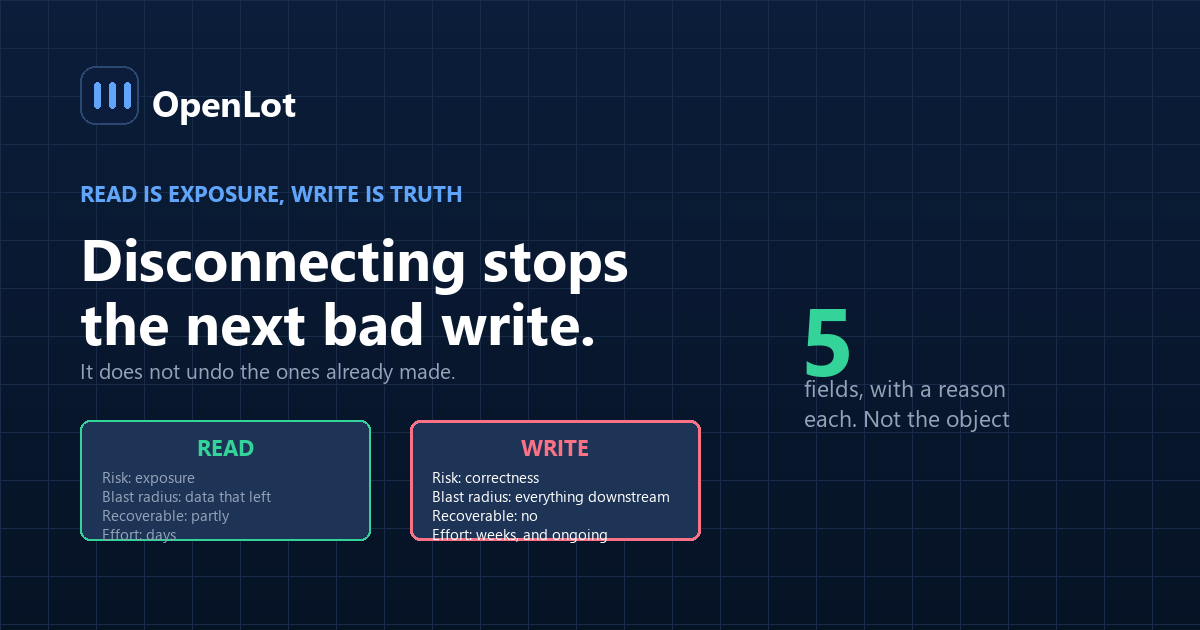
Write means a connected system can change what the DMS holds. The risks are about correctness, and the DMS is the source that your accounting, your reporting, your manufacturer submissions and every downstream tool depend on being correct.
| Read | Write | |
|---|---|---|
| Risk type | Exposure | Correctness |
| Blast radius | The data that left | Everything downstream |
| Recoverable by disconnecting? | The exposure, no. The ongoing risk, yes | No — the bad data stays |
| Scope needed | Narrow field list | Narrow field list plus validation and rollback |
| Typical effort | Days | Weeks, and ongoing |
The third row is the one that should change how write access is scoped. Switching off an integration stops it writing more bad data; it does not undo what was written.
What can write access damage?
Five things, in order of how long they take to notice.
1. Activity counts. A system logging every automated touch as an activity inflates reporting immediately. Managers lose the ability to see who is actually working, which is a quiet and complete loss of a management tool.
2. Customer records. Overwriting a phone number with one from a lead form, or a name with a differently formatted version, degrades records a person had curated.
3. Duplicate creation. A system that creates rather than matches produces the thing everyone is trying to avoid — see clean data first.
4. Deal and status fields. Changing a deal status automatically has consequences in accounting and in manufacturer reporting that are entirely outside the AI vendor's awareness.
5. Consent and opt-out state. The worst, because it is both a data error and an obligation failure. A system that overwrites an opt-out flag has created an exposure as well as a bad record.
How should permissions be scoped?
The narrow write set
Grant by field, not by object, and write down what each field is for.
Typically safe to write Typically not Activity log entries, tagged as automated Customer name and contact fields Appointment creation and changes Deal status Lead status, within a defined set Financial fields, anything Notes, in a dedicated field Consent and opt-out state Consent additions, never removals Anything accounting reads The left column covers almost everything an AI BDC genuinely needs. The right column is where damage happens and where a default "full write" grant quietly puts you.
Three controls alongside the field list: every automated write tagged as automated so it is distinguishable in reporting; validation before write; and a log of every write with its source, so a bad run can be identified even if it cannot be undone.
Where do DMS integrations break?
1. Granted whole-object write because narrowing was extra work. The default path, and the one that creates the exposure.
2. Automated writes indistinguishable from human ones. Reporting becomes unusable and nobody notices for a quarter.
3. No validation. A malformed value written once propagates to every downstream consumer.
4. Batch sync assumed to be real-time. The connection works and the data is yesterday's, which defeats every operational promise built on it — the disqualifier in what integration work contains.
5. Credentials held by a vendor or a departed employee. The ownership question that belongs in the handover clause.
6. Nobody notices when it stops. Integrations fail silently, and the discovery method is usually a gap in the data.
7. Per-rooftop pricing discovered at store two. Commercial rather than technical, and the most common surprise in a group — the path and fee structure is the subject of enterprise DMS integration.
What should you establish before connecting?
| Item | Why |
|---|---|
| Field-level read list | Not whole-record access |
| Field-level write list | Narrower still, and justified per field |
| Sync latency, as a number | Real-time or batch, stated in seconds |
| Automated-write tagging | So reporting stays usable |
| Write log with source | So a bad run is identifiable |
| Alerting on connection failure | Named recipient, not a dashboard |
| Credential ownership | In your accounts |
| Per-rooftop pricing | In writing, before store two |
The second row is the one to spend time on. A list of five writable fields with a reason each is a very different proposition from a grant of write access to the customer object.
What should you measure?
| Metric | How to compute | What it catches |
|---|---|---|
| Fields writable vs fields written | Granted against actually used | Over-granting, which is the norm |
| Automated activity share | Automated ÷ all logged activity | Whether reporting still means anything |
| Duplicates created by integration | New duplicates attributable to the connection | Matching logic failure |
| Integration downtime, unnoticed | Hours before anyone noticed | Whether alerting exists |
| Sync latency, actual | Measured, not quoted | Whether the operational promise holds |
| Consent-state writes | Count | Should be additions only |
Row one usually produces the most immediate improvement. Most integrations are granted far more write access than they use, and narrowing to what is actually written costs nothing and removes most of the risk.
Frequently asked questions
What is the difference between read and write DMS access?
Read lets a connected system see data, and its risks are about exposure, managed with contracts and a narrow field scope. Write lets a system change what the DMS holds, and its risks are about correctness — affecting accounting, reporting and every downstream tool that trusts the DMS to be right.
Can write damage be undone by disconnecting the integration?
No. Disconnecting stops further bad writes; it does not undo the ones already made. That asymmetry is why write access needs validation, logging and a narrow field list rather than being granted at the object level and monitored afterwards.
What can an AI integration damage with write access?
Activity counts, customer contact records, duplicate creation, deal and status fields with accounting and manufacturer-reporting consequences, and consent or opt-out state. The last is the worst because it is simultaneously a data error and an obligation failure.
What write access does an AI BDC actually need?
Usually: activity log entries tagged as automated, appointment creation and changes, lead status within a defined set, notes in a dedicated field, and consent additions but never removals. That covers nearly everything, and it is a much narrower grant than full write on the customer object.
Why does automated-write tagging matter?
Because without it, automated activity is indistinguishable from human activity in reporting. Managers lose the ability to see who is actually working, and the loss is complete and quiet — usually unnoticed for a quarter.
What happens if the sync is batch rather than real-time?
Every operational promise built on the integration fails, regardless of how good the system above it is. A unit sold this morning stays bookable, a lead from an hour ago has not arrived, and no amount of downstream capability compensates. Latency should be stated as a number in the scope.
Who should hold the integration credentials?
The dealership, in accounts the dealership controls. Credentials held in a departed employee's personal account break silently, and credentials held only by a vendor become a switching cost that is discovered at exactly the wrong moment.
What is the quickest risk reduction available?
Comparing fields granted for write against fields actually written. Most integrations are granted far more access than they use, and narrowing the grant to what is genuinely written costs nothing and removes most of the exposure.
Conclusion
- Two projects, quoted as one. Read is exposure; write is correctness.
- Disconnecting does not undo a bad write. That asymmetry decides how to scope it.
- Grant by field, with a reason each. Five fields, not the customer object.
- Tag automated writes, or reporting stops meaning anything within a quarter.
- Compare granted against used. The gap is free risk reduction.
Last updated: