Chat qualification fails on sequence more than on content. Four questions are worth asking and the order decides whether you get any of them — and the question most bots open with is the one most likely to end the conversation.
This guide covers the four questions, the order, what to never ask first, how to collect the rest, where qualification fails, and what to measure.
The four questions
Everything else can be collected later or inferred.
| # | Question | Why it earns its place |
|---|---|---|
| 1 | Which vehicle | Usually inferred from the page. Ask only if ambiguous |
| 2 | What they want to do next | Visit, more information, or hold it |
| 3 | When | Only once they have said they want to visit |
| 4 | How to reach them | The capture, and it comes last |
That is the list. Trade, financing, timeline, down payment, who else is deciding and credit position are all qualification the dealership wants and the visitor has no reason to provide to a widget.
The order
Where conversations end
Illustrative pattern. Read your own transcripts — the shape is consistent.
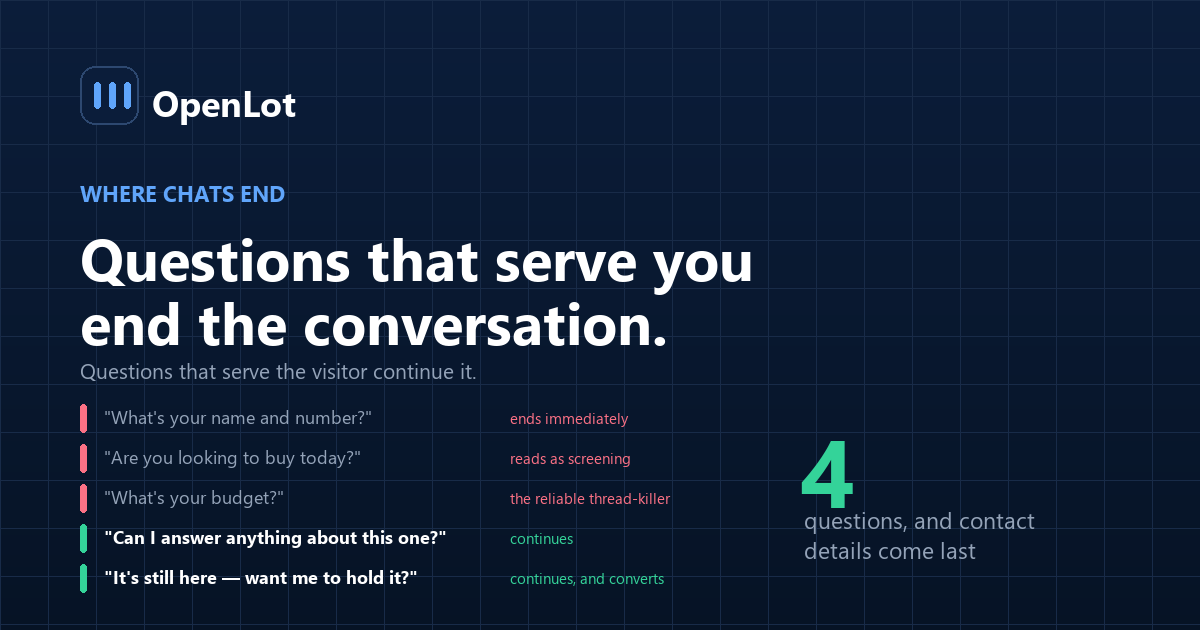
Opening question Typical outcome "What's your name and number?" Ends immediately. Asked before any value was given "Are you looking to buy today?" Ends often. Reads as a screening question "What's your budget?" Ends. The most common thread-killer "Can I answer anything about this one?" Continues "It's still here — want me to hold it for you?" Continues, and converts The pattern is that questions serving the dealership end conversations and questions serving the visitor continue them. Name and number serve the store. "It's still here" serves the visitor and produces the name and number two messages later.
Row five is the best-performing opening in the category because it answers the question the visitor actually has and offers something concrete.
The sequence that works: answer their question → offer something concrete → ask what they want to do → then capture.
Capture comes last, and it comes after value. Asked first, it is a toll gate; asked after an answer and an offer, it is the natural next step.
What should never be asked first?
Budget. The single most reliable way to end a chat. The visitor is looking at a car with a price on the page, and asking their budget implies the price is negotiable, that they are being sorted, or both.
Credit. Sensitive, and an escalation rather than a chat question.
Trade. It leads directly to "what's mine worth", which is a number the system must not produce — covered in why trade offers get rejected.
"Are you ready to buy?" Reads as a screening question, and the honest answer for most visitors is "not yet", which gives them a reason to leave.
How do you collect the rest?
After the appointment, not during the chat.
The confirmation sequence is the right place: a customer who has booked has a reason to answer, and the questions now have an obvious purpose — the structure in confirmation design.
| When | Collect |
|---|---|
| In chat | Vehicle, intent, timing, contact |
| In the confirmation | Trade, who is coming, anything the salesperson needs |
| At arrival | Everything else |
This sequence also produces better answers. A visitor typing into a widget gives a guess about their trade; the same person answering a confirmation message has looked at their paperwork.
Where does chat qualification fail?
1. Capture first. A toll gate before any value, and it ends the majority of conversations.
2. Budget early. The most reliable thread-killer in the category.
3. More than four questions. Each one sheds visitors, and the fifth onward rarely earns its place.
4. Asking what the page already answers. Which vehicle, on a vehicle page — the context failure in placement and intent.
5. Qualification as a scoring exercise. Collecting fields nobody acts on differently.
6. No concrete offer. "How can I help" is weaker than "it's still here, want me to hold it" — the prompt-copy point in chat that converts.
What should you measure?
| Metric | How to compute | What it tells you |
|---|---|---|
| Drop-off by question | Conversations ending after each question | Finds your own thread-killer |
| Questions asked before capture | Average | Should be two or three |
| Completion rate | Contact details obtained ÷ chats | The conversion job |
| Completion by opening message | Split by first message type | Which opening works |
| Chat-to-appointment | Appointments ÷ chats with details | The business outcome |
| Fields collected and never used | Audit | The scoring-exercise test |
Row one is the whole exercise and it takes an afternoon. Take fifty abandoned chats, note the last message the bot sent, and categorise. The thread-killer at your store will be obvious, and it is usually the second question rather than the first.
Frequently asked questions
What should a car sales chatbot ask?
Four things: which vehicle, if it is not obvious from the page; what the visitor wants to do next; when, once they have said they want to visit; and how to reach them. Trade, financing, budget and timeline belong after an appointment exists rather than during the chat.
What is the most common thread-killer in chat?
Asking about budget early. The visitor is looking at a car with a price displayed, and being asked their budget implies either that the price is negotiable or that they are being screened — and both give them a reason to leave.
When should contact details be collected?
Last, and after value has been provided. Asked first it functions as a toll gate and ends the majority of conversations; asked after a question has been answered and something concrete offered, it is the natural next step.
What is the best opening message?
Something that answers the question the visitor actually has and offers something concrete — confirming the vehicle is still available and offering to hold it, for example. Openings that serve the visitor continue conversations; openings that serve the dealership end them.
How many questions should a chat ask?
Two or three before capture, four in total. Each additional question sheds visitors, and the fifth onward rarely earns its place — particularly since the same information is easier to collect once an appointment exists.
Where should trade and financing questions go?
Into the confirmation sequence after an appointment is booked, or to the salesperson at arrival. A visitor typing into a widget guesses at their trade value; the same person answering a confirmation message has usually looked at their paperwork.
Should the bot ask which vehicle on a vehicle page?
No. The page answers it, and asking anyway signals that nothing is connected. The vehicle should be in the widget's context, along with price, mileage and current availability.
How do you find your own thread-killer?
Take fifty abandoned chats, note the last message the bot sent before silence, and categorise them. The pattern is obvious within an afternoon and it is specific to your copy — and it is usually the second question rather than the first.
Conclusion
- Four questions. Vehicle, intent, timing, contact — and contact comes last.
- Questions serving the dealership end conversations. Questions serving the visitor continue them.
- Budget is the reliable thread-killer. It implies screening or a negotiable price.
- Collect the rest in the confirmation, where the answers are better anyway.
- Find your own thread-killer. Fifty abandoned chats, one afternoon.
Last updated: