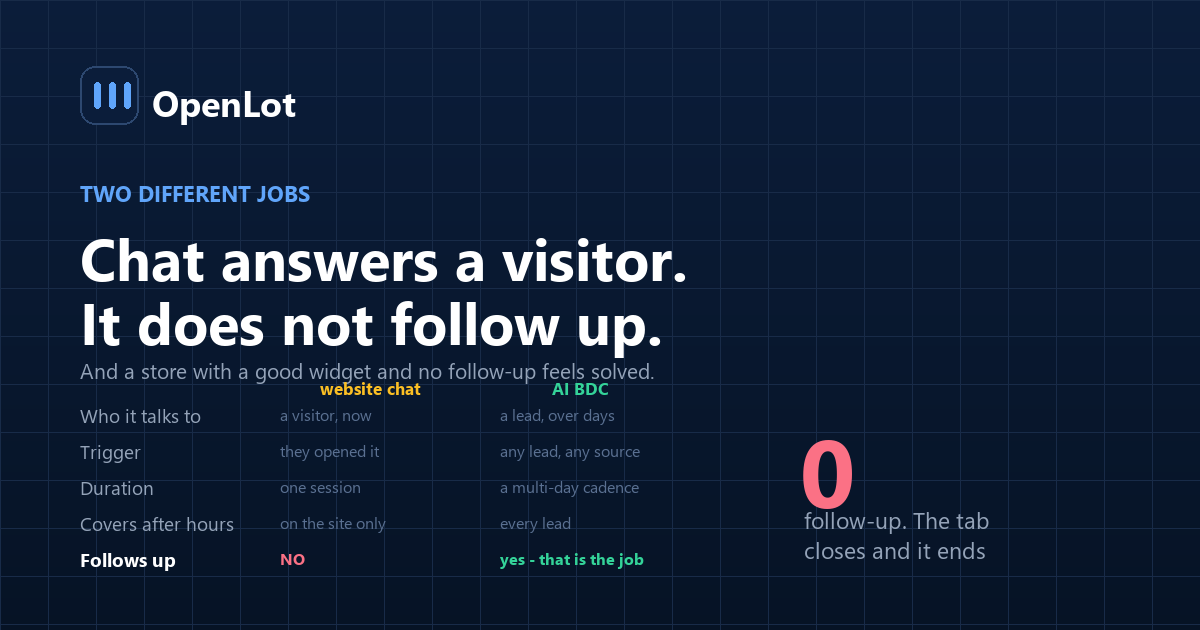
A website chatbot answers someone already on your site, which is a narrower job than the category implies. It is not an AI BDC, and conflating the two is why stores conclude they already have AI — the widget answers questions during a visit, and nothing is working the lead afterwards.
This guide covers what chat actually fixes, how it differs from an AI BDC, the four places it fails, where the categories blur, and what to measure.
What does website chat fix?
Four things, and they are all about a visitor who is currently on the site.
1. The question that blocks a form. "Is it still available?", "does it have a third row?", "what's the mileage?" A visitor with an unanswered question frequently leaves rather than submitting.
2. Capture of someone who would not have filled a form. Chat converts a share of visitors who find forms too committal. That share is real and it is the core argument for the category.
3. After-hours presence on the site. A visitor at 11pm gets an answer instead of a contact form.
4. Intent signal. What people ask in chat is the single best record of what your inventory listings fail to say — and almost nobody reads it.
The fourth is the most under-used output of a chat deployment. A month of chat transcripts tells you exactly which information is missing from your vehicle pages, which is a merchandising fix rather than a chat one.
How is this different from an AI BDC?
The distinction decides whether a store has a gap it does not know about.
| Website chat | AI BDC | |
|---|---|---|
| Who it talks to | A visitor on the site, now | A lead, over days |
| Trigger | They opened the widget | A lead arrived from any source |
| Duration | One session | A multi-day cadence |
| Covers after hours? | On the site only | Every lead, every source |
| Follows up? | No | Yes — that is the job |
The row that matters is the last one. A chatbot does not follow up. When the visitor closes the tab, the conversation ends unless something else picks it up.
This is the specific confusion that leaves stores exposed: a dealership with a good chat widget and no follow-up automation has covered the on-site moment and left the 99 uncovered hours of lead follow-up untouched, while believing the problem is solved.
Where does chat fail?
1. It answers what it should escalate. Price, payment, trade and availability it cannot verify — the same boundary as everywhere, enforced the same way, through capability limits rather than instructions.
2. The chat ends and nothing happens. The visitor gave a name and a question and nothing picks it up. The single most common failure.
3. It annoys more visitors than it helps. Proactive prompts, repeated popups, and a widget that covers the photos — the subject of chat that converts versus chat that annoys.
4. It does not know the vehicle. A chat on a vehicle page that cannot see which vehicle is a generic contact form with a conversational interface.
Where do the categories blur?
Three products are sold under similar names and do different things.
Rules-based chat follows a decision tree. Predictable, cheap, and unable to handle anything the tree does not anticipate — the comparison in rules-based versus conversational.
Conversational chat handles arbitrary phrasing in the session. Better at the conversation and worse at predictability.
A messaging layer continues across channels and sessions — web to text to phone, the same thread. This is where chat starts overlapping with the BDC job, and it is the one worth paying attention to, per one thread, many apps.
Ask which of the three any proposal actually is. The answer changes what you should expect from it.
What should you measure?
| Metric | How to compute | What it tells you |
|---|---|---|
| Engagement rate | Chats started ÷ sessions | Whether anyone uses it |
| Completion rate | Chats producing contact details ÷ started | The conversion job |
| Escalation accuracy | Price and availability questions escalated correctly | The boundary |
| Post-chat follow-up rate | Chats followed up ÷ chats with contact details | Usually the worst number |
| Chat-to-appointment | Appointments ÷ chats with details | The business outcome |
| Top unanswered questions | Categorised from transcripts | The merchandising fix |
Row four is the one that exposes the gap. A store with strong engagement and near-zero follow-up has bought a conversation and discarded the lead it produced.
Row six costs an afternoon and frequently produces the highest-return finding in the whole deployment: the five questions people ask most are five things missing from your vehicle pages.
Frequently asked questions
What does a dealership website chatbot actually do?
It answers questions from a visitor who is currently on your site, captures a share of people who would not fill in a form, provides a presence after hours on the site itself, and records what visitors ask — which is the best available signal of what your vehicle listings fail to say.
Is a chatbot the same as an AI BDC?
No, and confusing them is why stores believe they already have AI coverage. A chatbot talks to a visitor during one session on the site. An AI BDC works a lead across days, from every source, including the leads that never visited the site at all.
What happens when a chat conversation ends?
In most deployments, nothing — which is the single most common failure in the category. A visitor who gave a name and a question is a lead, and unless something picks it up afterwards the conversation was a cost rather than a conversion.
Should a chatbot answer price questions?
No. Price, payment, trade value and availability it cannot verify are commitments, and the enforcement should be a capability limit rather than an instruction. A widget that cannot produce a currency figure will not produce one regardless of how the question is phrased.
What is the most under-used output of a chat deployment?
The transcripts. A month of chat questions tells you exactly which information is missing from your vehicle detail pages, which is a merchandising fix rather than a chat one and frequently returns more than the chat product itself.
What are the three products sold as chatbots?
Rules-based chat following a decision tree, conversational chat handling arbitrary phrasing within a session, and a messaging layer that continues across channels and sessions. They have different capabilities and different prices, and any proposal should be identified as one of the three.
Does a chatbot need to know which vehicle the visitor is looking at?
Yes. Chat on a vehicle detail page that cannot see the vehicle is a generic contact form with a conversational interface, and the visitor notices immediately when they are asked which car they are enquiring about on the page for that car.
What is the single number that exposes a chat gap?
Post-chat follow-up rate: the share of chats producing contact details that were actually followed up. Strong engagement with near-zero follow-up means the store bought a conversation and discarded the lead it generated.
Conclusion
- Chat answers someone already on your site. That is narrower than the category implies.
- It does not follow up. When the tab closes, the conversation ends unless something else picks it up.
- A good widget plus no follow-up leaves the real gap untouched while feeling solved.
- Three different products share the name. Ask which one a proposal is.
- Read the transcripts. The five most common questions are five gaps in your listings.
Last updated: