Customers move between channels without thinking about it, and dealership systems treat each move as a new conversation. One customer becomes three threads, none of which knows about the others — and the consent that governs each of them does not transfer either, which turns an inconvenience into an obligation problem.
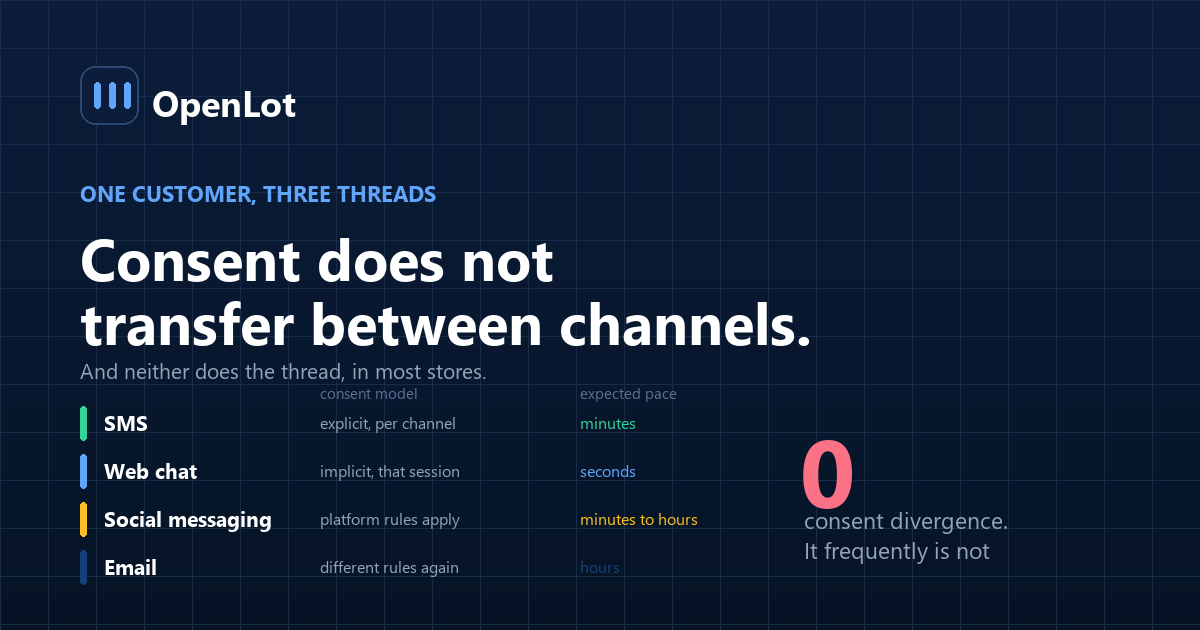
This guide covers the four channels and their differences, what unification requires, why consent does not transfer, where it breaks, and what to measure.
The four channels
| Channel | Who starts it | Consent model | Latency expected |
|---|---|---|---|
| SMS | Either | Explicit, per channel | Minutes |
| Web chat | Visitor | Implicit for that session | Seconds |
| Social messaging | Customer | Platform rules apply | Minutes to hours |
| Either | Different rules again | Hours |
The important column is the third. Consent does not transfer between channels, and neither do the rules governing them. A customer who opted in to texts has not opted in to social messaging, and a platform's own messaging policies apply regardless of what the customer told you — the per-channel principle in SMS compliance.
The fourth column explains most customer frustration. A visitor in web chat expects an answer in seconds; the same person emailing expects hours. A unified system has to carry the thread and respect each channel's expected pace, which is a design requirement rather than a detail.
What does one thread require?
Four things, and the first is the foundation.
1. Identity resolution. A phone number, a web session, a social account and an email address resolving to one person. Without it, unification is impossible regardless of what the interface shows.
2. One conversation store. Every channel writes to the same thread rather than to per-channel logs. If the data exists in four places and a screen assembles it visually, that is a view rather than a thread — and the AI layer reading it will see whichever source it was connected to.
3. Per-channel consent, carried with the thread. One conversation, four consent states, each checked before sending on that channel.
4. Channel-appropriate behaviour. Same context, different pace and different length. A message that works as a text is too terse as an email.
Point 3 is the one that distinguishes a serious product. A unified thread that treats consent as a single flag has unified the conversation and broken the obligation.
The test
Step What it shows Chat on the site, ask a question — Text the number from the confirmation Does it know? Message the dealership's social account Does it know? Reply to the email that followed Does it know? Opt out by text, then check the other three The consent question Step five is the one that matters most and is almost never tested. A customer who texts STOP should not receive a social message the following week, and whether that works is a property of the system rather than of anyone's intentions.
Why does consent not transfer?
Because the channels are governed differently and the customer's expectation differs with them.
A customer who gave you a phone number for appointment reminders has consented to that, on that channel, for that purpose. Treating it as general permission to message them anywhere is both an obligation problem and a reliable way to produce an opt-out across everything.
The practical rule: consent is per channel and per purpose, and an opt-out on any channel is a signal about all of them. Not a legal equivalence — a signal, and one worth acting on, because a customer who asks you to stop texting has told you something about how they want to be contacted.
Where does unification break?
1. Separate products per channel. Chat from one vendor, texting from another, social handled in a browser tab. No shared identity and no shared thread.
2. A view rather than a thread. The screen assembles four sources and the automation reads one.
3. Consent as a single flag. Unified the conversation, broke the obligation.
4. Same message, every channel. Length and tone that work as a text read badly as an email.
5. Social messaging handled by whoever notices. Frequently marketing rather than sales, with no CRM record.
6. No identity resolution. The foundation, and its absence caps everything else — the matching rules problem again.
7. Latency expectations ignored. A two-hour reply to a web chat and a two-minute reply to an email are both wrong — and the thread that should carry across them breaks in five specific places. Whether a person or a system answers on each channel is the routing question.
What should you measure?
| Metric | How to compute | What it catches |
|---|---|---|
| Threads per customer | Distinct threads ÷ unique customers | Should approach one |
| Cross-channel continuity rate | Threads continuing across channels ÷ cross-channel customers | The headline |
| Consent-state divergence | Opt-out on one channel, active on another | Should be zero |
| Response latency by channel | Median, per channel | Whether pace is respected |
| Social messages with a CRM record | Recorded ÷ received | Usually the worst channel |
| Identity match rate | Resolved to one person ÷ interactions | The foundation |
Row three should be zero and frequently is not. It is a single query across your messaging systems and it finds the customers currently being contacted on a channel after asking you to stop on another — which is both the obligation exposure and the most avoidable complaint in the category.
Row five is usually the surprise. Social messages are often handled outside the CRM entirely, which means a share of your conversations has no record at all.
Frequently asked questions
What does unified dealership messaging require?
Four things: identity resolution matching a phone number, web session, social account and email to one person; a single conversation store every channel writes to; per-channel consent carried with the thread; and channel-appropriate behaviour, since pace and length differ.
Does consent transfer between messaging channels?
No. A customer who gave a phone number for appointment reminders consented on that channel for that purpose, and treating it as general permission is both an obligation problem and a reliable way to produce an opt-out from everything.
Should an opt-out on one channel stop the others?
In practice, yes. It is not a legal equivalence but it is a clear signal about how the customer wants to be contacted, and continuing on another channel after being asked to stop on one is the most avoidable complaint in this area.
What is the difference between a unified view and a unified thread?
A view assembles several sources on a screen for a person to read. A thread is a single store every channel writes to. The distinction matters because automation reads the data rather than the screen, and will see whichever source it was connected to.
How do you test whether messaging is actually unified?
Start a web chat, then text the number from the confirmation, then message the social account, then reply to the follow-up email — checking at each step whether the system knows. Then opt out by text and check whether the other three stopped.
Why is social messaging usually the weakest channel?
Because it is frequently handled outside the CRM by whoever notices it, often in marketing rather than sales. A share of those conversations has no record at all, which means they are invisible to every other system and to any follow-up.
Should the same message be sent on every channel?
No. Length and tone that work as a text read badly as an email, and the expected response pace differs by channel too. The context should be shared and the expression should be channel-appropriate.
What is the single most important measurement?
Consent-state divergence — opt-outs recorded on one channel while another remains active. It should be zero, it is a single query to run, and it finds the customers currently being contacted after they asked you to stop.
Conclusion
- Four channels, four consent models, and consent does not transfer between them.
- Identity resolution is the foundation. Without it, nothing else unifies.
- A view is not a thread. Automation reads the data, not the screen.
- An opt-out anywhere is a signal about everywhere. Act on it.
- Measure consent-state divergence. Zero, and it frequently is not.
Last updated: