Live chat and AI chat are usually compared as alternatives and work better as a routed pair. The routing rule most stores use is the hour of day, and it is the weakest of the four available — better rules exist, they are cheap to implement, and they produce a different allocation entirely.
This guide covers the three options, the four routing rules, the hybrid configuration, where it breaks, and what to measure.
The three options
| Live chat, in-house | Outsourced chat | AI chat | |
|---|---|---|---|
| Cost shape | Staff time, interrupting other work | Per chat or per lead | Licence |
| Coverage | When someone is watching | Contracted | Always |
| Knows your inventory | Yes | Variably | If integrated |
| Handles the unexpected | Yes | Moderately | Poorly |
| Response latency | Minutes, if distracted | Fast | Seconds |
| Fails at | Attention and consistency | Context | Ambiguity |
The in-house row deserves a specific note. Live chat is almost never someone's only job at a dealership, which means the real comparison is not "a person versus AI" but "a person who is also doing something else versus AI" — and the something else is usually why the chat sat unanswered for four minutes.
The four routing rules
Ranked by how well they allocate
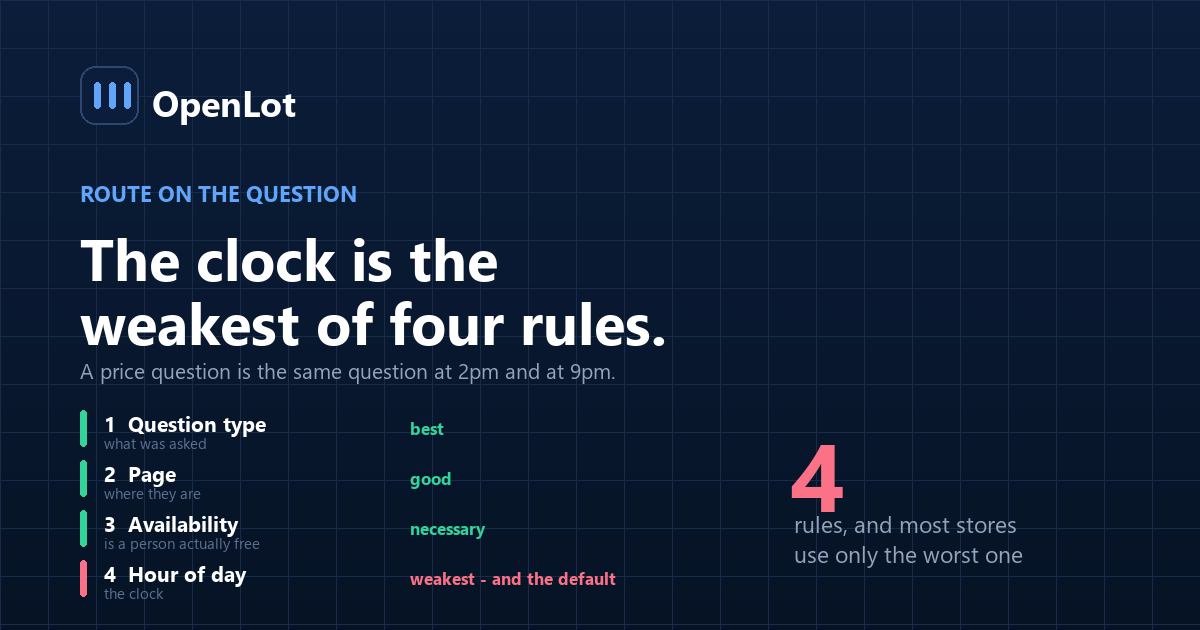
Rule Routes on Quality 1. Question type What was asked Best 2. Page Where they are Good 3. Availability Whether a person is actually free Good, and necessary 4. Hour of day The clock Weakest Most stores use rule 4 alone: people during opening hours, AI after. That allocates a price question at 2pm to a person and an identical one at 9pm to a system, which is backwards from how the conversations differ.
Rule 1 is the one worth building. "Is it still available" is mechanical at any hour. "What would my payment be" needs a person at any hour. The clock is not the variable that distinguishes them.
Rule 1 — question type
| Question | Route to |
|---|---|
| Availability, specifications, hours | AI, always |
| Booking a test drive or service | AI, always |
| Price, payment, trade | Person, always |
| Negotiation or an objection | Person |
| Anything ambiguous | Person |
| Complaint | Person, immediately |
This is the escalation document applied to chat, and the same discipline holds: enumerate it, implement it as a capability limit, revise it from transcripts.
Rule 3 — availability
The rule that makes the others work. Routing to a person who is with a customer produces a slower response than the AI would have given, and the visitor experiences a delay rather than an upgrade.
Presence has to be real rather than scheduled — the same requirement as in call routing.
The hybrid configuration
| Situation | Handled by |
|---|---|
| Mechanical question, any hour | AI |
| Commitment question, person available | Person |
| Commitment question, nobody available | AI captures and escalates with a promise, honoured |
| Anything ambiguous, person available | Person |
| Ambiguous, nobody available | AI captures, escalates |
| Visitor asks for a person | Person, or an honest wait time |
The third and fifth rows are where most designs are thin. "Nobody is available" is not an excuse to let the AI attempt a price question — it is a reason to capture, promise a specific response time, and ensure that promise is kept.
Where does the hybrid break?
1. Routing on the clock alone. The default, and the weakest allocation available.
2. Scheduled rather than real presence. Routes to someone who is with a customer.
3. Live chat as a secondary duty with no SLA. A four-minute response to a web chat is worse than an instant AI answer.
4. No honest wait time. "Someone will be right with you" with no number, followed by silence.
5. The AI attempting commitments when nobody is free. Availability does not change what is safe to say.
6. Blended reporting. Hides which route produces appointments — and it obscures whether the qualification sequence differs between routes. The underlying technology on the AI side matters less than people expect, per rules-based versus conversational.
What should you measure?
| Metric | How to compute | What it decides |
|---|---|---|
| Response time by route | Median, AI vs person | Whether live chat is actually faster |
| Completion rate by route | Contact details ÷ chats, split | Which route converts |
| Chat-to-appointment by route | Split | The business outcome |
| Misroutes | Commitment questions handled by AI, or mechanical ones queued | Rule 1, tested |
| Person-unavailable rate | Chats routed to a person who was busy | Rule 3, tested |
| Promise-kept rate | Promised callbacks honoured ÷ promised | The third-row design |
Row one is frequently the uncomfortable finding. At stores where live chat is a secondary duty, the median human response is slower than the AI's, which means the routing rule that sends conversations to people during the day is producing a worse experience in the name of a better one.
Frequently asked questions
Should dealership chat be handled by people or AI?
By both, routed. The useful question is which conversation goes where, and the best routing rule is question type rather than hour of day — mechanical questions to the system at any hour, commitment and judgment questions to a person at any hour.
What is wrong with routing by time of day?
It allocates on the wrong variable. A price question at two in the afternoon and the same question at nine at night are the same conversation and need the same handling, while an availability question is mechanical at both times. The clock does not distinguish them.
Is live chat faster than AI chat?
Frequently not, at stores where chat is a secondary duty for whoever is watching it. The honest comparison is a distracted person against an instant system, and the median human response time is worth measuring before assuming the human route is the better experience.
What happens when a commitment question arrives and nobody is available?
The system captures it, escalates, and promises a specific response time — which is then kept. Availability does not change what is safe for a system to say, so letting it attempt a price question because nobody is free is the wrong resolution.
Why does presence have to be real rather than scheduled?
Because routing to someone who is with a customer produces a slower response than the system would have given, and the visitor experiences a delay rather than an upgrade. Scheduled availability routinely does not match actual availability on a sales floor.
What should outsourced chat be used for?
Overflow, mostly. Its weakness is context — an agent covering many dealerships does not know your inventory or your market — which makes it better suited to absorbing volume than to handling the conversations where context matters most.
How should chat performance be reported?
Split by route. Blended reporting hides which allocation produces appointments, and the comparison between human-handled and AI-handled conversations is the main evidence for whether the routing rules are set correctly.
What is the most common design gap?
No honest wait time. "Someone will be right with you" followed by silence is worse than either route handled properly, and giving a specific number that is then met performs better than an optimistic vagueness that is not.
Conclusion
- Route by question type, not by the clock. The clock is the weakest of four rules.
- Mechanical to AI at any hour; commitments to a person at any hour.
- Presence must be real. Routing to a busy person is a downgrade dressed as an upgrade.
- Nobody available is not permission for the system to attempt a commitment.
- Measure response time by route. The human route is frequently the slower one.
Last updated: