The same customer frequently arrives twice — once through your website, once through a marketplace, within the same hour. Whether that becomes one conversation or two is decided by matching rules nobody wrote, and automation turns a reporting duplicate into a customer receiving two different messages from the same store.
Verify platform specifics with the vendors themselves. Matching behaviour, available fields and integration terms differ by platform and by configuration. This article is about the rules to establish, not a description of any system's current behaviour.
This guide covers why duplicates arrive, the five matching rules, which record should win, where routing breaks, and what to measure.
Why does the same person arrive twice?
Four common paths, and they overlap.
1. Multiple sources. A shopper submits on a marketplace, then on your website, then calls. Three leads, one person, frequently within an hour.
2. Formatting differences. "Bob Smith" and "Robert Smith", a phone with and without formatting, a work email and a personal one.
3. Household. Two people at one address enquiring on the same vehicle, which should sometimes merge and sometimes not.
4. Returning customers. Someone who bought three years ago submits a fresh lead and arrives as new, discarding everything you know about them.
The fourth is the most costly and the least noticed: a repeat customer treated as a stranger is both a worse experience and a thrown-away advantage.
The five matching rules
Decide these before any automation touches leads
Rule The question Common answer 1. Primary key What makes two records the same person? Normalised phone, then email 2. Normalisation How are phone, email and name standardised before comparison? Strip formatting; lowercase; no nicknames 3. Household Same address, different person — merge? No, link rather than merge 4. Time window Within what window is a second lead the same enquiry? Hours for the same vehicle; days across vehicles 5. Precedence When records conflict, which field wins? Most recent for contact; earliest for source Rule five is the one that gets skipped and the one that causes the visible damage. If a marketplace lead overwrites a phone number a rep had corrected, the store has traded a verified number for an unverified one — and the next contact attempt fails.
Rule three deserves care. Merging two people at one address destroys information; linking them preserves both while preventing the double contact. Link rather than merge is almost always right.
Which record wins?
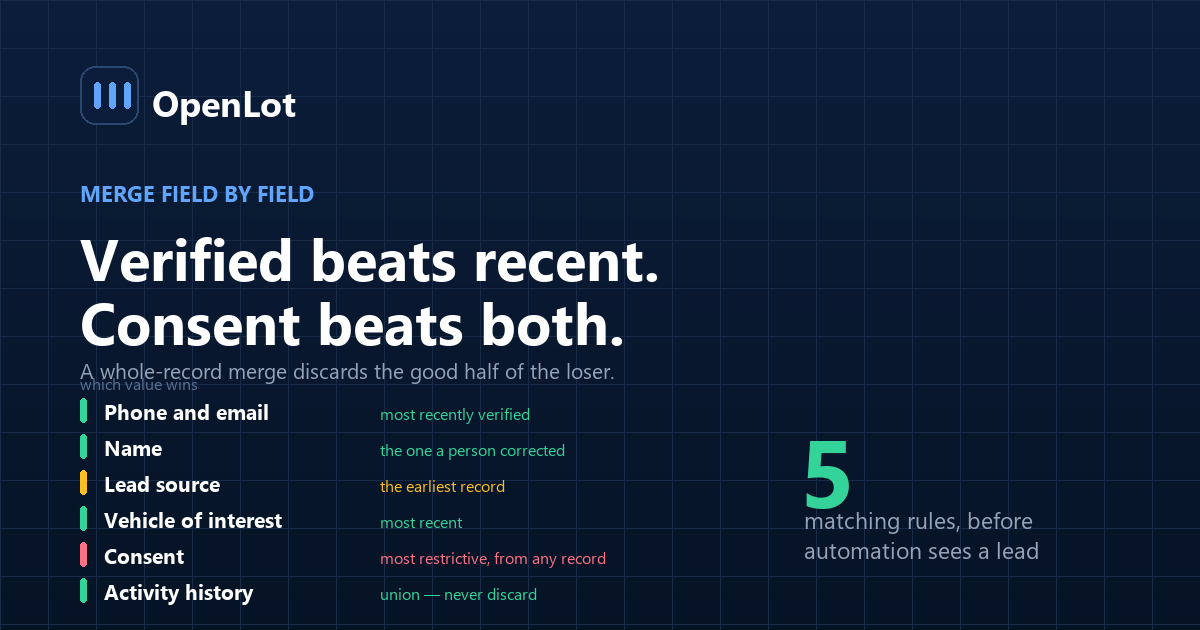
Not one record wholesale. Field by field, which is the part most implementations get wrong by merging whole records.
| Field | Usually wins |
|---|---|
| Phone and email | The most recently verified, not the most recent |
| Name | The one a person entered or corrected |
| Lead source | The earliest — that is what produced the customer |
| Vehicle of interest | The most recent |
| Consent | The most restrictive, always, from any record |
| Activity history | Union — never discard |
The source row matters for attribution: if a merge assigns the customer to whichever source arrived last, every source report is wrong in favour of whichever channel tends to be second.
The consent row is not symmetric with the others, for the same reason it is not elsewhere: an opt-out on any record applies to the merged customer, regardless of which record is otherwise authoritative.
Where does routing break?
1. Matching on exact string equality. "Bob" and "Robert" are two people to a system that does not normalise.
2. Whole-record merge. Discards the good fields from the losing record.
3. Last-write-wins on contact details. Overwrites a verified number with an unverified one.
4. Source overwritten on merge. Breaks attribution silently and in a biased direction.
5. Consent not unioned. An opt-out disappears in a merge, which is an obligation failure as well as a data one — the precedence rule in which system owns what.
6. No matching at all before automation. The duplicates become two conversations, and the customer sees both — the amplification described in CRM data decay.
7. Returning customers arriving as new. History discarded at exactly the moment it was most useful — and the reason clean data comes before automation. Whether the AI layer can even see the full thread is the CRM integration question.
What should you establish before connecting?
| Item | Why |
|---|---|
| The five matching rules, written | They will not be decided consistently otherwise |
| Field-level precedence table | Whole-record merges lose information |
| Consent as union, enforced | Obligation, not preference |
| Link-not-merge for households | Preserves both records |
| What the integration can actually do | Some platforms match on a fixed key you cannot change |
| Manual merge path | Automated matching will be wrong sometimes |
The fifth row is the constraint check. If the platform matches on a key you cannot configure, your rules have to be built around that rather than assuming they can be implemented — which is worth establishing before writing them.
What should you measure?
| Metric | How to compute | What it catches |
|---|---|---|
| Cross-source duplicate rate | Same person from two sources ÷ leads | The size of the problem |
| Duplicate contact incidents | Customers who received two conversations | The customer-visible version |
| Returning customers arriving as new | Matched against sold history | The expensive one |
| Verified contact overwritten | Verified field replaced by unverified | Rule five, failing |
| Source reassignment on merge | Leads whose source changed | Attribution damage |
| Consent lost on merge | Opt-outs that disappeared | Should be zero |
Row three is usually the most surprising number in this set. A store that has been selling for years has a substantial repeat population, and the share of fresh leads that are actually returning customers arriving as strangers is typically larger than anyone expects.
Frequently asked questions
Why does the same customer arrive as two leads?
Four paths: submitting on multiple sources within a short window, formatting differences in name, phone or email, two people at the same household, and returning customers submitting a fresh lead and arriving as new. The last is the most costly and the least noticed.
What matching rules need to be decided?
Five: what makes two records the same person, how fields are normalised before comparison, whether same-household records merge, within what time window a second lead is the same enquiry, and which field wins when records conflict. The fifth is most often skipped and causes the visible damage.
Should records be merged whole or field by field?
Field by field. A whole-record merge discards the good fields from the losing record, which commonly means replacing a phone number a person had verified with one from a web form that has never been dialled.
Which field should win on a conflict?
Contact details go to the most recently verified rather than the most recent, name to whatever a person entered or corrected, lead source to the earliest record, vehicle of interest to the most recent, consent to the most restrictive from any record, and activity history is a union that is never discarded.
Should household records be merged?
Usually not. Two people at one address are two customers, and merging destroys information. Linking them preserves both records while still preventing the same household receiving duplicate contact, which is almost always the right handling.
Why does merging damage attribution?
Because if a merge assigns the customer to whichever source arrived last, every source report shifts in favour of whichever channel tends to be second. Source should follow the earliest record, since that is the channel that actually produced the customer.
What happens to consent on a merge?
It should be a union of the most restrictive state across all records. An opt-out that disappears in a merge is an obligation failure as well as a data error, and it is the one outcome in this area that should be structurally impossible rather than merely rare.
What is the most surprising thing stores find?
The share of fresh leads that are actually returning customers arriving as strangers. A store selling for several years has a substantial repeat population, and that history is usually being discarded at exactly the moment it would have been most useful.
Conclusion
- The same person arrives twice, routinely. Whether it becomes one conversation is a rules decision.
- Five matching rules, written before automation touches leads.
- Merge field by field, not whole records. Verified beats recent.
- Source follows the earliest record, or attribution shifts in a biased direction.
- Consent is a union of the most restrictive. Losing an opt-out in a merge is not acceptable.
Last updated: