Connecting an AI layer to VinSolutions is a CRM-side integration, which makes it a question about leads, activities and customer records rather than about deals. Four things decide whether it works, and none is answerable from a data sheet — each has to be verified live, against your own tenant.
Verify everything here against the vendors themselves. Platform capabilities, API access and partner terms change, and what is true for one dealership's configuration is not automatically true for another. This article is about what to establish, not a description of any platform's current behaviour.
This guide covers why CRM-side integration differs, the four things to verify, how to run the verification, where CRM integrations break, and what to measure.
Why is a CRM-side integration different?
Because the objects are different, and so are the risks.
A DMS integration touches deals, financial data and service history, where the risk is correctness with accounting downstream — the subject of read, write and what breaks.
A CRM integration touches leads, activities, customer records and consent, where the risk is the customer experience: duplicate contact, lost consent state, and activity logs that stop meaning anything.
| DMS integration | CRM integration | |
|---|---|---|
| Primary objects | Deals, service, inventory | Leads, activities, customers |
| Risk if wrong | Accounting and reporting | The customer is contacted twice |
| Who notices first | Finance, eventually | The customer, immediately |
| Write scope needed | Very narrow | Narrow, but larger |
The four things to verify
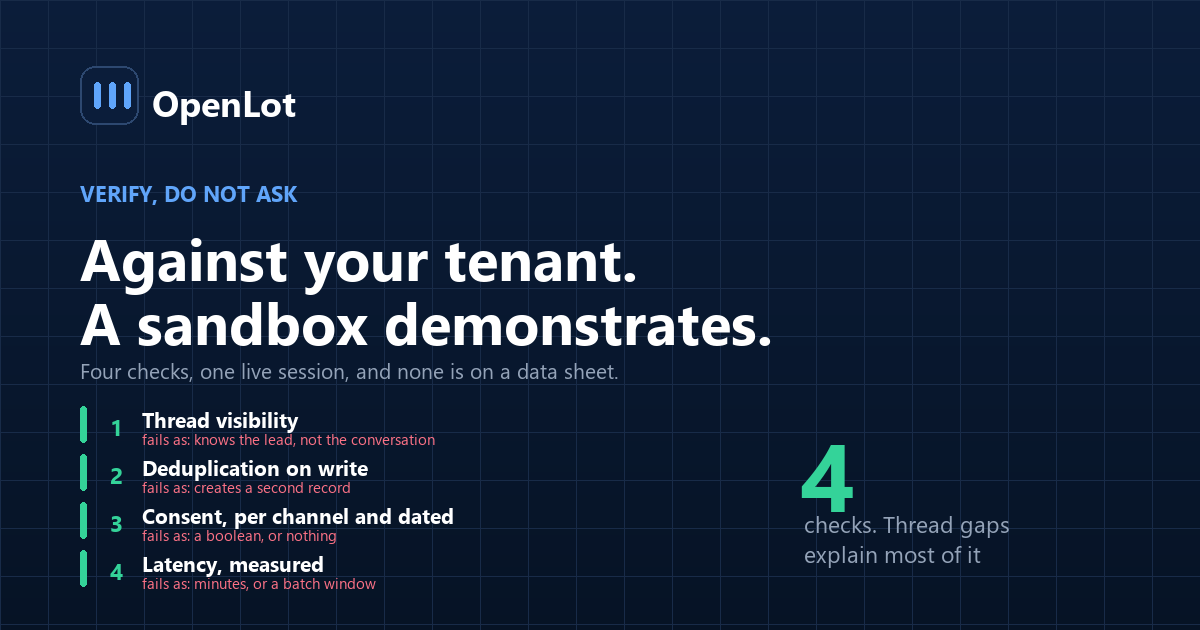
1. Lead-level read, including the thread. Not just the lead record — the message history. An AI layer that can see a lead but not what was already said will repeat questions the customer already answered, which is the most common disappointment in this category.
2. Deduplication behaviour on write. When the AI logs an activity or creates a record, what matches and what creates? Ask to see it with a deliberately near-duplicate contact. This is the behaviour that decides whether automation makes your data quality better or worse.
3. Consent state, readable per channel and dated. Not a single flag. If the integration cannot read a dated, channel-specific consent, any outbound automation built on it is unsupported — the standard in SMS compliance.
4. Latency, measured. Time from a lead arriving in the CRM to the AI layer seeing it. A number, measured live, not a specification.
How to run the verification
One session, with the vendor, against your own instance rather than a sandbox.
The live checks
Check Do this Fail looks like Thread visibility Create a lead with two messages, then ask the AI about it It knows the lead and not the conversation Deduplication Submit a near-duplicate — same person, formatted differently A second record is created Consent read Point at a record and ask what consent exists, per channel, with dates A boolean, or nothing Latency Submit a lead and time until the AI layer acts Minutes, or a batch window Insist on your own tenant. A sandbox is configured to demonstrate rather than to reflect, and the configuration differences between a demo instance and a dealership that has been running for six years are exactly where integrations fail.
Where do CRM integrations break?
1. Lead visible, thread not. Covered above, and it produces a system that asks what the customer already told you.
2. Creating rather than matching. Duplicates at automation volume.
3. Consent as a single boolean. Unsupportable for outbound, and it is an obligation question.
4. Custom fields the integration cannot see. A store that has configured its CRM over years keeps important information in custom fields, and generic integrations frequently read only the standard set — part of the broader DMS and CRM integration scoping question.
5. Activity writes untagged. Automated activity indistinguishable from human activity, and reporting becomes unusable.
6. Latency discovered after go-live. Every operational promise rests on it.
7. Per-rooftop pricing on the connection. Commercial, and the most common surprise in a group rollout. Whether an integration is permitted at all is settled with the platform provider, as in enterprise DMS paths.
What should you establish in writing?
| Item | Why |
|---|---|
| Objects and fields read, including custom fields | Generic lists miss what your store actually uses |
| Objects and fields written | Narrow, with a reason each |
| Deduplication and matching logic | The behaviour that decides data quality |
| Consent model: per channel, dated, retrievable | The obligation |
| Latency, as a number | Everything operational depends on it |
| Alerting on connection failure, named recipient | Integrations fail silently |
| Per-rooftop pricing | Before store two |
The first row matters more at an established store than a new one. A dealership that has run the same CRM for years has shaped it, and an integration reading only standard fields will miss a meaningful share of what the store knows.
What should you measure after connecting?
| Metric | How to compute | What it catches |
|---|---|---|
| Thread-complete rate | Leads where the AI saw full history ÷ leads | The most common gap |
| Duplicates created by the integration | Attributable new duplicates | Matching logic |
| Consent-read success | Records with retrievable per-channel consent ÷ contacted | The obligation |
| Latency, actual | Lead arrival → AI action | Against the quoted number |
| Automated activity share | Tagged automated ÷ all activity | Whether reporting survived |
| Custom-field coverage | Fields the integration reads ÷ fields in use | Usually a surprise |
Row one is the diagnostic that explains most disappointment. A system that repeats questions is almost always a system that could see the lead and not the conversation, and that is an integration scope issue rather than a capability one.
Frequently asked questions
What is different about integrating AI with a CRM rather than a DMS?
The objects and the risk. A DMS integration touches deals and financial data, where errors surface in accounting. A CRM integration touches leads, activities, customer records and consent, where errors surface immediately as a customer contacted twice or asked something they already answered.
What should be verified before signing a CRM integration?
Four things, live against your own instance: whether the AI can see message history and not only the lead record, how it behaves on a near-duplicate contact, whether it can read dated per-channel consent, and the measured latency from lead arrival to action.
Why does thread visibility matter so much?
Because a system that sees a lead but not the conversation will repeat questions the customer has already answered, which is the most common source of disappointment in this category and reads to the customer as the store not keeping track.
Should the verification happen in a sandbox?
No. A sandbox is configured to demonstrate rather than to reflect, and the differences between a demo instance and a CRM a dealership has been shaping for years are exactly where integrations fail. Insist on your own tenant.
What happens if consent is only a single flag?
Outbound automation built on it is unsupported, because the question that gets asked is what permission existed for a specific channel on a specific date. A boolean cannot answer it, and that makes it an obligation issue rather than a data inconvenience.
What about custom fields?
They matter more at an established store than anyone expects. A dealership that has run the same CRM for years keeps important information in fields it added, and generic integrations frequently read only the standard set — which means the AI sees a thinner picture than the store has.
Why do automated activities need tagging?
Because without it, automated entries are indistinguishable from human ones in reporting, and managers lose the ability to see who is actually working. The loss is complete and quiet, and it typically goes unnoticed for a quarter.
What should be confirmed commercially?
Per-rooftop pricing on the connection, in writing, before the second store. It is the most common surprise in group rollouts and it is entirely avoidable by asking the question during the first negotiation rather than the second.
Conclusion
- CRM-side risk is the customer experience, and it surfaces immediately rather than in accounting.
- Four live checks: thread visibility, deduplication, consent read, measured latency.
- Verify against your own tenant. A sandbox demonstrates; it does not reflect.
- Custom fields are where an established store keeps what it knows.
- Thread-complete rate explains most disappointment in this category.
Last updated: