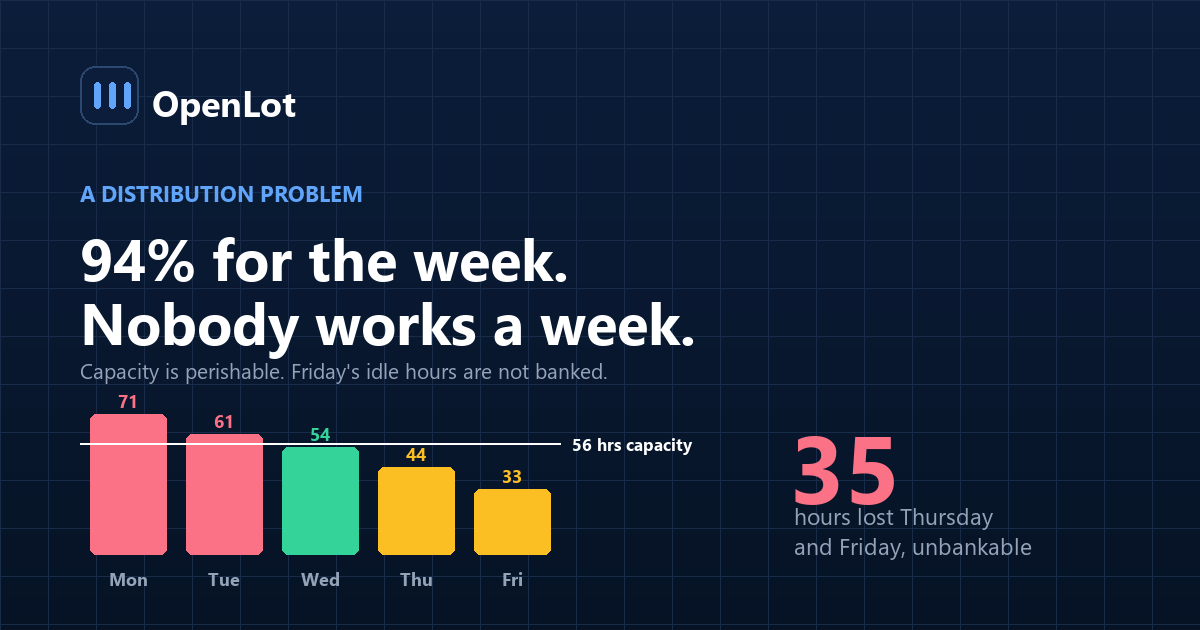
Most service departments do not have a capacity problem across the week — they have a distribution problem within it. Monday runs over and Friday runs empty, and because capacity is perishable, the idle Friday hours are gone rather than banked against the overloaded Monday.
This guide covers why demand concentrates, what the uneven week costs, the five ways to move a customer without discounting, where smoothing goes wrong, and what to measure.
Why does service demand concentrate?
Four reasons, none of them about customer preference in the way people assume.
The weekend backlog. Something went wrong on Saturday, the shop was closed or short-staffed, and the call comes first thing Monday.
Default offers. When an advisor or a scheduler offers "the next available," and the next available is Monday because that is what came up first, the pattern reinforces itself.
Carryover. Work not finished Friday consumes Monday hours before a single new appointment is booked, which makes the real Monday overload worse than the booking count suggests.
Nobody offers Friday. Not because customers refuse it — because the option is rarely presented with any reason to take it.
What the uneven week costs
Illustrative. A shop with 56 hours of capacity per day.
Day Hours sold Utilisation Lost Mon 71 127% Promise times slip Tue 61 109% Pressure Wed 54 96% Healthy Thu 44 79% 12 hours Fri 33 59% 23 hours Week 263 94% — The week looks like 94% utilisation, which sounds close to full. But the shop lost 35 hours on Thursday and Friday that it could not bank, while running two days at a level where quality and promise times degrade.
Capacity is perishable. Moving even half the Thursday and Friday shortfall into the week is worth more than any marginal booking increase, and it costs nothing in media spend.
How do you move a customer without discounting?
Discounting Friday works and it is the expensive answer — and it shows up later as rising cost per sale on work that would have arrived anyway. Five alternatives, roughly in order of effectiveness:
1. Offer the earlier completion honestly. "Monday we would have it back to you around 4pm; Thursday we could have it done by 11am." Most customers care about getting the car back, not about the day they drop it off. This is the single most effective lever and it requires nothing but accurate promise times.
2. Default the offer differently. If the scheduler presents Thursday and Friday first for non-urgent work, a meaningful share take them. The current Monday concentration is partly an artifact of what gets offered first.
3. Loaner and shuttle availability as the incentive. A loaner is easier to guarantee on a light day, and for many customers that is worth more than a price break.
4. Wait-appointments on light days. Customers who want to wait rather than drop off are far better served on a Thursday, and telling them so is honest rather than promotional.
5. Reserve Monday for genuine urgency. Hold a share of Monday capacity for same-day and breakdown work instead of filling it with maintenance booked three weeks out. Maintenance is the most movable work in the shop.
Note what none of these require: a discount, a campaign, or a new system. They require accurate promise times and a scheduler that presents availability in a deliberate order rather than chronologically.
Where does automation fit?
In two places, both narrow.
Presenting the right options. A scheduler that knows remaining hours per day, by skill, can offer the days that need filling first for work that is not urgent — provided it is checking real bay and technician capacity rather than calendar slots.
Reallocating during the day. When a job comes in shorter than estimated or a no-show opens a block, same-day capacity becomes available and someone should be offered it. That requires a live DMS connection rather than a nightly sync, which is the distinction that decides whether a scheduler can do this at all.
What automation should not do is move an existing appointment unilaterally. A customer whose Monday booking is silently shifted to Thursday has been treated as inventory.
Where does smoothing go wrong?
1. Discounting Friday by default. It works, and it trains customers to wait for the discount, and it gives away margin on work they would have brought anyway.
2. Smoothing before measuring. A shop that has not plotted hours sold against hours available by day is guessing which days need filling — and the baseline rule is the same one that governs any deployment measurement.
3. Ignoring carryover. Monday is worse than the booking count suggests because Friday's unfinished work is already consuming it. A model that resets each morning will keep overbooking Mondays.
4. Treating all work as movable. A breakdown is not movable. Maintenance is highly movable. Mixing them in one smoothing rule produces an unhappy customer with a non-functioning vehicle.
5. Moving the customer and not the parts. A job rescheduled to a day when the part has not arrived has been moved into a second failure, and it reads to the customer exactly like a no-show that was your fault.
6. Filling light days and then not staffing them. If technicians are scheduled around the historical pattern, smoothing demand into Friday without smoothing labour achieves nothing — the hours still are not there.
The last one is worth stating plainly: labour scheduling and appointment scheduling have to move together, and in most stores they are owned by different people who do not meet.
What should you measure?
| Metric | How to compute | What it tells you |
|---|---|---|
| Hours sold ÷ hours available, by day | Daily, 90 days | The actual shape of the week |
| Lost hours on light days | Available minus sold, days under 100% | The recoverable number |
| Overbooked hours on heavy days | Sold minus available, days over 100% | What is damaging promise times |
| Carryover hours into Monday | Work in progress at Friday close | Why Monday is worse than it looks |
| Offer-to-acceptance by day | Accepted ÷ offered, per weekday | Whether customers actually refuse Friday |
| Promise-time accuracy by day | Delivered on time ÷ promised, per weekday | The cost of the spike, in customer terms |
The fifth row usually surprises people. Stores assume customers refuse the light days, and the acceptance rate when those days are genuinely offered first — with an earlier completion time attached — is frequently much higher than anyone expected.
Frequently asked questions
Why is Monday always the busiest day in a service department?
Three reasons compound: problems that appeared over the weekend arrive first thing, work not finished on Friday consumes Monday hours before any new appointment is booked, and schedulers offering "the next available" default to it. Only the first is genuinely about customer behaviour.
What does an uneven service week cost?
The idle hours on light days, which cannot be banked because capacity is perishable. A shop running 127% on Monday and 59% on Friday can show a healthy weekly average while losing a day's worth of hours across Thursday and Friday and degrading promise times on Monday and Tuesday.
How do you get customers to take a Thursday or Friday appointment?
Offer the earlier completion rather than the earlier drop-off. Most customers care about when the vehicle comes back, not which day they bring it in, so "Thursday, done by 11am" beats "Monday, back around 4pm" for a large share of them. Loaner availability on light days works similarly.
Should light days be discounted?
It works and it is the expensive answer. Discounting trains customers to wait for the offer and gives away margin on work that would have arrived anyway. Accurate promise times, a deliberate order of offered availability and loaner access achieve most of the same effect without the margin cost.
Can a scheduler move appointments automatically to balance the week?
It should not move existing appointments unilaterally — that treats the customer as inventory. What it can do is present availability in a deliberate order for new non-urgent bookings, and offer newly freed same-day capacity when a job finishes early or a no-show opens a block.
Does carryover work affect the Monday overload?
Significantly. Work in progress at Friday close consumes Monday hours before a single new appointment is counted, so a Monday that looks fully booked on paper is frequently overbooked in practice. Carryover needs to be subtracted from available hours rather than ignored.
What happens if we smooth demand but not technician scheduling?
Nothing improves. If labour is scheduled around the historical pattern, moving appointments into Friday puts work on a day with fewer technicians available, and the hours still are not there. Appointment scheduling and labour scheduling have to move together, which usually means two people who do not currently meet need to.
Which work is movable and which is not?
Maintenance is highly movable, and it is also the work most commonly occupying the overloaded days because it is booked weeks in advance. Breakdowns and genuine urgency are not movable at all. A smoothing rule that does not distinguish them produces a stranded customer, which costs far more than an idle bay.
Conclusion
- It is a distribution problem, not a capacity problem. The week averages out; nobody experiences the average.
- Capacity is perishable. Idle Friday hours are not banked against an overloaded Monday.
- Sell the completion time, not the drop-off day. The most effective lever, and it is free.
- Subtract carryover. Monday is worse than the booking count shows.
- Move labour with the demand, or smoothing achieves nothing at all.
Last updated: