Buy here pay here operations have more recurring customer contact than any other dealership model, which makes automation obviously useful and unusually risky. The line between a payment reminder and a collections communication is narrower than it looks, and a system with no judgment will not notice when it crosses.
This is operational guidance, not legal advice. Collections practice is governed by federal and state law that varies considerably and changes. Have counsel review any automated account-servicing programme before it runs.
This guide covers where BHPH differs, what automation does safely, where the line sits, what must stay human, and what to measure.
Why is BHPH different?
Because the relationship continues after the sale, and most of the contact volume is about money.
A conventional dealer contacts a customer a handful of times after delivery. A BHPH operation contacts the same customer every payment period for years, and the subject of nearly every contact is an obligation. That changes both the economics — automation has far more volume to work with — and the risk, because the content of those messages is regulated in ways a service reminder is not.
It also changes the data picture. The store holds the loan, which means it sees payment behaviour no third party does, and that is genuinely useful for anything from scheduling to acquisition.
What does automation do safely?
| Task | Safe? | Why |
|---|---|---|
| Payment due reminder, before the date | Yes | Informational, not a demand |
| Payment received confirmation | Yes | Service |
| Scheduling a service appointment | Yes | Nothing to do with the loan |
| Insurance lapse notification | Yes, carefully | Factual, and contractually relevant |
| Offering a self-serve payment link | Yes | Convenience, customer-initiated |
| Post-due-date contact | Treat as collections | The boundary |
| Repeated contact after no response | Treat as collections | Frequency is itself regulated |
| Any mention of consequences | No | Repossession, legal action, credit impact |
| Negotiating a payment arrangement | No | Judgment, and a modification of terms |
| Responding to a dispute | No | Escalate immediately, always |
The first five are genuinely valuable and genuinely low-risk. They are also the bulk of the volume, which is the useful finding: most of what automation can help with in BHPH sits comfortably on the safe side.
Where exactly is the line?
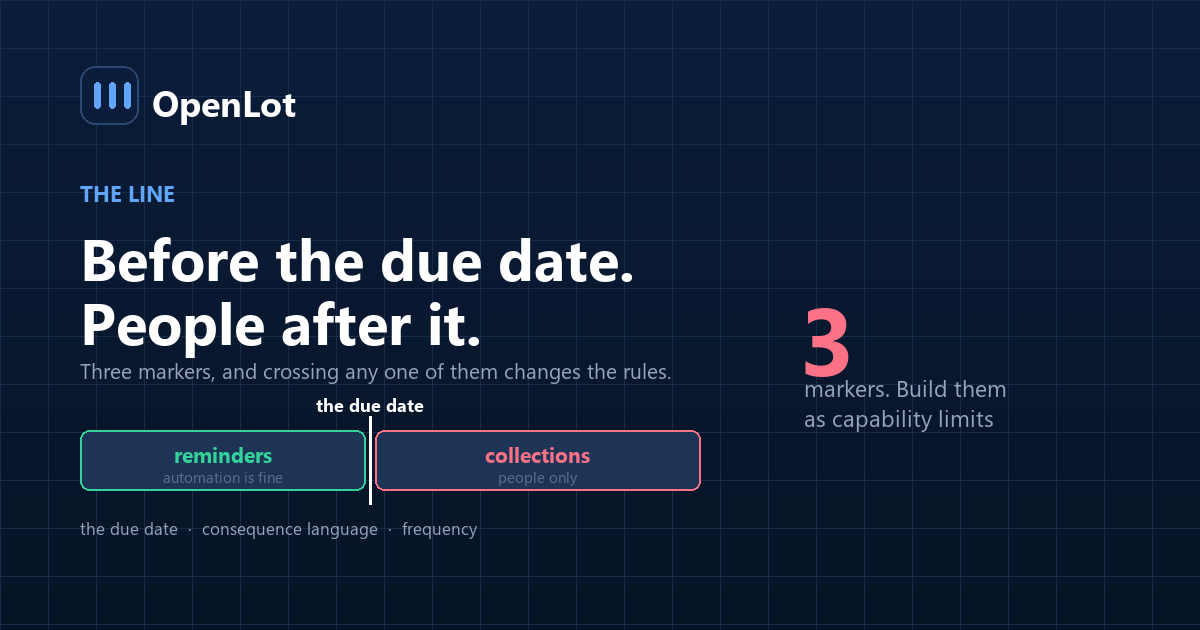
Three markers. If a message touches any of them, it is not a reminder.
1. The due date. Before it, a message is informational. After it, the communication is about a debt that is late, and a different set of rules applies.
2. Consequence language. Any reference to what happens if payment is not made — repossession, additional fees, credit reporting, legal action — moves a message firmly across the line regardless of tone.
3. Frequency. Repeated contact after no response is a pattern, and patterns are regulated independently of the content of any single message. An automated sequence that keeps running is exactly the behaviour that creates exposure.
The three tests before any automated message goes out
- Is it before the due date? After, and it stops being a reminder.
- Does it describe a consequence? Any consequence. Including a gentle one.
- Is it the first contact on this matter, or the fourth?
A message that is pre-due-date, consequence-free and first is almost always safe. Change any one of the three and the answer changes with it.
Build these as hard capability limits rather than instructions — the same principle as enforcing an agent's scope. If the system cannot send post-due-date messages, it will not.
What must stay human?
Anything after the due date. The simplest and safest rule, and the one most worth adopting: automation handles the before, people handle the after.
Payment arrangements. A modification of terms needs a person with authority, and the conversation needs judgment about circumstances a system cannot evaluate.
Disputes. Immediate escalation, no exceptions, no automated response.
Anything involving hardship. A customer explaining that they lost their job is having a conversation no automated system should be part of.
The division is the same one that holds everywhere in the store — automate the interruption, never the judgment — but the consequences of getting it wrong are larger here, because the subject is a debt rather than an appointment.
What should you require from a vendor?
| Requirement | Why |
|---|---|
| Hard block on post-due-date messaging | Capability limit, not a setting |
| Consent and contact-time records per message | The same standard as SMS compliance |
| Frequency caps, enforced | Patterns are regulated independently |
| Immediate halt on any dispute keyword | Escalation, not a response |
| Full audit log, exportable | You need it without asking them |
| Separate consent for servicing and marketing | They are different communications |
A vendor selling into BHPH without a hard post-due-date block is selling a general messaging tool with a different cover page.
Where do BHPH automation programmes go wrong?
1. A reminder sequence that keeps running past the due date. The single most common failure, and it happens because the sequence was designed around dates rather than around the line.
2. Consequence language in a template. "To avoid additional fees" in a pre-due reminder has already crossed.
3. One consent for everything. Account servicing and marketing offers are different communications and need separate permission — the same per-purpose rule as everywhere else in the store, and one more reason a small operation needs tools that do not need babysitting.
4. No frequency cap. The sequence runs, the customer does not reply, the sequence runs again.
5. Automation handling a hardship reply. The customer explains a job loss and receives a templated payment link.
6. No audit trail. The one place where the record is most likely to be requested is the one where stores most often cannot produce it.
What should you measure?
| Metric | How to compute | What it catches |
|---|---|---|
| Post-due-date automated sends | Count | Should be zero |
| Consequence-language audit | Sample 50 templates and messages | Should be zero |
| Messages per customer per period | Count against the cap | Pattern exposure |
| Dispute keyword halts | Halted ÷ disputes raised | Should be 100% |
| On-time payment rate, before and after | The business case | The reason to do it |
| Opt-out rate, servicing channel | Opt-outs ÷ customers | The guardrail |
Row one should be structurally impossible rather than merely low. If it is a number greater than zero, the block is a setting rather than a capability limit, and settings get changed.
Frequently asked questions
Can buy here pay here dealers use automated payment reminders?
Pre-due-date informational reminders are generally the safest and most useful application, along with payment confirmations, service scheduling and self-serve payment links. The boundary is the due date: after it, communications about a late debt fall under a different set of rules and should be handled by people.
What is the line between a payment reminder and collections?
Three markers: whether the message is before or after the due date, whether it describes any consequence of non-payment, and whether it is the first contact or part of a repeated pattern. A pre-due, consequence-free first contact is almost always a reminder. Change any one of those and it may not be.
Should automation handle messages after the due date?
The safest and simplest rule is no. Automation handles the period before the due date and people handle everything after it. That boundary is easy to implement as a hard capability limit and removes most of the risk from the programme.
Can an automated system negotiate a payment arrangement?
No. A payment arrangement modifies the terms of an agreement and requires a person with authority as well as judgment about circumstances a system cannot evaluate. Any message heading toward an arrangement should escalate rather than continue.
What happens if a customer disputes something?
Immediate escalation to a person, with the automated sequence halted. Dispute keywords should trigger a hard stop rather than a response, and the halt rate against disputes raised is worth measuring, because it should be complete rather than mostly complete.
Does servicing consent cover marketing messages?
No. Account servicing communications and marketing offers are different in kind and need separately recorded permission. Bundling them is both a compliance exposure and a reliable way to have customers opt out of messages you actually need them to receive.
What should a BHPH vendor be required to provide?
A hard block on post-due-date messaging implemented as a capability rather than a setting, per-message consent and contact-time records, enforced frequency caps, an immediate halt on dispute keywords, an exportable audit log, and separate consent handling for servicing and marketing.
What is the most common failure in these programmes?
A reminder sequence that keeps running past the due date, because the sequence was built around dates rather than around the boundary. It is also the easiest to prevent, since a system that structurally cannot send after the due date will not do it by accident.
Conclusion
- The relationship is recurring and the subject is money. That changes both the value and the risk.
- Three markers define the line: the due date, consequence language, and frequency.
- Automate before the due date, people handle after. Simple, safe, and most of the volume.
- Build the block as a capability limit, not a setting. Settings get changed.
- Post-due-date automated sends should be structurally impossible, not merely rare.
Last updated: