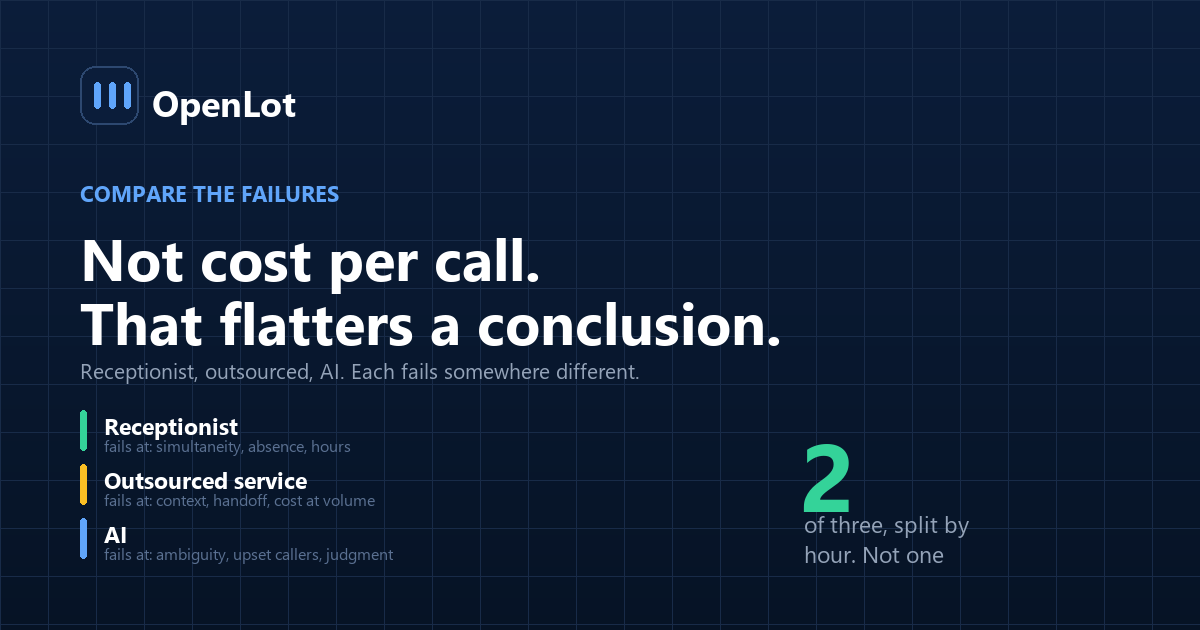
Three ways exist to answer a dealership's phone, and comparing them on cost produces whichever answer you went in with. Comparing them on failure modes produces a different and more useful conclusion — usually that the right configuration is two of the three, split by hour rather than by preference.
This guide covers the three options and where each fails, the hybrid that usually wins, how to split by hour, where this goes wrong, and what to measure.
The three options
| Human receptionist | Outsourced service | AI | |
|---|---|---|---|
| Cost shape | Salary, fixed | Per call or per minute | Licence, near-fixed |
| Coverage | Shift hours | Contracted hours, often 24/7 | 168 hours |
| Peak handling | Degrades | Scales, at cost | Unchanged |
| Knows your store | Completely | Barely | Partly — what it is given |
| Handles the unexpected | Well | Variably | Poorly |
| Fails at | Volume spikes and absence | Context and warmth | Anything ambiguous |
The rows that matter are the last three. Cost comparisons in this category are usually constructed to favour a conclusion, and the failure modes are not.
Where a receptionist fails
Simultaneity. One person, one call. The second caller waits or goes to voicemail, and dealership calls cluster into sharp peaks rather than arriving evenly — which is the arithmetic behind where missed calls leak.
Absence. Lunch, holiday, illness, turnover. The coverage is as good as the attendance.
Hours. Evenings, Sundays, and the two hours after close when a meaningful share of enquiries arrive.
Where an outsourced service fails
Context. An agent handling eleven dealerships cannot know that the blue Accord is the one in the ad, or which advisor the customer always asks for.
Handoff. A message taken at 1am that reaches someone at 10am has usually lost whatever made it urgent.
Cost at volume. Per-call pricing rises exactly when the store is doing well.
Where AI fails
Ambiguity. A customer who does not know what they need, or whose request has three parts.
Upset callers. Immediate escalation, every time.
Anything requiring judgment. The boundary is the same one that holds everywhere — see where agent autonomy should end.
The hybrid that usually wins
Not one option. Two, split by hour and by call type.
A working configuration
Illustrative. Build yours from your own call-volume-by-hour plot.
Hours Primary Overflow Why Staffed, normal volume Receptionist AI Context and warmth where it is available Staffed, peak (10–11am, 4–6pm) Receptionist AI, immediately The second caller never waits Evenings AI Voicemail with text-back Volume does not justify a shift Overnight and Sunday AI — Coverage that was otherwise zero The important row is the second. Most stores think of AI as after-hours coverage, and the peak-hour overflow is frequently worth more — because those are the highest-intent calls of the day and they are currently being lost to a busy signal.
This also changes the cost comparison. Overflow AI is not replacing a receptionist; it is replacing the voicemail the second caller currently reaches.
How do you split it by hour?
One plot, no vendor required.
Step 1: calls by hour and weekday, for 90 days. Filter out vendors and robocalls.
Step 2: overlay who is available in each hour.
Step 3: mark three zones. Covered and comfortable, covered but at peak, and uncovered.
Zone two and zone three get different solutions, and most stores discover that zone two is larger than they assumed — the pattern behind why leads never reach anyone.
Where does this go wrong?
1. Replacing the receptionist entirely. The context a long-serving receptionist carries is worth real money and it is not recoverable. Overflow and after-hours, not replacement.
2. Comparing on cost per call. It flatters whichever option you already prefer and ignores every failure mode.
3. AI as the primary during staffed hours. Customers who could have reached a person reach a system instead, which is a downgrade on the highest-value calls.
4. Outsourced with no context pipeline. A service that cannot see your inventory or appointment book is taking messages, not answering calls.
5. No overflow at all. The most common status quo: the second caller gets voicemail at the busiest hour of the week.
6. Ignoring who takes the transfer. Any of the three options escalates eventually, and a transfer target nobody works defeats all of them equally — which is why the transfer triggers and the routing design matter more than the answering method.
What should you measure?
| Metric | How to compute | What it decides |
|---|---|---|
| Calls by hour and weekday | 90 days, filtered | The whole configuration |
| Simultaneous call rate | Calls arriving while another is active | The size of the overflow need |
| Answer rate by zone | Covered, peak, uncovered | Where the loss is |
| Abandonment by wait time | Hung up, by seconds on hold | The cost of the second-caller problem |
| Containment by option | Resolved without transfer, per answering method | What each is actually doing |
| Cost per answered call, by option | All in, per method | The comparison, done honestly |
Row two is the one that makes the case internally. A store that has never measured how often two calls arrive at once has never seen the size of the problem the overflow option solves.
Frequently asked questions
Should a dealership replace its receptionist with AI?
No. A long-serving receptionist carries context that is worth real money and cannot be recovered once lost. The configuration that works uses AI for peak-hour overflow and for the hours nobody is staffed, with the receptionist primary during normal staffed volume.
What is the most valuable use of AI on a dealership phone?
Peak-hour overflow, more often than after-hours coverage. Those are the highest-intent calls of the day and they are currently reaching voicemail because the receptionist is already on a call. The after-hours case is real but usually smaller.
How do the three answering options compare?
They fail in different places. A receptionist fails on simultaneity, absence and hours. An outsourced service fails on context, handoff and cost at volume. AI fails on ambiguity, upset callers and anything requiring judgment. Comparing on cost per call flatters whichever option you already prefer.
Where does an outsourced answering service fall short?
Context and handoff. An agent covering many dealerships cannot know which vehicle is in the ad or which advisor a customer always asks for, and a message taken overnight that reaches someone mid-morning has usually lost whatever made it urgent.
How do you decide which hours each option covers?
Plot calls by hour and weekday over 90 days, overlay who is available in each hour, and mark three zones: covered and comfortable, covered but at peak, and uncovered. The second and third zones get different solutions, and the second is usually larger than expected.
What is the simultaneous call rate and why does it matter?
The share of calls arriving while another is already in progress. It sizes the overflow problem directly, and most stores have never measured it — which is why the second-caller-reaches-voicemail situation persists at the busiest hour of the week.
Should AI be primary during staffed hours?
No. Customers who could have reached a person reaching a system instead is a downgrade on the calls that matter most. AI belongs behind the receptionist during staffed hours and in front of voicemail outside them.
What defeats all three options equally?
A transfer target nobody works. Every answering method escalates eventually, and if the escalation lands in a queue with nobody on it, the caller experiences a fast answer followed by silence — which performs worse than a slow answer from a person.
Conclusion
- Compare on failure modes, not cost per call. The cost comparison flatters a conclusion.
- Peak overflow is usually worth more than after-hours, and almost nobody measures it.
- Do not replace the receptionist. The context is worth money and does not come back.
- Three zones from one plot: comfortable, peak, uncovered. They need different answers.
- Measure the simultaneous call rate. It sizes the problem nobody has looked at.
Last updated: