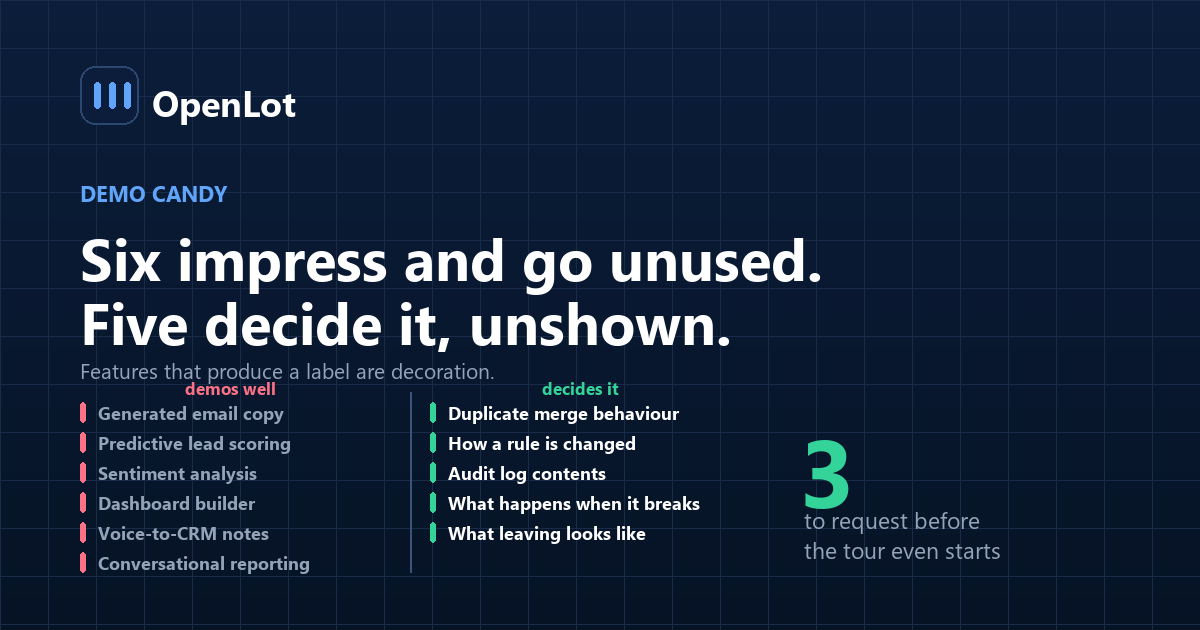
A CRM demo shows the features that demo well, which is a different set from the features that matter. Six things impress in a demo and go unused; five decide the deployment and are never shown — and the second list is the one to ask for explicitly, because it will not be volunteered.
This guide covers the six that demo well, the five that decide it, how to tell them apart, where evaluations go wrong, and what to measure.
The six that demo well and go unused
| Feature | Why it demos well | Why it goes unused |
|---|---|---|
| AI-generated email copy | Instant, impressive | Generic output; staff rewrite it or stop using it |
| Predictive lead scoring | A confident number per lead | Nobody acts differently on a score of 72 vs 68 |
| Sentiment analysis | Novel | Produces a label with no attached action |
| Custom dashboard builder | Looks powerful | Six numbers are needed and they are standard |
| Voice-to-CRM notes | Visually striking | Accuracy on a noisy lot, and nobody reads notes |
| Conversational reporting | "Ask the CRM a question" | Asked twice in week one, never again |
None of these is fake. Each works roughly as shown. They go unused because they produce information without a decision attached, and the daily reality of a dealership is that unattached information accumulates unread — the same failure as an aging alert nobody owns.
Lead scoring deserves a specific note. It is the most persuasive demo in the category and the most consistently unused, for one reason: unless the store does something different with a high-scoring lead than with a low-scoring one, the score is decoration. Ask the vendor what action the score triggers. If the answer is "the team can prioritise", nothing will change.
The five that decide it and are never shown
1. What happens to a duplicate. The single most consequential behaviour in a dealership CRM, and nobody demos it. Ask to see two records for the same person merged, live, and watch what happens to the activity history and the consent state.
2. How a rule is changed. Ask to change an escalation trigger or a routing rule during the demo. If it needs a support ticket, every future change costs a week — and the rules will need changing, repeatedly.
3. What the audit log contains. Ask for one message with the consent state attached at the time it was sent. The standard applies here as everywhere — see AI data security.
4. What happens when an integration breaks. Not whether it can break. What happens: who is told, how fast, and what the system does in the meantime.
5. What leaving looks like. Export format, what is included, what it costs, and how long you have. The answer correlates strongly with how confident the vendor is.
The demo request that changes everything
One sentence, near the start:
"Before the tour — can you show me a duplicate merge, a rule change, and one audit log entry with consent state?"
A mature product does all three in ten minutes. A product built for the demo cannot do any of them without a follow-up call, and you have learned more in those ten minutes than the remaining hour would have taught you.
How do you tell them apart?
One test: does the feature end in a decision somebody will actually make differently?
| Feature | Ends in a decision? |
|---|---|
| Lead score | Only if the store treats scored leads differently. Usually not |
| Duplicate merge behaviour | Yes — it determines whether customers get contacted twice |
| Sentiment label | Rarely |
| Rule change speed | Yes — it determines whether the system adapts |
| Generated copy | Only if someone sends it without rewriting |
| Audit log contents | Yes — when it is needed, it is needed completely |
The pattern: features that produce a label are demo candy; features that change what the system does are not.
Where do CRM evaluations go wrong?
1. Evaluating on the demo. The demo is the best case, scripted and prepared.
2. The GM evaluating alone. The GM sees the dashboard; the BDC manager sees the daily reality. Products that impress one frequently frustrate the other.
3. Not asking about duplicates. The most consequential behaviour, and it is invisible unless asked for.
4. Accepting "our platform supports that". A documentation claim is not a demonstration — including on data export, which is the claim least often tested.
5. Weighting the AI features over the data behaviour. The AI runs on the data, and the data behaviour decides whether the AI is useful — the dependency in clean data first.
6. Ignoring rule-change latency. A product where every change is a support ticket is a product that stops reflecting your store within a quarter.
What should you measure?
| Metric | When | What it tells you |
|---|---|---|
| Features used ÷ features paid for | 90 days after go-live | The demo candy ratio, measured |
| Time to change a rule | Request to live | Whether the product adapts |
| Duplicate contact rate | Monthly | The behaviour nobody demos |
| Audit log completeness | Sampled | Whether the compliance claim held |
| Integration downtime, unnoticed | Hours | Whether alerting exists |
| Lead score acted upon | Different handling ÷ scored leads | Usually near zero |
Row six is the honest test of the most persuasive feature in the category. If scored leads are not handled differently from unscored ones, the score is decoration and the store is paying for it.
Frequently asked questions
Which automotive AI CRM features demo well but go unused?
Generated email copy, predictive lead scoring, sentiment analysis, custom dashboard builders, voice-to-CRM notes and conversational reporting. Each works roughly as shown and each produces information with no decision attached, which is why they accumulate unread.
Why does lead scoring rarely get used?
Because unless the store handles a high-scoring lead differently from a low-scoring one, the score changes nothing. The question to ask a vendor is what action the score triggers, and an answer along the lines of "the team can prioritise" means nothing will change.
What should be asked for in a CRM demo?
Three things, before the tour: a live duplicate merge, a rule change made during the call, and one audit log entry showing consent state at the time a message was sent. A mature product does all three in ten minutes, which tells you more than the remaining hour would.
Why is duplicate handling so important?
Because it determines whether a customer gets contacted twice from two records, which is the most visible data failure a dealership produces. It is also the single most consequential CRM behaviour and the one no vendor demonstrates unless asked.
How do you separate a useful feature from demo candy?
Ask whether the feature ends in a decision somebody will actually make differently. Features that produce a label — a score, a sentiment, a summary — are usually decoration. Features that change what the system does are not.
Why does rule-change latency matter?
Because the rules will need changing repeatedly as customers reveal phrasings nobody anticipated. A product where each change requires a support ticket stops reflecting your store within a quarter, regardless of how good it was at go-live.
Who should be in the CRM evaluation?
At minimum the GM and the manager of the department that will use it daily. They see different things, and a product that impresses on the dashboard frequently frustrates on the floor — which only surfaces when both are in the room.
What should be measured after go-live?
Features actually used against features paid for, time to change a rule, duplicate contact rate, audit log completeness when sampled, unnoticed integration downtime, and whether scored leads are genuinely handled differently. The last of these is usually near zero.
Conclusion
- Six features demo well and go unused. Each produces a label with no decision attached.
- Five decide the deployment and are never shown. Ask for them explicitly.
- Request a duplicate merge, a rule change and an audit entry before the tour.
- Lead scoring is the most persuasive and least used feature in the category.
- Measure whether scored leads are handled differently. Usually they are not.
Last updated: