An AI BDC is deployed source by source, and the order decides whether you can learn anything. The first source should be the one that is high volume, homogeneous and low stakes — which is rarely the one with the most urgency attached to it, and never the one somebody is complaining about.
This guide covers how to choose the first source, the onboarding order, what must be true before adding the next, where rollouts go wrong, and what to measure.
Why does source order decide the implementation?
Because each source behaves differently, and mixing them at the start makes everything unattributable.
A marketplace lead arrives with a vehicle and a phone number of uncertain quality. A website form lead arrives with intent and better data. A chat transcript arrives mid-conversation. A phone lead arrives with no written record at all. The same system performs very differently across the four, and a deployment that enables all of them simultaneously produces one blended result nobody can act on.
This is the same discipline as the 30-day implementation plan, applied to the dimension that matters most in a BDC: which leads, in what order.
Choosing the first source
Score each source on three axes.
| Axis | Want | Why |
|---|---|---|
| Volume | High | Enough instances to learn from in two weeks |
| Homogeneity | High | Leads that look alike, so behaviour is consistent |
| Stakes | Low | The first source will expose what the escalation rules missed |
Scoring your sources
Illustrative. Score 1–3 on each and total.
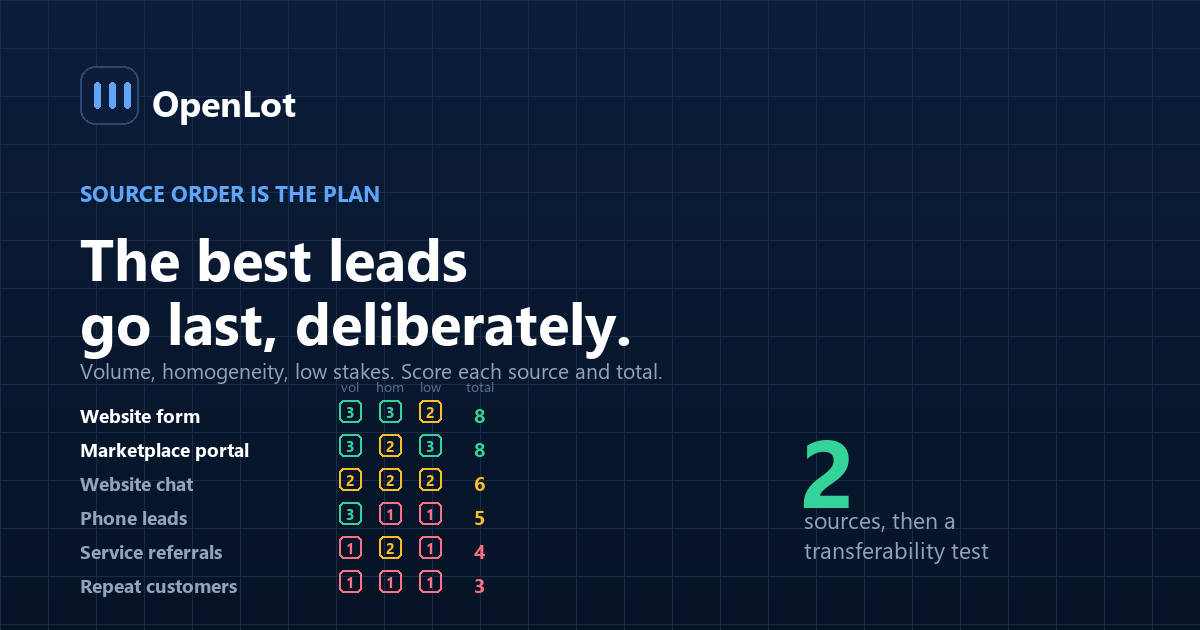
Source Volume Homogeneity Low stakes Total Website form, new vehicle 3 3 2 8 Marketplace portal 3 2 3 8 Website chat 2 2 2 6 Phone leads 3 1 1 5 Service-to-sales referrals 1 2 1 4 Repeat and referral customers 1 1 1 3 The bottom row is the one stores are tempted by, because those leads matter most. That is exactly why it goes last: the first source is where you discover what the escalation list missed, and discovering it on your best customers is expensive.
The onboarding order
Source 1 — highest total. Usually a website form or a marketplace portal. Run it for two weeks with every thread reviewed.
Source 2 — the other one of those two. This is a transferability test, not an expansion. If the result does not hold on a second similar source, the first result was about that source rather than about the system.
Source 3 — chat. Different in kind: the conversation is already in progress and the handoff mid-thread is a new failure mode.
Source 4 — phone. Only after the voice question has been settled on its own terms — the readiness assessment in voice AI.
Source 5 — service-to-sales and referrals. Last, because the stakes are highest and the volume is lowest, which is the worst combination for learning.
What has to be true before adding the next source?
Four gates. Skipping them is how a rollout becomes five separate deployments.
1. Escalation accuracy is acceptable on the current source. Measured from transcripts, not assumed.
2. The escalation list has been revised at least once. If it has not, nobody has read the transcripts properly. Customers always phrase things in ways the original list missed — the artifact discussed in escalation rules.
3. The handoff is being picked up. If escalations are queuing on one source, adding a second multiplies the queue.
4. The baseline comparison is in hand. First-touch time, contact rate and appointment rate on that source, before and after.
Where do rollouts go wrong?
1. All sources at once. The dominant error, and it costs the ability to attribute anything.
2. Starting with the source somebody is complaining about. Usually the hardest and most emotionally loaded, and the worst place to discover an escalation gap.
3. Starting with repeat customers. Highest stakes, lowest volume, slowest learning.
4. Adding source two before revising the escalation list. The list is written from real transcripts, and source one is where they come from.
5. No per-source measurement. Blending the sources after the fact loses the only thing the staged rollout bought.
6. Treating phone as just another source. It is a different channel with different mechanics and different obligations, and the BDC version of it is its own job.
What should you measure, per source?
| Metric | Why per source |
|---|---|
| First-touch time by day-part | Sources arrive at different hours |
| Contact rate | Data quality varies enormously by source |
| Escalation rate | Marketplace leads escalate more — more price questions |
| Escalation accuracy | Where the rule list gets written |
| Appointment rate | Should be roughly stable across sources |
| Show rate | Where source quality actually shows up |
Keep these split for at least a quarter after the full rollout. Blending them immediately discards the main benefit of having staged it, and the per-source differences are usually large enough to change how each source is worked — including whether it is worth buying.
Frequently asked questions
Which lead source should an AI BDC start with?
The one scoring highest on volume, homogeneity and low stakes — usually a website form or a marketplace portal. High volume gives enough instances to learn from quickly, homogeneity makes behaviour consistent, and low stakes means discovering escalation gaps costs little.
Why not start with the most important leads?
Because the first source is where you find out what the escalation rules missed, and customers always phrase things in ways the original list did not anticipate. Discovering that on referrals and repeat customers is the most expensive possible way to learn it.
Why deploy source by source rather than all at once?
Because each source behaves differently — different data quality, different arrival hours, different question mix — and enabling them together produces one blended result nobody can attribute or act on. The staged order is what makes the result interpretable.
What has to be true before adding the second source?
Escalation accuracy measured from transcripts on the current source, an escalation list that has been revised at least once, evidence that escalations are being picked up rather than queuing, and a baseline comparison in hand for that source.
What does the second source actually test?
Transferability. If the result from source one does not hold on a second similar source, the gain belonged to that source rather than to the system, and expanding further would compound a misunderstanding.
Where does phone fit in the order?
Late, and only after the voice question has been assessed on its own terms. It is a different channel with different mechanics, different failure modes and different obligations, which makes treating it as simply the next source a mistake.
How long should each source run before adding another?
Around two weeks with every thread reviewed for the first source, and somewhat less for later ones as the escalation list matures. The gating factor is whether anyone has actually read the transcripts, not the calendar.
How long should sources stay measured separately?
At least a quarter after the full rollout. The per-source differences in contact rate, escalation rate and show rate are usually large enough to change how each source is worked and whether it is worth continuing to buy.
Conclusion
- Source order is the implementation decision. All at once costs you attribution.
- Score on volume, homogeneity and low stakes. The best leads go last, deliberately.
- Source two is a transferability test, not an expansion.
- Four gates before adding the next, and the escalation-list revision is the one skipped.
- Keep the measurement split for a quarter. Blending discards what staging bought.
Last updated: